|
|
|
|
 |
Abraham Cooper
|
|
British Painter, 1787-1868
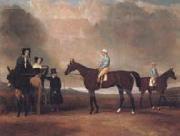
English animal and battle painter, the son of a tobacconist, was born in London. At the age of thirteen he became an employee at Astley's Amphitheatre, and was afterwards groomed in the service of Sir Henry Meux. When he was twenty-two, wishing to possess a portrait of a favorite horse under his care, he bought a manual of painting, learned something of the use of oil-colours, and painted the picture on a canvas hung against the stable wall. His master bought it and encouraged him to continue in his efforts. He accordingly began to copy prints of horses, and was introduced to Benjamin Marshall, the animal painter, who took him into his studio, and seems to have introduced him to the Sporting Magazine, an illustrated periodical to which he was himself a contributor. In 1814 he exhibited his Tam O'Shanter, and in 1816 he won a prize for his Battle of Ligny. In 1817 he exhibited his Battle of Marston Moor and was made associate of the Academy, and in 1820 he was elected Academician. Cooper, although ill-educated, was a clever and conscientious artist; his coloring was somewhat flat and dead, but he was a master of equine portraiture and anatomy, and had some antiquarian knowledge. |
|
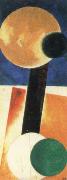 |
abstract composition
|
|
Russian painter, sculptor, designer and photographer. He was a central exponent of Russian Constructivism, owing much to the pre-Revolutionary work of Malevich and Tatlin, and he was closely involved in the cultural debates and experiments that followed the Revolution of 1917. In 1921 he denounced, on ideological grounds, easel painting and fine art, and he became an exponent of Productivism (see CONSTRUCTIVISM,
|
|
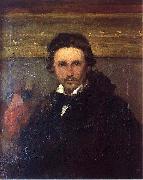 |
Adam Chmielowski
|
|
1845-1916) was a Polish religious brother and founder of the Albertines. He is a saint of the Catholic Church. Albert is also known as Brat Albert (Brother Albert); in recognition of his holiness he has also been called the "Brother of Our Lord", "Brother of Our God", and "Our God's Brother".
Adam Chmielowski was born to a wealthy aristocratic family, and initially studied agriculture with the intention of managing the family estate. Involved in politics since his youth, he lost a leg at the age of 17 while fighting in an insurrection. He became a well-known and well-liked artist in Krakew, his political convictions inspiring his interest in the human condition. A gentle and compassionate spirit, Chmielowski felt compelled to help those in need and after years of reflection, decided to follow his calling into the service of God.
In 1880, Chmielowski joined the Jesuits, took up the name Albert and abandoned painting. He began a life of service to the poor. In 1887, he founded the Brothers of the Third Order of Saint Francis, Servants of the Poor, known in honor of their founder as the Albertines or the Gray Brothers, after their rough gray habits. In 1891, he founded the women's congregation, the Gray Sisters. The Albertines organized food and shelter for the poor and homeless. |
|
|
|
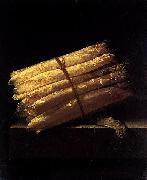 |
Adriaen Coorte
|
|
(ca. 1665 - after 1707) was a Dutch Golden Age painter of still lifes, who signed works between 1683 and 1707. He painted small and unpretentious still lifes in a style more typical of the first half of the century, and was "one of the last practitioners of this intimate category".
Very little is known of his life, but he is assumed to have been born and died in Middelburg. He became a pupil of Melchior d'Hondecoeter around 1680 in Amsterdam. From 1683 he seems to have returned to Middelburg, where he set up a workshop and signed his small, carefully balanced minimalist still lifes. He often painted on paper that was glued to a wooden panel. About 80 signed works by him have been catalogued, and nearly all of them follow the same pattern; small arrangements of fruits, vegetables, or shells on a stone slab, lit from above, with the dark background typical of still lifes earlier in the century. Instead of the Chinese or silver vessels favoured by his contemporaries, his tableware is very basic pottery. "Objects and light are studied intensely, and are painted with a wondrous tenderness".[1] Neither his birth nor death date is certain, and archival evidence only exists in Middelburg for his membership in the Guild of St. Luke there from 1695 onwards, when he was fined for selling a painting without being a member of the guild. His works appear frequently in contemporary Middelburg taxation inventories |
|
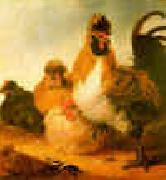 |
Aelbert Cuyp
|
|
1620-1691
Dutch
Aelbert Cuyp Locations
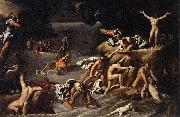
Painter and draughtsman, son of Jacob Cuyp. One of the most important landscape painters of 17th-century Netherlands, he combined a wide range of sources and influences, most notably in the application of lighting effects derived from Italianate painting to typical Dutch subjects. Such traditional themes as townscapes, winter scenes, cattle pieces and equestrian portraits were stylistically transformed and given new grandeur. Aelbert was virtually unknown outside his native town, and his influence in the 17th century was negligible. He became popular in the late 18th century, especially in England. |
|
 |
Agostino Carracci
|
|
(16 August 1557 ?C 22 March 1602) was an Italian painter and printmaker. He was the brother of the more famous Annibale and cousin of Lodovico Carracci.
He posited the ideal in nature, and was the founder of the competing school to the more gritty (for lack of a better term) view of nature as expressed by Caravaggio. He was one of the founders of the Accademia degli Incamminati along with his brother, Annibale Carracci, and cousin, Ludovico Carracci. The academy helped propel painters of the School of Bologna to prominence.
Agostino Carracci was born in Bologna, and trained at the workshop of the architect Domenico Tibaldi. Starting from 1574 he worked as a reproductive engraver, copying works of 16th century masters such as Federico Barocci, Tintoretto, Antonio Campi, Veronese and Correggio. He also produced some original prints, including two etchings.
He travelled to Venice (1582, 1587?C1589) and Parma (1586?C1587). Together with Annibale and Ludovico he worked in Bologna on the fresco cycles in Palazzo Fava (Histories of Jason and Medea, 1584) and Palazzo Magnani (Histories of Romulus, 1590?C1592). In 1592 he also painted the Communion of St. Jerome, now in the Pinacoteca di Bologna and considered his masterwork. From 1586 is his altarpiece of the Madonna with Child and Saints, in the National Gallery of Parma.
In 1598 Carracci joined his brother Annibale in Rome, to collaborate on the decoration of the Gallery in Palazzo Farnese. From 1598?C1600 is a triple Portrait, now in Naples, an example of genre painting.
In 1600 he was called to Parma by Duke Ranuccio I Farnese to began the decoration of the Palazzo del Giardino, but he died before it was finished.
Agostino's son Antonio Carracci was also a painter, and attempted to compete with his father's Academy.
|
|
 |
Albert Chmielowski
|
|
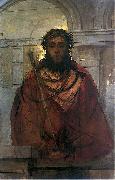
(born Adam Hilary Bernard Chmielowski; 1845 - 1916) was a Polish religious brother and founder of the Albertines. He is a saint of the Catholic Church. Albert is also known as Brat Albert (Brother Albert); in recognition of his holiness, he has also been called the "Brother of Our Lord", "Brother of Our God", and "Our God's Brother".
Adam Chmielowski was born to a wealthy aristocratic family, and initially studied agriculture with the intention of managing the family estate. Involved in politics since his youth, he lost a leg at the age of 17 while fighting in an insurrection. He became a well-known and well-liked artist in Krakew, his political convictions inspiring his interest in the human condition. A gentle and compassionate spirit, Chmielowski felt compelled to help those in need and after years of reflection, decided to follow his calling into the service of God.
In 1880, Chmielowski joined the Jesuits, took up the name Albert and abandoned painting. He began a life of service to the poor. In 1887, he founded the Brothers of the Third Order of Saint Francis, Servants of the Poor, known in honor of their founder as the Albertines or the Gray Brothers, after their rough gray habits. In 1891, he founded the women's congregation, the Gray Sisters. The Albertines organized food and shelter for the poor and homeless.
Albert believed that the great calamity of our time is that so many refuse to see and relieve the suffering of others. The so-called "haves" live away from the "have-nots", ignoring them and leaving their care to society.
|
|
|
|
 |
Alexander Coosemans
|
|
(1627, Antwerp - 1689, Antwerp), was a Flemish Baroque painter.
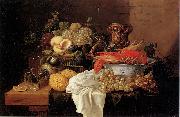
According to the RKD he was registered as a pupil of Jan Davidsz de Heem in 1641 and in 1645 he became a master in the Guild of St. Luke.He travelled to Rome in 1649 but was back in Antwerp in 1651. He painted flowers, fruit, and inanimate subjects, and flourished in the Netherlands about 1630. Fruit subjects by him are in the Augsburg Gallery and the Belvedere at Vienna. In the Madrid Gallery there is a fruit-piece attributed to a J. D. Cooseman, who is said to have flourished in the Netherlands in the 17th century: and in the Bordeaux Museum, a fruit-piece ascribed to a N. Coosman. He was followed by Hendrik Schoock. |
|
|
|
 |
Alexandre Cabanel
|
|
1823-1889
French Alexandre Cabanel Locations
French painter and teacher. His skill in drawing was apparently evident by the age of 11. His father could not afford his training, but in 1839 his departement gave him a grant to go to Paris. This enabled him to register at the Ecole des Beaux-Arts the following October as a pupil of Francois-Edouard Picot. At his first Salon in 1843 he presented Agony in the Garden (Valenciennes, Mus. B.-A.) and won second place in the Prix de Rome competition (after Lon Benouville, also a pupil of Picot) in 1845 with Christ at the Praetorium (Paris, Ecole N. Sup. B.-A.). Both Cabanel and Benouville were able to go to Rome, as there was a vacancy from the previous year. Cabanel Death of Moses (untraced), an academic composition, painted to comply with the regulations of the Ecole de Rome, was exhibited at the Salon of 1852. The pictures he painted for Alfred Bruyas, his chief patron at this time (and, like Cabanel, a native of Montpellier), showed more clearly the direction his art had taken during his stay in Italy. Albayde, Angel of the Evening, Chiarruccia and Velleda (all in Montpellier, Mus. Fabre) were the first of many mysterious or tragic heroines painted by Cabanel and show his taste for the elegiac types and suave finish of the Florentine Mannerists. |
|
 |
Alexandre Cabanel
|
|
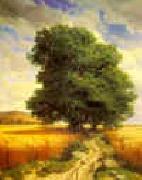
French Academic Painter, 1823-1889
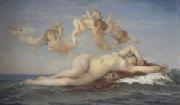
French painter and teacher. His skill in drawing was apparently evident by the age of 11. His father could not afford his training, but in 1839 his departement gave him a grant to go to Paris. This enabled him to register at the Ecole des Beaux-Arts the following October as a pupil of Franeois-Edouard Picot. At his first Salon in 1843 he presented Agony in the Garden (Valenciennes, Mus. B.-A.) and won second place in the Prix de Rome competition (after Leon B?nouville, also a pupil of Picot) in 1845 with Christ at the Praetorium (Paris, Ecole N. Sup. B.-A.). Both Cabanel and Benouville were able to go to Rome, as there was a vacancy from the previous year. Cabanel's Death of Moses (untraced), an academic composition, painted to comply with the regulations of the Ecole de Rome, was exhibited at the Salon of 1852. |
|
 |
Alexandre Calame
|
|
1810-1864
French Alexandre Calame Locations
Swiss painter, draughtsman and printmaker. He studied under Francois Diday in Geneva and then travelled to Paris (1837), to the Netherlands and Desseldorf (1838), to Italy (1844) and to London (1850). Despite his frail health he spent each summer painting in the mountains of the Bernese Oberland and central Switzerland, where he produced the drawings and studies from nature that were later used in his studio compositions. A fervent Calvinist, he saw his subjects. |
|
|
|
|
|
Alexandre-Francois Caminade
|
|
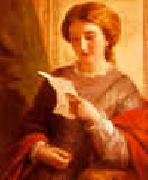
Alexandre-Francois Caminade (December 14, 1783 - May 1862) was a French painter.
Caminade was born and died in Paris. He was a portraitist and a religious painter. He was Jacques Louis David's pupil. See also, Larousse article at Cyclopedia of Painters and Paintings, eds. John Desnison Champlin and Charles Callahan Perkins |
|
 |
Alfred Chalon
|
|
English 1780-1860
Swiss-British painter and illustrator. Much of what we know about the look of romantic ballet is owed to his lithographs and illustrations. He was Taglioni portraitist and his 1845 lithograph of the Pas de quatre, with Carlotta Grisi, Marie Taglioni, Lucile Grahn, and Fanny Cerrito, is one of the most famous images in all dance. |
|
|
|
|
|
|
|
|
|
 |
ALLORI Cristofano
|
|
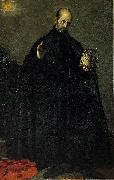
Italian Baroque Era Painter, 1577-1621
Allori was born at Florence and received his first lessons in painting from his father, Alessandro Allori, but becoming dissatisfied with the hard anatomical drawing and cold coloring of the latter, he entered the studio of Gregorio Pagani (1558-1605) who was one of the leaders of the late Florentine school, which sought to unite the rich coloring of the Venetians with the Florentine attention to drawing. Allori also appears to have worked under Cigoli.
His pictures are distinguished by their close adherence to nature and the delicacy and technical perfection of their execution. His technical skill is shown by the fact that several copies he made of Correggio's works were thought to be duplicates by Correggio himself. His extreme fastidiousness limited the number of his works. Several specimens are to be seen at Florence and elsewhere.
The finest of his works is his Judith with the Head of Holofernes. It exists in two copies in the Pitti Palace in Florence and in the Queen's Gallery in London. The model for the Judith was his mistress, the beautiful Mazzafirra, who is also represented in his Magdalene; and the head of Holofernes is generally supposed to represent himself. |
|
 |
Alonso Cano
|
|
(19 March 1601 - 3 September 1667) was a Spanish painter, architect and sculptor born in Granada. He learned architecture from his father, Miguel Cano; painting in the academy of Juan del Castillo, and from Francisco Pacheco the teacher of Velezquez; and sculpture from Juan Martenez Montañ's. As a sculptor, his most famous works are the Madonna and Child in the church of Lebrija (also called Nebrija), and the colossal figures of San Pedro and San Pablo.
He was made first royal architect, painter to Philip IV, and instructor to the prince, Balthasar Charles, Prince of Asturias.The King gave him the church preferment of a canon of the Granada Cathedral (1652), in order to take up a position as chief architect of the cathedral, where his main achievement in architecture was the façade, designed at the end of his life and erected to his design after his death.
Ideal portrait of a Spanish King.He was notorious for his ungovernable temper; and it is said that once he risked his life by committing the then capital offence of dashing to pieces the statue of a saint, when in a rage with the purchaser who begrudged the price he demanded. According to another story, he found his house robbed after coming home one evening, his wife murdered, and his Italian servant fled. Notwithstanding the presumption against the fugitive, the magistrates condemned Cano, because he was of a jealous temper. Upon this he fled to Valencia, but afterwards returned to Madrid, where he was put to the torture, which he endured without incriminating himself, and the king received him into favour.
After the death of his wife he took Holy Orders as a protection from farther prosecution, but still continued his professional pursuits. He died in 1676. In his last moments, when the priest held to him a crucifix, he told him to take it away; according to the Catholic Encyclopedia, this was because the priest gave the Sacrament to conversos.
|
|
 |
Alonso Sanchez Coello
|
|
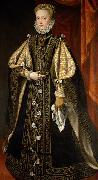
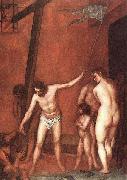
Alonso Sachez Coello (1531/32 -August 8, 1588) was a portrait painter of the Spanish Renaissance and one of the pioneers of the great tradition of Spanish portrait painting.
Alonso Sachez Coello was born in Benifairode les Valls, near Valencia, and spent his childhood there, until the death of his father when he was around ten years old. He was educated in Portugal at his grandfather's home. Coello's years in Portugal and his family name of Portuguese origin led to a long-standing belief that he was in fact Portuguese. His grandfather (after whom he was named) was in the service of King John III of Portugal who sent the young painter to study with Anthonis Mor (also known as Antonio Moro) in Flanders around 1550. He was under the service of Antoine de Granville, bishop of Arras, learning from Mor. While studying in Flanders, Coello also spent time copying some of Titian's works. |
|
 |
Alonzo Cano
|
|
Alonzo Cano or Alonso Cano (19 March 1601 - 3 September 1667) was a Spanish painter, architect and sculptor born in Granada. He learned architecture from his father, Miguel Cano;painting in the academy of Juan del Castillo, and from Francisco Pacheco the teacher of Velezquez; and sculpture from Juan Martenez Montañes. As a sculptor, his most famous works are the Madonna and Child in the church of Lebrija (also called Nebrija), and the colossal figures of San Pedro and San Pablo.
He was made first royal architect, painter to Philip IV, and instructor to the prince, Balthasar Charles, Prince of Asturias. The King gave him the church preferment of a canonof the Granada Cathedral (1652), in order to take up a position as chief architect of the cathedral, where his main achievement in architecture was the façade, designed at the end of his life and erected to his design after his death.[citation needed]
Ideal portrait of a Spanish King.He was notorious for his ungovernable temper; and it is said that once he risked his life by committing the then capital offence of dashing to pieces the statue of a saint, when in a rage with the purchaser who begrudged the price he demanded.[1] According to another story, he found his house robbed after coming home one evening, his wife murdered, and his Italian servant fled. Notwithstanding the presumption against the fugitive, the magistrates condemned Cano, because he was of a jealous temper. Upon this he fled to Valencia, but afterwards returned to Madrid, where he was put to the torture, which he endured without incriminating himself, and the king received him into favour.
After the death of his wife he took Holy Orders as a protection from farther prosecution, but still continued his professional pursuits. He died in 1676. In his last moments, when the priest held to him a crucifix, he told him to take it away; according to the Catholic Encyclopedia, this was because the priest gave the Sacrament to conversos. |
|
 |
Alonzo Chappel
|
|
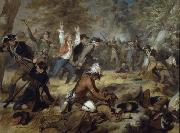
Alonzo Chappel (1828 - 1887) was an American painter, best known for paintings depicting personalities and events from the American Revolution and early 19th-century American history.
Chappel was born in New York City and died in Middle Island, New York. |
|
 |
Alson Clark
|
|
1876-1949
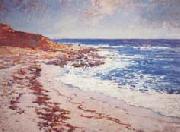
was an American Impressionist painter best remembered for his impressionist landscapes. Born in Chicago, Illinois, his art education included training at the Art Institute of Chicago (where he enrolled at Saturday classes at the age of 11), the Art Students League of New York, and in the atelier of William Merritt Chase. He spent much of his early career working in Paris, France. He served in the US Army as an aerial photographer during World War I. In 1920 he and his wife relocated to Pasadena, California. He taught fine art at Occidental College, and was director of the Stickney Memorial School of Art in Pasadena. His memberships in arts organizations included the Pasadena Society of Artists and the California Art Club. In addition to landscape paintings, Alson Clark painted murals for the Cathay Circle Theatre in Los Angeles, and the fire curtain of the Pasadena Playhouse, depicting a Spanish galleon in full sail. A group of murals completed in 1929 can still be seen at the former 1st Trust & Savings Bank at 587 East Colorado Boulevard in Pasadena, California. |
|
|
|
 |
Amaldus Clarin Nielsen
|
|
(23 May 1838 - 10 December 1932) was a Norwegian painter.
He was born in Halse as a son of shipmaster and merchant Niels Clemetsen Nielsen (1795 - 1845) and his wife Andrea Marie Møller (1802 - 1866). He grew up in Mandal in Vest-Agder county, Norway. He lived most of his childhood and adolescence without a father. He received some tuition from a traveling drawing teacher and traveled to Copenhagen to study in 1854
|
|
 |
AMBERGER, Christoph
|
|
German Painter, ca.1500-1562
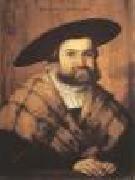
German painter and draughtsman. His family came from the Upper Palatinate. He served his apprenticeship in Augsburg, probably with Leonhard Beck, whose daughter Barbara he married. He became a master on 15 May 1530 but rarely signed his work. He was in northern Italy and Venice c. 1525-7. His full-length pendant portraits of a husband and wife (both 1525; Vienna, Ksthist. Mus.) show Venetian influence, and the portrait of Anton Welser (1527; priv. col., see 1980 exh. cat., p. 98) is in the Italian style. According to Sandrart, during the Imperial Diet of 1530 in Augsburg Amberger painted a portrait of Emperor Charles V to the Emperor's satisfaction, but the surviving work (Berlin, Gem?ldegal.) dates from 1532, based on the age given. In the decades that followed, Amberger was the favourite portrait painter of ambitious merchant families, such as the Fugger, who belonged to guilds but were connected with the nobility by family or marriage ties. |
|
 |
Andien de Clermont
|
|
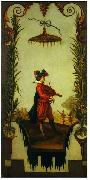
Andien de Clermont (d.1783) was a French artist who worked in England in the 18th century (ca.1716-1756). He was particularly known for his decorative flower paintings in the Rococo style, and for "singeries, chinoiseries, and turqueries." He decorated interiors at Kirtlington Park, Langley Hall, Wentworth Castle, Wilton House, and "the second earl of Strafford's (now destroyed) dining room at No. 5 St. James's Square, London."
|
|
 |
Andrea del Castagno
|
|
Italian
c1421-1457
Andrea del Castagno Location
Italian
c1421-1457
Andrea del Castagno Location
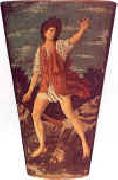
Italian painter. He was the most influential 15th-century Florentine master, after Masaccio, of the realistic rendering of the figure and the representation of the human body as a three-dimensional solid by means of contours. By translating into the terms of painting the statues of the Florentine sculptors Nanni di Banco and Donatello, Castagno set Florentine painting on a course dominated by line (the Florentine tradition of disegno), the effect of relief and the sculptural depiction of the figure that became its distinctive trait throughout the Italian Renaissance, a trend that culminated in the art of Michelangelo. |
|
|
|
|
|
|
|
 |
Anne Vallayer-Coster
|
|
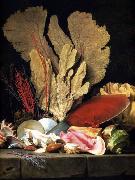
French Rococo Era Painter, 1744-1818,was an eighteenth-century French painter. Known as a prodigy artist at a young age, she achieved fame and recognition very early in her career, being admitted to the Royal Academy in 1770, at the age of twenty-six.
Despite the negative reputation that still-life painting had at this time, Vallayer-Coster??s highly developed skills, especially in the depiction of flowers, soon generated a great deal of attention from collectors and other artists. Her precocious talent and the rave reviews?? earned her the attention of the court, where Marie Antoinette took a particular interest in Vallayer-Coster's paintings.
Regardless of her closeness to the ancient regime and France's hated monarch she survived the bloodshed of the French Revolution. However, the fall of the French monarchy, which were her primary patrons, caused her banishment into the shadows.
Anne Vallayer-Coster was a woman in a man??s world. It is unknown what she thought of contemporaries who admitted her to the confraternity, and made her an honorary ??man??. Her life was determinedly private, dignified and hard-working. Occasionally she attempted other genres, but for the usual reasons her success at figure painting was limited
|
|
 |
Annibale Carracci
|
|
1560-1609
Italian
Annibale Carracci Locations
Painter, draughtsman and printmaker, brother of (2) Agostino Carracci. Since his lifetime, he has been considered one of the greatest Italian painters of his age. His masterpiece, the ceiling (1597-1601) of the Galleria Farnese, Rome, merges a vibrant naturalism with the formal language of classicism in a grand and monumental style. Annibale was also instrumental in evolving the ideal, classical landscape and is generally credited with the invention of CARICATURE. |
|
|
|
 |
ANTHONISZ Cornelis
|
|
b. ca. 1499, Amsterdam, d. ca. 1555, Amsterdam
Dutch printmaker, painter and cartographer, maternal grandson of JACOB CORNELISZ. VAN OOSTSANEN. He was the dominant figure in the creation of north Netherlandish woodcuts from the mid-1530s until his death. His monogram, which combines the initials 'C' and 'T' with the staff and bell of St Anthony, was probably inspired by his father's first name. The greater part of his career was apparently spent in his native Amsterdam, where he probably trained with his grandfather. |
|
|
|
 |
Antoine Caron
|
|
1520-1598
French
Antoine Caron Location
Antoine Caron (1521 in Beauvais - 1599 in Paris) was a French master glassmaker, illustrator, Mannerist painter and a master (teacher) at the School of Fontainebleau.
He is one of the few French painters of his time who had a pronounced artistic personality. His work reflects the refined, although highly unstable, atmosphere at the court of the House of Valois during the French Wars of Religion of 1560 to 1598. |
|
 |
Antoine Chintreuil
|
|
Antoine Chintreuil
Antoine Chintreuil (May 15, 1814 - August 8, 1873) was a French landscape painter.
He was born in Pont-de-Vaux, Ain and grew up in Bresse. In 1838 he moved to Paris, where he began studying under Paul Delaroche in 1842. The following year he met Corot, who influenced him profoundly by encouraging him to paint landscape en plein air.
Art historian Athena S. E. Leoussi suggests that Chintreuil's work can be divided into three periods: From c. 1846-1850 he painted Paris and its surroundings, particularly Montmartre; from 1850-1857 he lived in Igny and frequently painted in Barbizon, and from 1857 on he lived and worked in La Tournelle-Septeuil in the Seine valley. During this final period his work reached its fullest development, and he achieved critical recognition.
In the breadth and simplicity of his execution, and in his attention to capturing light and atmosphere, Chintreuil can be placed alongside Eugene Boudin, Johan Barthold Jongkind, and the painters of the Barbizon school, as an important forerunner of Impressionism.
He died in Septeuil, Seine-et-Oise in 1873. |
|
 |
Antoine Coypel
|
|
1661-1722
French
Antoine Coypel Location
Antoine studied at the Coll?ge d Harcourt and then trained in his father studio and at the Academie Royale. In 1672 No Coypel was made Director of the Academie de France in Rome, and Antoine, who accompanied his father to Italy, benefited from the education given to the students there. He also joined in their long sessions spent copying Raphael frescoes in the Vatican Loggie and the works of the Carracci and Domenichino in the Palazzo Farnese. He met Giovanni Lorenzo Bernini and Carlo Maratti and was awarded a drawing prize by the Accademia di S Luca. During his return journey Antoine stopped in northern Italy to study the works of Correggio |
|
 |
Antoine-Francois Callet
|
|
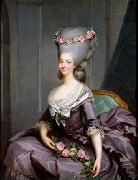
(1741-1823, Paris), generally known as Antoine Callet, was a French painter of portraits and allegorical works, who acted as official portraitist to Louis XVI.
He won the grand prix de Rome in 1764 with Cleobis et Biton conduisent le char de leur mere au temple de Junon (Kleobis and Biton dragging their mother's cart to the temple of Juno). He was accepted by the Academie des beaux arts in 1779, with his entry piece being a portrait of the comte d'Artois, and received with his allegory Le printemps (Spring) in 1781. He exhibited at the Salon from 1783 onwards. He painted the centre of the ceiling of the grande galerie of the palais du Luxembourg, with a composition entitled L'Aurore (Aurora). Under the French Consulate and the First French Empire he painted several more allegories, including an Allegorie du dix-huit brumaire ou la France sauvee (Allegory of 18 Brumaire, or France saved - 1801, château de Versailles) and an Allegorie de la bataille d'Austerlitz (Allegory of the Battle of Austerlitz - 1806, château de Versailles).
|
|
 |
Anton Chladek
|
|
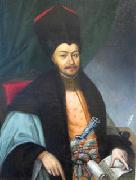
painted Portrait of Ienachita Vacarescu in 1794 - 1882 |
|
 |
Antonin Chittussi
|
|
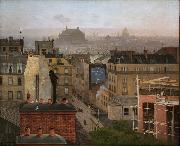
(1 December 1847 - 1 May 1891) was a Czech Impressionist landscape painter.
He was born in Ronov nad Doubravou to a Czech mother and a father of Italian descent. He was fascinated by the landscape of South Bohemia and of the Bohemian and Moravian Highlands. In particular, his smaller pictures replete with quick, easy brushstrokes are among the most admired of Czech landscape painting. He died in Prague.
|
|
 |
Antonio Carnicero
|
|
1748-1814
Italian Antonio Carnicero Location
Antonio Carnicero (1748- 1814) was a Spanish painter of the Neoclassic style.
Born in Salamanca and died in Madrid. He was trained with his father, Alejandro Carnicero, a sculptor. He then traveled to Rome and returned to be named chamber painter for King Charles III. He also worked as an engraveor. He illustrated and edition of Don Quixote. |
|
 |
antonio canaletto
|
|
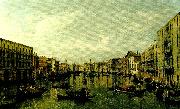
Giovanni Antonio Canal (28 October 1697 - 19 April 1768) better known as Canaletto, was a Venetian painter famous for his landscapes, or vedute, of Venice. He was also an important printmaker in etching. |
|
 |
Antonio Canova
|
|
Italian Neoclassical Sculptor, 1757-1822
Italian sculptor, painter, draughtsman and architect. He was the most innovative and widely acclaimed sculptor of NEO-CLASSICISM. His development during the 1780s of a new style of revolutionary severity and idealistic purity led many of his contemporaries to prefer his ideal sculptures to such previously universally admired Antique statues as the Medici Venus and the Farnese Hercules, thus greatly increasing the prestige of 'modern' sculpture. He was also much in demand as a portrait sculptor. |
|
|