|
|
 |
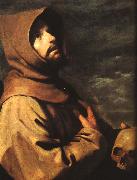
ALTICHIERO da Zevio
|
|
Italian Gothic Era Painter, ca.1330-1390
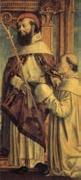
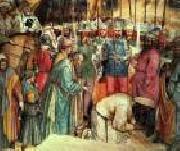
Altichiero da Verona (also called Aldighieri da Zevio; c. 1330 ?C c. 1390) was an Italian painter of the Gothic style. A follower of Giotto, Altichiero is credited with founding the Veronese school. He worked in Verona and Padua ?? works by him survive in the church of Sant'Anastasia in Verona and in the basilica of Sant'Antonio and the Oratorio di San Giorgio in Padua (where the credit for the work has been generally shared with Jacopo d'Avanzi, about whom little is known).
Altichiero was probably born somewhere near Zevio. He became an important member of the della Scala's household, and around 1364 painted a series of frescoes based upon Flavius Josephus's The Wars of the Jews at the della Scala palace of Sala del Podest??.
There are frescoes by him in the Basilica of Saint Anthony of Padua. In conjunction with D'Avanzo Veronese, he frescoed the chapel of St. James for which he was paid 792 ducats. The first seven frescoes on the life of St. James the Elder were by Altichiero. |
|
 |
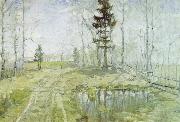
Anders Zorn
|
|
Swedish 1860-1920
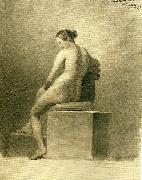
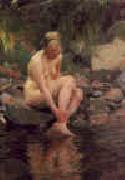
Swedish painter, etcher and sculptor. He was brought up by his grandparents at Mora. As he displayed a precocious talent for drawing he was admitted to the preparatory class of the Kungliga Akademi for de Fria Konsterna, Stockholm, at the age of 15. Dissatisfied with the outdated teaching and discipline of the Academy and encouraged by his early success as a painter of watercolour portraits and genre scenes (e.g. Old Woman from Mora, 1879; Mora, Zornmus.) Zorn left the Academy in 1881 to try to establish an international career. He later resided mainly in London but also travelled extensively in Italy, France, Spain, Algeria and the Balkans and visited Constantinople. However, he continued to spend most of his summers in Sweden. |
|
|
|
 |
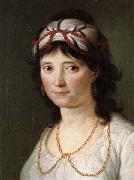
Domenico Zampieri
|
|
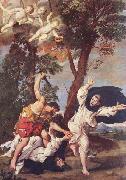
(October 21, 1581 C April 16, 1641) was an Italian Baroque painter of the Bolognese School, or Carracci School, of painters.
Domenichino was born at Bologna, son of a shoemaker, and there initially studied under Denis Calvaert. After quarreling with Calvaert, he left to work in the Accademia degli Incamminati of the Carracci where, because of his small stature, he was nicknamed Domenichino, meaning "little Domenico" in Italian. He left Bologna for Rome in 1602 and became one of the most talented apprentices to emerge from Annibale Carracci's supervision. As a young artist in Rome he lived with his slightly older Bolognese colleagues Albani and Guido Reni, and worked alongside Lanfranco, who later would become a chief rival.
In addition to assisting Annibale with completion of his frescoes in the Galleria Farnese, including A Virgin with a Unicorn (c. 1604-5), he painted three of his own frescoes in the Loggia del Giardino of the Palazzo Farnese c. 1603-04. With the support of Monsignor Giovanni Battista Agucchi, the maggiordomo to Cardinal Aldobrandini and later Gregory XV, and Giovanni??s brother Cardinal Girolamo Agucchi, Domenichino obtained further commissions in Rome. His most important project of the first decade was decoration of the Cappella dei Santissimi Fondatori in the medieval basilica of the Abbey of Grottaferrata (1608-10), some 20 kilometers outside Rome, where Odoardo Farnese was the titular abbot. Meanwhile he had completed frescoes c. 1604-05 in the church of Sant'Onofrio, feigned stucco decoration of 1606-07 in the Palazzo Mattei, a large scene of The Flagellation of St. Andrew at San Gregorio Magno, painted in competition with a fresco by Reni that faces it, and a ceiling with Scenes from the Life of Diana, 1609, in the Villa Odescalchi at Bassano di Sutri (today Bassano Romano).
Following Annibale Carracci's death in 1609, Annibale's Bolognese pupils, foremost Domenichino, Albani, Reni and Lanfranco, became the leading painters in Rome (Caravaggio had left Rome in 1606 and his followers there did not compete successfully with the Bolognese for fresco or altarpiece commissions). One of Domenichino's masterpieces, his frescoes of Scenes of the Life of Saint Cecilia in the Polet Chapel of San Luigi dei Francesi, was commissioned in 1612 and completed in 1615. Concurrently he painted his first, and most celebrated, altarpiece, The Last Communion of St. Jerome for the church of San Girolamo della Carite (signed and dated, 1614). It subsequently would be judged as being comparable to Raphael great Transfiguration and even as "the best picture in the world."
By late 1616, Domenichino had designed the coffered ceiling with The Assumption of the Virgin in Santa Maria in Trastevere; and he had begun a cycle of ten frescoes depicting the Life of Apollo in a garden pavilion of the Villa Aldobrandini (Belvedere) in Frascati, where he was assisted by Giovanni Battista Viola, a Bolognese artist who, like Domenichino himself, was a pioneer in the development of classicistic landscape painting. From 1617 until 1621, Domenichino was absent from Rome, working in Bologna and at Fano, where during 1618-19 he frescoed the Nolfi chapel of the Fano Cathedral with Scenes from the Life of the Virgin.
With the election of a Bolognese pope (Gregory XV) in 1621, Domenichino returned to Rome. Appointed Papal Architect (he built little but left drawings for various projects, most notably for the façade of Sant'Andrea della Valle and for the plan of Sant'Ignazio, both in Rome), he nonetheless continued to be most active as a painter, obtaining many commissions for altarpieces in Roman churches (San Lorenzo in Miranda, 1626-27, SS. Giovanni Evangelista e Petronio dei Bolognese, 1626-29, Santa Maria della Vittoria, 1629-30, and St. Peter's, 1625-30). He also executed numerous frescoes in Rome during the 1620s: a ceiling in the Palazzo Costaguti (c. 1622); the choir and pendentives in Sant'Andrea della Valle, where he worked in fierce competition with Lanfranco, who painted the dome above Domenichino's pendentives; and the pendentives of San Silvestro al Quirinale (c. 1628) and San Carlo ai Catinari (1628-30). |
|
 |
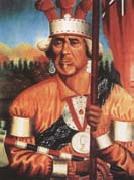
Federico zandomeneghi
|
|
Italian Painter, 1841-1917
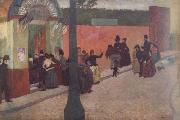
.Italian painter. His father Pietro and grandfather Luigi tried to interest him in the plastic arts, but from a very early age he showed a stronger inclination for painting. Zandomeneghi soon rebelled against their teachings, and by 1856 he was attending the Accademia di Belle Arti in Venice, studying under the painters Michelangelo Grigoletti (1801-70) and Pompeo Molmenti (1819-94). As a Venetian he was born an Austrian subject, and, to escape conscription, he fled his city in 1859 and went to Pavia, where he enrolled at the university. In the following year he followed Garibaldi in the Expedition of the Thousand; afterwards, having been convicted of desertion and therefore unable to return to Venice, he went to Florence, where he remained from 1862 to 1866. This period was essential for his artistic development. In Tuscany he frequented the Florentine painters known as the Macchiaioli, with some of whom he took part in the Third Italian War of Independence (1866). Zandomeneghi formed a strong friendship with Telemaco Signorini and Diego Martelli, with whom he corresponded frequently for the rest of his life. In this period he painted the Palazzo Pretorio of Florence |
|
 |
Felix Ziem
|
|
French Painter, 1821-1911
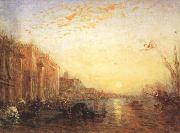
was a French painter in the style of the Barbizon School. Born Felix-Francois Georges Philibert Ziem in Beaune in the Côte d'Or departement of the Burgundy region of France, his mother was a native of Burgundy who married a Croatian immigrant. Originally, Ziem planned to be an architect and studied at the School of Architecture in Dijon, and for a time worked as an architect. Painting developed from a hobby to a career following an 1841 visit to Italy where he fell in love with the city of Venice, a place that would become the source for many of his works. Apart from Venetian scenes, he also painted many still lifes, portraits and landscapes from a variety of places including Constantinople, Martigues, Cagnes-sur-Mer and his native Burgundy. Ziem's works were first exhibited in 1849 at the Paris Salon and remained a regular exhibitor there for many years. Part of the Barbizon school, he also traveled extensively throughout Europe and in 1860 moved to Montmartre, the artistic quarter of the city of Paris. Financially successful, he was known to assist struggling young artists. In 1857, the government of France recognized his contribution to the art world by making him a Chevalier of the Legion of Honor. |
|
 |
Francesco Zuccarelli
|
|
Italian 1702-1788
1788). Italian painter and draughtsman, active in England.
Zuccarelli training began in Florence, where he engraved the frescoes by Andrea del Sarto in SS Annunziata. He then studied in Rome under Paolo Anesi and learnt figure drawing from Giovanni Maria Morandi (1622-1717), although in this he never acquired any great skill. His earliest recorded paintings were Mary Magdalene and St Jerome (both untraced), which he contributed to the exhibition of the feast of St Luke in Florence in 1729. He also painted portraits. Around 1730 he moved to Venice and began painting landscapes exclusively. His interest in this field may have led to his becoming acquainted with the Welsh landscape painter Richard Wilson in 1750-51. Wilson painted a lively portrait of him (1751; London, Tate) in exchange for one of Zuccarellis landscapes. Zuccarelli avoided both the topographical type of Venetian view developed by Canaletto and the stormier landscapes of Marco Ricci, adopting instead a decorative landscape style of idealized Italian countryside. His subject-matter was usually unspecific rather than recognizably historical, biblical or mythological. For example, in the early 1740s he executed six paintings purporting to be scenes from the story of Jacob, but the paintings themselves bear few references to it (e.g. Landscape with Two Seated Women Embracing, 1743; Windsor Castle, Berks, Royal Col.). |
|
 |
Francesco Zugno
|
|
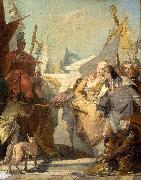
Francesco Zugno (c. 1708-1787) was an Italian painter of the Rococo period. He was born in Brescia. Among his masterworks is a series of wall frescoes of figures in quadratura balconiesepart genre, part courtly conceit. He was strongly influenced by Giovanni Battista Tiepolo and his works. |
|
 |
Francisco de Zurbaran
|
|
1598-1664
Spanish Francisco de Zurbaran Galleries
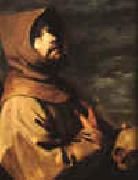
Spanish baroque painter, active mainly at Llerena, Madrid, and Seville. He worked mostly for ecclesiastical patrons. His early paintings, including Crucifixion (1627; Art Inst., Chicago), St. Michael (Metropolitan Mus.), and St. Francis (City Art Museum, St. Louis), often suggest the austere simplicity of wooden sculpture. The figures, placed close to the picture surface, are strongly modeled in dramatic light against dark backgrounds, indicating the influence of Caravaggio. They were clearly painted as altarpieces or devotional objects. In the 1630s the realistic style seen in his famous Apotheosis of St. Thomas Aquinas (1631; Seville) yields to a more mystical expression in works such as the Adoration of the Shepherds (1638; Grenoble); in this decade he was influenced by Ribera figural types and rapid brushwork. While in Seville, Zurbur??n was clearly influenced by Velazquez. After c.1640 the simple power of Zurbaran work lessened as Murillo influence on his painting increased (e.g., Virgin and Child with St. John, Fine Arts Gall., San Diego, Calif.). There are works by Zurbar??n in the Hispanic Society of America, New York City; the National Gallery, Washington, D.C.; and the Philadelphia Museum of Art.. |
|
 |
Franciszek zmurko
|
|
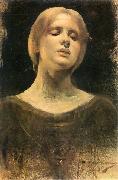
(18 July 1859 in Lviv - 9 October 1910 in Warsaw) was a Polish painter. Zmurko began drawing lessons as a young boy in his hometown with the painter Franciszek Tepa. As an adolescent he moved to Krakow to study at the The Academy of Fine Arts where he had lessons from Jan Matejko. In 1877 Zmurko moved to Vienna, Austria where he was accepted at the Vienna Academy, but left soon thereafter to study under Aleksander Wagner in Munich. Zmurko returned to Krakow in 1880 and then moved to Warsaw in 1882 where he remained until his death in 1910.
|
|
 |
Fritz Zuber-Buhler
|
|
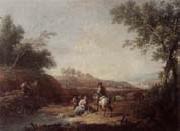
was a Swiss painter integrant of the style Academic Classicism, born in 1822 at Le Locle in Switzerland and died November 23, 1896.
At sixteen years old he moved to Paris, France where found his first teacher Louis Grosclaude. Later he studied at the École des Beaux-Arts and then refined his technical skills with François-Édouard Picot, who followed the same lineage of contemporaneous artists such as Leon Perrault, Bouguereau, Alexandre Cabanel and many others. Afterwards he spent some time in Italy searching for inspiration and raise the quality of his art. Then, returning to Paris, he made his debut at the Salon in 1850 exhibiting alongside oil paintings, drawings, pastels and watercolors.
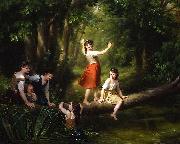
His painting Innocence shows his romantic view of the peasant childhood and their environments, expressing nature, softness and intense details. Also his works were drawn by popular themes at that period like mythology, religion and requested portraits. Zuber-Buhler produced exhibitions in the United States, comprising at the Pennsylvania Academy of the Fine Arts and achieved great admiration as a classic academic painter. |
|
 |
Giuseppe Zais
|
|
Italian Painter , Forno di Canale1709-1784 Treviso
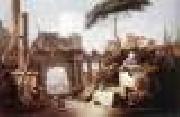
was an Italian painter of landscapes (vedutisti) who painted mostly in Venice. He was born in Forno di Canale. He was influenced in his vedute by Marco Ricci and later Francesco Zuccarelli, who helped train him. He is best known for frescoes in Villa Pisani in Stra. While he had been a member of the Academy of Painters in Venice from 1774, he died in poverty at Treviso. |
|
|
|
 |
Ignacio Zuloaga
|
|
Spanish Painter, 1870-1945
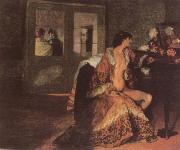
was a Spanish Basque painter, born in Eibar, in the Basque country, near the monastery of Loyola. He was the son of metalworker and damascener Placido Zuloaga and grandson of the organizer and director of the royal armoury in Madrid. In his youth, he drew and worked in his father's workshop. He was educated by the Jesuits in France. His father wanted him to be an architect, and with this objective in mind, he was sent to Rome, where he immediately followed the strong impulse that led him to painting. After only six months' work he completed his first picture, which was exhibited at the Paris Salon of 1890. Continuing his studies in Paris, where he lived for five years, he was strongly influenced by Paul Gauguin and Henri de Toulouse-Lautrec. Only upon returning to his native land did he find his true style, which is based on the national Spanish tradition embodied in the work of Diego Velazquez, Francisco de Zurbaran, El Greco, and Francisco Goya. Bleeding Christ; or Blood Christ (El cristo de la Sangre) (1911)His own country was slow in acknowledging the young artist whose strong, decorative and rugged style stood in opposition to the styles of well-known modern Spanish artists such as Fortuny, Madrazo, |
|
 |
Ignacio Zuloaga y Zabaleta
|
|
July 26, 1870 - October 31, 1945
Spanish Basque painter. He studied in Paris in 1891, coming under the influence of Impressionism and of the group of Catalan painters around Santiago Rusieol. His visit to Andalusia in 1892 provided the key to his later work, leading him to replace the grey tonalities of his Paris paintings with more brightly coloured images of Spanish folkloric subjects and of male or female figures in regional dress, for example Merceditas (1911/13; Washington, DC, N.G.A.). Zuloaga turned to Castilian subjects in works such as Segoviano and Toreros de Pueblo (both 1906; both Madrid, Mus. A. Contemp.) after the defeat suffered by Spain in the Spanish-American War of 1898; like the group of writers known as the Generation of 98, with whom he was associated and who were among his most articulate supporters, he sought to encourage the regeneration of his country culture but with a critical spirit.. |
|
 |
Jacopo Zanguidi Bertoia
|
|
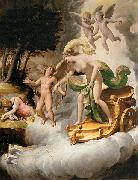
Jacopo Bertoia, also known as Giacomo Zanguidi or Jacopo Zanguidi or Bertoja, (1544 - ca. 1574), was an Italian painter of a late-Renaissance or Mannerist style that emerged in Parma towards the end of the 16th century.
He was strongly influenced by Parmigianino.
Born in Parma, he apparently studied in Bologna with Sabatini. His masterpiece is the Sala del Bacio, in the Palazzo del Giardino in Parma. He also helped decorate the Sala di Orfeo in the same palace. He was part of the team that decorated the walls of the Oratorio del Gonfalone (Entry into Jerusalem) in Rome. He was commissioned by Cardinal Alessandro Farnese in 1572-1573 to paint galleries (Sale del Giudizio, della Penitenza, dei Sogni, as well as the Anticamera degli Angeli) of the Villa Farnese in Caprarola, where he replaced the role of Taddeo Zuccari. |
|
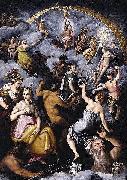 |
Jacopo Zucchi
|
|
(c. 1541- c. 1590) was a Florentine painter of the Mannerist style, active in Florence and Rome.
His training began in the studio of Giorgio Vasari, and he participated in decoration of the Studiolo and the Salone dei Cinquecento in the Palazzo Vecchio. Moving to Rome in the early 1570s, he worked for the Cardinal Ferdinando de' Medici in his Palazzo Firenze (1574). He also helped decorate, along with his brother, the apse and dome of Santo Spirito in Sassia with a fresco of the Pentecost. He painted the grand salon of the former Rucellai (now Ruspoli) palace in Rome with mythologic genealogies. Two canvases, representing the Ascension and Resurrection, are housed in the church of San Lorenzo Martire in San Lorenzo Nuovo (Italy).
|
|
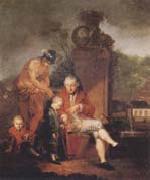 |
Januarius Zick
|
|
German,1730-1797
was a painter and architect. He is considered to be the one of the main masters of the Late-Baroque. Januarius Zick was born in Munich and began to learn his trade from his father, Johannes Zick, a renowned painter himself, to whom he was apprenticed in order to learn how to paint frescoes. In 1744, when Januarius Zick was fourteen years old, his brother, three years his junior, fell to his death from a scaffolding in Weingarten. From 1745 to 1748, Januarius Zick was apprenticed as a bricklayer to Jakob Emele in Schussenried. Having finished his apprenticeship, he worked, together with his father, at the residence of the Prince-Bishop of Wurzburg and then, until the mid-1750s, at the residence of the Prince-Bishop of Speyer in Bruchsal. In 1756, Januarius Zick went to Paris to further his education. There, he came into contact with artists and art connoiseurs from Rome, Basel and Augsburg, who broadened his horizon concerning his art and had a considerable influence on him. After having furnished Castle Engers near Neuwied with frescoes in 1760, he was appointed court painter to the Prince-Elector of Trier, the archbishop of Trier. He married in Ehrenbreitstein and settled there. After 1774, he also designed intarsia paintings for cabinet maker David Roentgen. From the late 1770s on, Januarius Zick was very active in Upper Swabia, furnishing a number of monastery churches and parish churches with frescoes and altarpieces. |
|
|
|
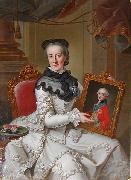 |
Johann Georg Ziesenis
|
|
(b Copenhagen, 1716; d Hannover, 4 March 1776). German painter of Danish birth. He trained with his father, Johann Georg Ziesenis (1681-1748); he became a German citizen in 1743 and subsequently was appointed court painter to Herzog Christian von Pfalz-Zweibrecken in Zweibrecken and, later, Mannheim. In the early 1750s he overcame his technical shortcomings by studying Flemish art, particularly the work of Rubens and van Dyck. He also introduced a new genre, the private court portrait. His portrait of Karl Philipp Theodor, Kurferst von der Pfalz (1757; Munich, Alte Pin.) is original in its intimate view of a nobleman posed at leisure in casual dress, seated in his private study. |
|
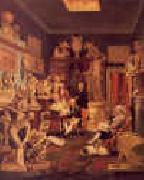 |
Johann Zoffany
|
|
German
(Resident in Britain)
1734-1810
Johann Zoffany Galleries
Painter of portraits, conversation pieces, and theatrical scenes, Zoffany was born in Germany and came to England about 1758 after studying in Italy. He began by painting clock faces and doing hack work, before turning to painting theatrical scenes, especially depicting David Garrick. He was favoured by the royal family. George III nominated him for the Royal Academy in 1769 and recommended him to the duke of Tuscany. |
|
|
|
 |
Kapiton Zelentsov
|
|
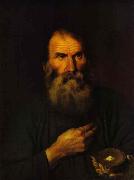
Kapiton Zelentsov (Russian 1790-1845) was a Russian painter notable for his illustrations for books by Aleksandr Pushkin, Faddei Bulgarin and Mikhail Zagoskin. He was the student of Alexey Venetsianov.
|
|
 |
kilian zoll
|
|
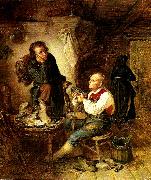
Kilian Christoffer Zoll (29 september 1818 - 9 november 1860) was a Swedish artist. He belonged to the Dusseldorf school of painting and painted genre pictures, landscape, portraits, children and altarpieces.
Zoll studied at the Royal Swedish Academy of Arts in Stockholm 1835-1839. Within the Academy, Zoll and his fellow students mostly treated mythical and historical subjects, but as soon as he became independent he devoted himself to genre painting.
He travelled and made sketches through Sweden; Skåne, Halland, Småland and Dalarna. He participated in the academy exhibitions 1850, 1853, 1856 and 1858 with a total of 19 oil paintings. His paintings from this period address topics such as Children playing with a cat, Grandma's joy, Old Woman at the Spinning Wheel.
In 1854 he traveled to Dusseldorf in the company of a fellow artist Bengt Nordenberg. In Dusseldorf he studied art together with another Swedish artist Marcus Larson - together they executed several paintings. He returned to Sweden in 1855. He and Nordenberg tried to get a travel grant from the Swedish Academy of Arts, but he could not get it because he was older than the rules allowed.
The following year he went back to Dusseldorf, now married, and returned to Sweden 1858. Once again, he traveled through the province of Halland in artistic studies and had planned to return to Dusseldorf. He, however, fell ill and died before then. |
|
 |
Kristian Zahrtmann
|
|
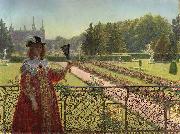
(31 March 1843 - 22 June 1917) was a Danish painter. He was a part of the Danish artistic generation in the late 19th century, along with Peder Severin Krøyer and Theodor Esbern Philipsen, who broke away from both the strictures of traditional Academicism and the heritage of the Golden Age of Danish Painting, in favor of naturalism and realism.
He was known especially for his history paintings, and especially those depicting strong, tragic, legendary women in Danish history. He also produced works of many other genres including landscapes, street scenes, folk scenes and portraits.
He had a far-reaching effect on the development of Danish art through his effective support of individual style among his students during the many years he taught, and by his pioneering use of color.
|
|
 |
Marcin Zaleski
|
|
was a Polish painter.
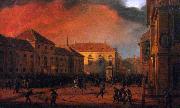
Zaleski was born in Krakew. Among his works was a series of paintings on the November Uprising in Warsaw, to which he was an eyewitness as well as numerous other paintings of the city. His work is featured in Turkey's Adam Mickiewicz Museum and the Gomel Palace, among other locations. He died in Warsaw.
|
|
|
|
|
|
|
|
|
|
 |
Mihaly Zichy
|
|
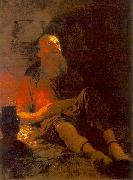
(Hungarian pronunciation: [ˈmihaːj ˈzitʃi]; German: Michael von Zichy; October 15, 1827, Zala, Hungary - February 28, 1906, St. Petersburg, Russia) was a Hungarian painter and graphic artist.
Mihely Zichy was a significant representative of Hungarian romantic painting. During his law studies in Pest from 1842, he attended Jakab Marastoni's school as well. In Vienna he was Waldmeller's pupil in 1844. "Life Boat", his first major work, comes from this time. On Waldmeller's recommendation, he became an art teacher in St. Petersburg. He swore allegiance to freedom by painting the portrait of Lajos Batthyeny, the first Hungarian prime minister, in 1849. From 1850 onwards, he worked as a retoucher, but he also did pencil drawings, water colours and portraits in oil. The series on the Gatchina hunting ordered by the Russian tsar raised him to a court artist. He founded a society to support painters in need. "Autodafe" on the horrors of Spanish inquisition was painted in 1868. He travelled around Europe in 1871, and settled down in Paris in 1874.
He painted "Queen Elisabeth is Laying Flowers by the Coffin of Ferenc Deek" on Treffort's order. "Drinking Bout of Henry III", his next large scale picture came from 1875. "The Victory of the Genius of Destruction" painted for the Paris Exhibition was banned by French authorities because of its daring antimilitarist message. He left Paris in 1881 and returned to St. Petersburg after short stays in Nizza, Vienna and Zala (village). From this time onwards, he was mostly engaged in illustrations ("The Tragedy of Man" by Made - h, 1887, and twenty-four ballads of Jenos Arany, 1894 - 98).
|
|
 |
Sergey Zaryanko
|
|
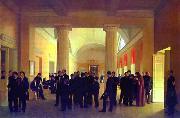
Sergey Konstantinovich Zaryanko (1818 - 1871) was a Russian painter, he was as a pupil of Venetzianov |
|
|
|
|
|
 |
Willem de Zwart
|
|
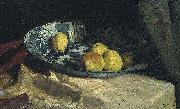
(16 May 1862 The Hague - 11 December 1931 The Hague) was a Dutch painter, engraver, watercolorist, with many connections to the Hague School.
Willem De Zwart was born in The Hague on 16 May 1862, the eldest of eight children. His youngest brother, Pieter, would also become a painter. His father painted carriages for a living, and in 1875 the fourteen-year-old Willem was apprenticed to a carriage maker to learn the same trade. In his spare time, he copied prints he found in magazines, and a year later he enrolled in the evening class at the Royal Academy of Visual Art in The Hague. The following year, he was admitted at the studio of Jacob Maris. In the three years that he remained here, it is probable that he got to know many of the leading lights of the Hague School. Maris also sent De Zwart on a journey to the coast, without drawing materials, and had him work out his impressions directly on canvas when he returned to the studio.
De Zwart made several copies of works by 16th and 17th century masters in the Mauritshuis. He was most interested in the works of Johannes Vermeer, Paulus Potter, and Rembrandt, but studied paintings by German and Italian masters, as well. Sometimes he produced copies on commission. In this period, he also made detailed studies of animals, concentrating particularly on their legs, heads and snouts. De Zwart developed a fastidious painting style with a sober, predominantly brown palette.
Willem de Zwart lived and worked until 1894 in The Hague and from 1900 to 1905 in Amsterdam. His work has a wide range of subjects: landscapes, cityscapes, portraits and still life, rendered in a naturalistic or impressionist style. His work shows affinity with the people and city-oriented Amsterdam Impressionism. In his choice of subjects belonged to the Hague School and in his style and his exuberant use of color to the school of Amsterdam Impressionism. He is also known as the "Hague Breitner" because of the similarity of his work to that of George Hendrik Breitner. He painted his landscapes, figure paintings and still lifes with smooth, bold brushstrokes. De Zwart applied the paint thickly, sometimes straight from the tube, with bright colors, exuberant reds, yellows and blues, giving his paintings special vibrancy.
|
|
|
|
|
|
 |
Zahari Zograf
|
|
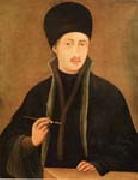
(1810?C1853), better known as Zahari Zograf (or Zahariy Zograf) is arguably the most famous Bulgarian painter of the Bulgarian National Revival, noted for his church mural paintings and icons and often regarded as the founder of secular art in Bulgaria due to the introduction of everyday life elements in his work.
Zahari Zograf was born in the town of Samokov in 1810 and was taught by his brother Dimitar Zograf, with whom he later worked together, as his father died early. A spiritual student of Neophyte of Rila since 1827, he became an equal partner of his brother at the age of 21 in 1831, i.e. he was proclaimed a master.
His best known icons are those of the SS Constantine and Helen Church in Plovdiv, the Church of the Theotokos in Koprivshtitsa, as well as a number of monasteries. Zahari Zograf's best known frescoes are those in the main church of the Rila Monastery, in the chapel and the St Nicholas church of the Bachkovo Monastery, the Troyan Monastery and the Monastery of the Transfiguration. He painted three mural portraits of himself in the latter three, a move that was regarded as controversial during the time. |
|
 |
ZAIS, Giuseppe
|
|
Italian painter, Venetian school (b. 1709, Canale d'Agordo, d. 1789, Venezia) |
|
|
|
 |
Zdenka Braunerova
|
|
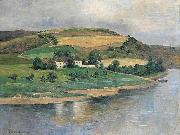
(April 9, 1858 - May 23, 1934 in Prague) was a Czech painter and graphic designer. A prominent Czech artist, she takes her place on history alongside the likes of Chittussi, Mršt??k, Zeyer, Marten, Joža Uprka and sculptors František B??lek and Jan Zrzavý.
Zrzavý described her as "... an extraordinary woman, funny, educated, genuine." He continued, "She had a wonderful, incisive intellect and a special charm. When I met her, she was sixty. Mirth and optimism are had by a only a few people. She supplied me with faith and zest for life",
|
|
 |
ZEILLER, Jakob Johann
|
|
German painter (b. 1708, Reutte, d. 1783, Reutte)
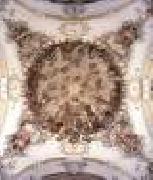
Austrian painter. Trained initially by his father, Paul Zeiller (1658-1738), he subsequently studied in Italy (1723-32) with Sebastiano Conca and at the Accademia di S Luca in Rome, and with Francesco Solimena in Naples, then at the Kaiserliche Akademie in Vienna. From 1733 to 1743 he was a regular collaborator on Paul Troger's frescoes, contributing mainly architectural frameworks painted in the style of the Bolognese quadraturisti. He retained such frameworks in his own paintings throughout his life, even in south Germany where this was generally unusual. Troger's influence on the style of Zeiller's figures and on his iconographic repertory was such that his first independent works in Austria |
|
 |
ZIMMERMANN Dominikus
|
|
German sculptor, Bavarian school (b. 1685, Wessobrunn, d. 1766, Wies)
German sculptor, Bavarian school (b. 1685, Wessobrunn, d. 1766, Wies)Architect, stuccoist and painter, brother of Johann Baptist Zimmermann. For the first two decades of his creative life, from about 1705, he worked mainly as a builder of altars and as a marbler. His most important commission came from the Benedictine abbey of Fischingen (Thurgau), for which he made six artificial marble altars with scagliola inlays (1708-9). Similar altars, mainly in Swabia, are attributed to him or known to be his work; their construction shows the influence of Johann Jakob Herkommer, with whose work Dominikus became familiar while living in Fessen (1708-16). Between 1709 and 1713 he worked with Johann Baptist Zimmermann at the Buxheim Charterhouse, producing artificial marble altars and stuccowork that is characterized by the botanical accuracy of the plant motifs. |
|
 |
ZIMMERMANN Johann Baptist
|
|
German painter, Bavarian school (b. 1680, Wessobrun, d. 1758, Menchen).
Painter and stuccoist. Much of his early stuccowork and frescoes, such as that in the choir of Gosseltshausen parish church (1701) and the refectories of the abbeys at Tegernsee, Weyarn and Beyharting (before 1710), has been destroyed. His earliest surviving stuccowork (1707-9) is in the pilgrimage church of Maria Schnee, near Markt Rettenbach, and reveals the influences of Johann Schmuzer from Wessobrunn and an Italian stucco workshop that practised in Tegernsee. |
|
 |
ZIMMERMANN, Dominikus
|
|
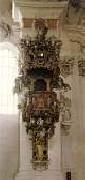
German sculptor, Bavarian school (b. 1685, Wessobrunn, d. 1766, Wies)..Architect, stuccoist and painter, brother of (1) Johann Baptist Zimmermann. For the first two decades of his creative life, from about 1705, he worked mainly as a builder of altars and as a marbler. His most important commission came from the Benedictine abbey of Fischingen (Thurgau), for which he made six artificial marble altars with scagliola inlays (1708-9). Similar altars, mainly in Swabia, are attributed to him or known to be his work; their construction shows the influence of Johann Jakob Herkommer, with whose work Dominikus became familiar while living in F?ssen (1708-16). Between 1709 and 1713 he worked with (1) Johann Baptist Zimmermann at the Buxheim Charterhouse (see above), producing artificial marble altars and stuccowork that is characterized by the botanical accuracy of the plant motifs. |
|
 |
ZOFFANY Johann
|
|
German/English painter (b. 1733, Frankfurt, d. 1810, Strand-on-the-Green)
|
|
|
|
 |
ZUCCARELLI Francesco
|
|
Italian painter, Venetian school (b. Pitigliano, 1702, d. 1788, Firenze)
Florentine landscape painter and decorator. He twice visited London, where he decorated the Opera House and was well known through popular engravings of his scenes on the Thames. He was a charter member of the Royal Academy. His facile paintings of landscapes with ruins and small figures are best seen in Windsor Castle and in the Academy, Venice. |
|
 |
ZUCCARO Taddeo
|
|
Italian Mannerist Painter, 1529-1566
Painter and draughtsman. Taught to draw by his father, at the age of 14 he went alone to Rome where, according to Vasari, he was employed in various workshops and studied independently, particularly the works of Raphael. Through assisting Daniele de Porri (1500-77), who had trained in Parma, he learnt of the work of Correggio and Parmigianino. He first became known for his paintings on fa?ades, notably scenes from the Story of Furius Camillus on the palazzo of a Roman nobleman Jacopo Matteo, executed in 1548. Vasari claimed that Taddeo's fa?ade decorations equalled those of Polidoro da Caravaggio; none survives, although some are documented in drawings (e.g. London, BM; Paris, Louvre) and show his assimilation of Polidoro's style. Taddeo's earliest extant works date from 1553 when he collaborated with Prospero Fontana on the decoration (part destr.) of the villa of Pope Julius III outside the Porta del Popolo in Rome; Taddeo's contributions included scenes of The Seasons in the loggia of the nymphaeum. In these, clarity of form and space, natural proportions and idealization of human form demonstrate his affinity with the classicism of the High Renaissance. He also assimilated the sculptural sensibility of Mannerism, derived from Michelangelo. |
|
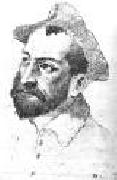 |
ZUCCARO Federico
|
|
Italian Mannerist Painter, ca.1542-1609
..Painter, draughtsman and writer, brother of (1) Taddeo Zuccaro. Having been invited to Rome by his brother, between 1555 and 1563 he worked with Taddeo on various projects including the Villa Farnese at Caprarola and the Pucci Chapel in Trinit? dei Monti, Rome. Many of Federico's drawings for both commissions show Taddeo's influence. According to Vasari, Taddeo supervised his brother's early work, which created friction between them. In 1558, for example, when they collaborated on painting the fa?ade of the house of Tizio da Spoleto with scenes from the Life of St Eustace, Taddeo retouched some of his brother's paintings, so offending Federico. Already at 18 Federico was commissioned to paint many works at the Vatican: the Transfiguration, the Marriage at Cana and other scenes from the Life of Christ for the decorations (part destr.) of the Casino of Pius IV; |
|
|