|
|
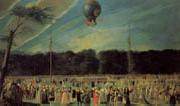 |
Antonio Carnicero
|
|
Spanish Rococo Era Painter, ca.1748-1814
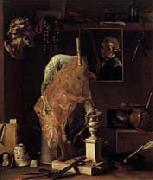
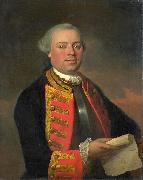
was a Spanish painter of the Neoclassic style. Born in Salamanca and died in Madrid. He was trained with his father, Alejandro Carnicero, a sculptor. He then traveled to Rome and returned to be named chamber painter for King Charles III of Spain. He also worked as an engraveor. |
|
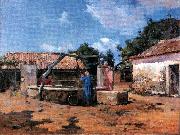 |
Antonio Carvalho de Silva Porto
|
|
(Porto, 11 November 1850 - Porto, 11 June 1893) was a Portuguese naturalist painter.
Born in Porto, he studied there under João Antenio Correia and T. Furtado, then continued his studies in Paris and Rome.
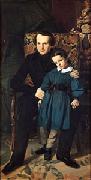
While in Paris he exhibited his work in the Salon and in the World´s Fair of 1878. In Paris, he studied with his friend João Marques de Oliveira, where they were pupils of Adolphe Yvon and Alexandre Cabanel. They became followers of the naturalist Barbizon School, and brought the new school of painting to Portugal, when they returned in 1879.
Silva Porto become one of the most acclaimed naturalist painters of his generation, showing the heritage of Jean-Baptiste Camille Corot and Charles-François Daubigny. Secondary effects from impressionism can sometimes be found in his paintings.
|
|
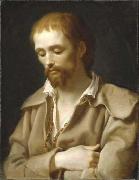 |
Antonio Cavallucci
|
|
(21 August 1752 - 18 November 1795) was an Italian painter of the late Baroque.
Cavallucci was born in Sermoneta in the Lazio. His artistic talents were recognized in an early stage by Francesco Caetani, Duke of Sermoneta in 1738-1810. In 1765, he brought the 13 year old Cavallucci to Rome, where he became a pupil of Stefano Pozzi and three years later of Gaetano Lapis. He also studied drawing at the Accademia di San Luca (c. 1769-1771).
His earliest work dates from the mid-1760s. It is a tempera frieze in the Casa Cavallucci in Sermoneta. His first portrait was of his benefactor Duke Francesco Caetani. This portrait is only preserved as an engraving in 1772 by Pietro Leone Bombelli (1737-1809).
His first major commission was the decoration of five audience chambers in the Caetani Palace in Rome in 1776. He painted mythological scenes and allegories appropriate for each room.
In the early 1780s he painted mostly portraits, such as those of Francesco Caetani and Teresa Corsini, Duchess of Sermoneta.
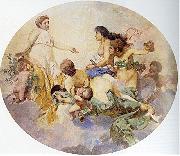
The Origin of Music (1786) is probably the most important painting of his mid-career. It was based on the illustrations in the book Iconologia (1593) from Cesare Ripa.
The commissions kept coming under his new patron, Cardinal Romualdo Braschi-Onesti (1753-1817), nephew of the pope Pius VI. He has painted the portraits of his new benefactor and of the pope in 1788.
He was inducted into the Accademia di San Luca in 1786, Academy of Arcadia in 1788, and the Congregazione dei Virtuosi al Pantheon in 1788.
He is said to have painted St Benedict Joseph Labre while the saint was in ecstasy, or (as is perhaps more plausible), having seen the saint in ecstasy, to have brought him to his studio and painted his portrait there. In later years he worked for Cardinal Francesco Saverio Zelada, decorating his titular church San Martino ai Monti in Rome. Cavallucci died in Rome in 1795.
He was influenced by Pompeo Batoni and Anton Raphael Mengs. There is in his art some of the northern European feeling that had made its way into Rome at the end of the eighteenth century. The Portuguese painter Domingos Sequeira was one of his pupils.
|
|
|
|
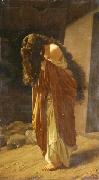 |
Antonio Ciseri
|
|
(October 25, 1821 ?C March 8, 1891) was a Swiss painter of religious subjects.
Ciseri was born in Ronco sopra Ascona in the canton of Ticino in Switzerland. In 1833 he moved with his father to Florence. He was admitted in 1834 to the Accademia di Belle Arti, where he trained under Niccola Benvenuti. In 1849, he began offering instruction to young painters, and eventually ran a private art school. Among his earliest students was Silvestro Lega.[1]
Ciseri's religious paintings are Raphaelesque in their compositional outlines and their polished surfaces, but are nearly photographic in effect. He fulfilled many important commissions from churches in Italy and Switzerland. Ciseri also painted a significant number of portraits. He died in Florence on March 8, 1891.
|
|
|
|
|
|
|
|
 |
Antoon Claeissens
|
|
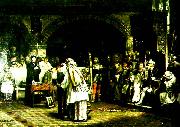
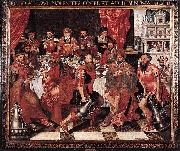
(his name is given in many varieties, with his first name rendered as Anton, Anthonie, Anthony, Anthuenis, and his surname as Claes, Claesz, Claeis, Claeiss, Claessens and Claeissins), the son of Pieter Claes the elder, painted historical and allegorical subjects, and portraits. He was a native of Bruges, and there entered the Guild of St. Luke in 1575, and became its dean in 1586, 1590, and 1601. He died in 1613. His works, several of which are in the Hôtel-de-Ville and churches of Bruges, are distinguished by their fine colouring and finish. In the H6tel-de-Ville is a 'Grand Banquet' with many portraits of magistrates of the time, dated 1574.
His son, Pieter Anthonie, was dean of the Guild of St. Luke at Bruges in 1607, and died in 1608.
|
|
|
|
|
|
 |
ASAM, Cosmas Damian
|
|
German Baroque Era Sculptor, 1686-1739
Bavarian architects and decorators. After studying in Rome (1711 ?C 13), Cosmas Damian became a prolific fresco painter, and his brother, Egid Quirin, became a sculptor and stuccoist. They developed the effects of dramatic lighting and illusionism originated by Gian Lorenzo Bernini and Andrea Pozzo. Working as a team, they produced magnificent illusionistic decoration in ecclesiastical buildings, combining dramatic lighting and colour. Their works are notable for their profound and dramatic intensity of religious feeling. The brothers became the principal late Baroque exponents of illusionist decoration in religious architecture. Their most notable collaboration is the church of St. John Nepomuk in Munich (1733 ?C 46) ?? known as the Asamkirche in honour of the brothers. |
|
|
|
|
|
|
|
 |
Auguste Chabaud
|
|
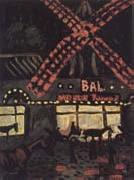
1882-1955,French painter, sculptor and writer. He trained at the Ecole des Beaux-Arts in Avignon with Pierre Grivolas (1824-1905). After moving to Paris in 1899 he attended Fernand Cormon's atelier in the Ecole des Beaux-Arts and William-Adolphe Bouguereau's studio in the Acad?mie Julian. He also studied at the Acad?mie Carriere, where he met Matisse, Jean Puy, Andre Derain and Pierre Laprade. While family responsibilities from 1901 and military service in World War I sharply curtailed much of his early output, he nonetheless produced noteworthy paintings and sculptures from 1907, the first year he exhibited at the Paris Salon, to 1913, when he exhibited at the Armory Show in New York. |
|
 |
Auguste Couder
|
|
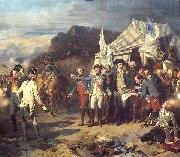
(1 April 1790 in Paris - 21 July 1873 in Paris) was a French painter and student of Jean-Baptiste Regnault and Jacques Louis David. He joined the Academie des beaux-arts in 1839 and was an officer of the Legion d'honneur. He married Cornelie Stouf, daughter of the sculptor Jean-Baptiste Stouf.
Couder was buried in the cemetery of Pere-Lachaise.
|
|
|
|
|
|
 |
Barend Cornelis Koekkoek
|
|
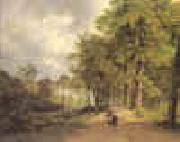
1803-1862
Dutch
Barend Cornelis Koekkoek Gallery
Koekkoek??s own paintings reveal a careful study and synthesis of Dutch seventeenth century painters. His art is firmly rooted in the great Dutch romantic tradition established by the seventeenth-century masters: Hobbema, Cuyp, Ruisdael and Wynants. The golden light and the inclusion of travellers in his work suggests Koekkoek also admired the Dutch Italianate painters of the seventeenth century, collectively known as the Bamboccianti, especially Pieter van Laer and Jan Both.
Koekkoek imagined his pictures as the result of an ideal combination of observation and artifice. He studied art and nature with equal acuity, creating beautiful landscape paintings that celebrated the greatness of Creation. ??Koekkoek's work impresses the spectator by its power, by the firm and correct construction of the trees, by the broad, natural growth of the leaves and boughs, [and] by the careful and elaborate reproduction of the wooded landscape?? (G. H. Marius, Dutch Painters of the Nineteenth Century, Woodbridge, 1973, p. 89). Up to this day, Willem Koekkoek's work is very much favoured for the lively composition and the mood of nostalgia, in which the Dutch Golden Age seems to linger on. Just as he was during his own lifetime, Koekkoek is widely regarded as the most accomplished landscape painter of Dutch romanticism, against whose scrupulously refined paintings the work his contemporaries is measured.
|
|
|
|
 |
Bartolomeo Caporali
|
|
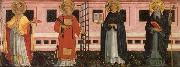
(c. 1420-c. 1505 ; active 1454-1499) was an Italian painter born and active in Perugia. He painted a Madonna and Saints (1487) for the church of Santa Maria Maddalena at Castiglione del Lago.
|
|
|
|
 |
Beaux, Cecilia
|
|
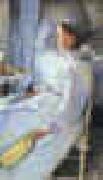
Studied under Bouguereau and Tony Robert-Fleury. Specializes in Portraits. American Painter, 1855-1942. American painter. She began her career painting on porcelain and producing lithographs and portrait drawings. She studied with Catharine Ann Drinker (1871), Francis Adolf van der Wielen (1872-3) and Camille Piton (1879), at the Pennsylvania Academy of the Fine Arts in Philadelphia (1877-8), and privately with William Sartain (1881-3). Under Sartain's guidance, she learnt to paint, producing her first major portrait, the Last Days of Infancy |
|
 |
Beckwith James Carroll
|
|
American, 1852-1917
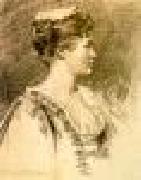
was an American portrait painter. He was born at Hannibal, Missouri, on 23 September 1852. He studied in the National Academy of Design, New York City, of which he afterwards became a member, and in Paris (1873-1878) under Carolus Duran. Returning to the United States in 1878, he gradually became a prominent figure in American art. He took an active part in the formation of The Fine Arts Society, and was president of the National Free Art League, which attempted to secure the repeal of the American duty on works of art. Among his portraits are those of William Merritt Chase (1882), Miss Jordan (1883), Mark Twain, Thomas Allibone Janvier, John Schofield and William Walton. He taught at the Art Students League of New York -- where Violet Oakley was one of his students |
|
 |
BEGA, Cornelis
|
|
Dutch Baroque Era Painter, ca.1620-1664
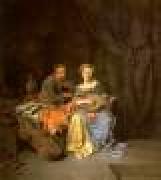
Dutch painter, draughtsman and etcher. He was born into prosperous circumstances; his mother, Maria Cornelis, inherited half the estate (gold, silver, paintings, drawings and prints) and all of the red chalk drawings of her father, Cornelis Cornelisz. van Haarlem, a renowned Mannerist artist. Bega's father was Pieter Jansz. Begijn (d 1648), a gold- and silversmith. Like other family members, Bega was probably Catholic. Houbraken's claim that Bega studied with Adriaen van Ostade is likely to be correct; this was probably before 24 April 1653, when Bega joined Vincent Laurentsz. van der Vinne in Frankfurt for a journey through Germany, Switzerland and France. Bega had returned to Haarlem by 1 September 1654, at which time he joined the Guild of St Luke. |
|
|
|
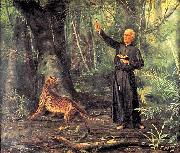 |
Benedito Calixto
|
|
(14 October 1853 -- 31 May 1927) was a Brazilian painter. His works usually depicted figures from Brazil and Brazilian culture, including a famous portrait of the bandeirante Domingos Jorge Velho in 1923, and scenes from the coastline of São Paulo. Unlike many artists of the time, Calixto's patron was an individual other than the state, who were "the most dependable source of patronage." |
|
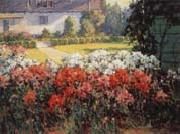 |
Benjamin C.Brown
|
|
American,is best remembered for his Impressionist renderings of the Sierra Mountains and poppy-filled spring meadows.1865-1942 |
|
|
|
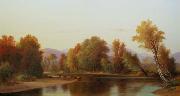 |
Benjamin Champney
|
|
(November 20, 1817 - December 11, 1907) was a painter whose name has become synonymous with White Mountain art of the 19th century. He began his training as a lithographer under celebrated marine artist Fitz Henry Lane at Pendleton's Lithography shop in Boston. Most art historians consider him the founder of the "North Conway Colony" of painters who came to North Conway, New Hampshire and the surrounding area during the second half of the 19th century. His paintings were often used to make chromolithographs that were subsequently sold to tourists who could not afford Champney's originals. He exhibited regularly at the Boston Athenæum and was a founder of the Boston Art Club
|
|
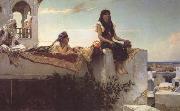 |
Benjamin Constant
|
|
1767-1830
French-Swiss novelist and political writer. He had a tumultuous 12-year relationship with Germaine de Staël, whose views influenced him to support the French Revolution and subsequently to oppose Napoleon, for which he was exiled (1803 C 14). He later served in the Chamber of Deputies (1819 C 30). Adolphe (1816) was a forerunner of the modern psychological novel. |
|
|
|
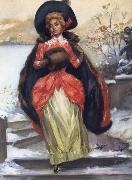 |
Benjamin West Clinedinst
|
|
Illustrator and Painter.
American , 1859-1931
was an American illustrator and painter, born at Woodstock, Va. He studied for a year in Baltimore and for five years in Paris under Cabanel and Bonnat and first attracted attention in New York with his illustrations for Leslie's Weekly. He was best known as the illustrator of Thomas Nelson Page's Unc' Edinburg, the works of Hawthorne, Stevenson, and Mark Twain, although he worked also in oils and water colors. His sympathetic collaboration with the author gave his work an especial charm. He was awarded the Evans prize of the American Water-Color Society in 1900. In 1947. |
|
|
|
|
|
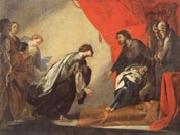 |
Bernardo Cavallino
|
|
Italian Baroque Era Painter, ca.1616-1656
was an Italian painter of the Baroque period, working in Naples. Born in Naples, he likely died during the plague epidemic in 1656. While his paintings are some of the more stunningly expressive works emerging from the Neapolitan artists of his day, little is known about the painter's background or training. Of eighty attributed paintings, less than ten are signed. He worked through private dealers and collectors whose records are no longer available. It is said that he trained with Massimo Stanzione, befriended the painter Andrea Vaccaro, and was influenced by Anthony Van Dyck, but his paintings could also be described as equidistant from Caravaggio and Bartolome Esteban Murillo in styles; tenebrism enveloped with a theatrical sweetness, a posed ecstasy and feeling characteristic of the high Roman baroque statuary. He is known to have worked in Neapolitan circles strongly influenced by Stanzione, which included Artemisia Gentileschi, Francesco Francanzano, Agostino Beltrano and Francesco Guarino. One of his masterpieces is the billowing maiden Virgin at the Brera Gallery in Milan. Passive amid the swirling, |
|
 |
Bingham, George Caleb
|
|
American Realist Painter, 1811-1879. American painter. Raised in rural Franklin County, MO, Bingham experienced from an early age the scenes on the major western rivers, the Missouri and the Mississippi, that inspired his development as a major genre painter. During his apprenticeship to a cabinetmaker, he met the itinerant portrait painter Chester Harding, who turned Bingham's attention to art. Teaching himself to draw and compose from art instruction books and engravings, the only resources available in the frontier territories, Bingham began painting portraits as early as 1834. |
|
|
|
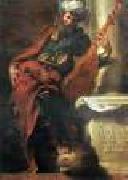 |
BOCCACCINO, Camillo
|
|
Italian painter, Cremonese school (b. 1504/5, Cremona, d. 1546, Cremona)
Camillo Boccaccino (c. 1504 - 1546) was an Italian painter of the Renaissance period, active mainly in Cremona and regions of Lombardy. He was the son and pupil of the painter Boccaccio Boccaccino. He was known to Gian Paolo Lomazzo and Giorgio Vasari. He painted the four evangelists (1537) in the niches of the cupola of San Sigismondo at Cremona. |
|
|
|
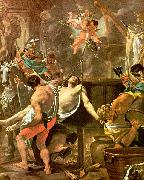 |
Brun, Charles Le
|
|
French Baroque Era Painter, 1619-1690
French painter and designer. He dominated 17th-century French painting as no other artist; it was not until over a century later, during the predominance of Jacques-Louis David, that artistic authority was again so concentrated in one man. Under the protection of a succession of important political figures, including Chancellor Pierre S?guier, Cardinal Richelieu and Nicolas Fouquet, Le Brun created a series of masterpieces of history and religious painting. For Louis XIV and his chief minister Jean-Baptiste Colbert he executed his greatest work, the royal palace of Versailles: an almost perfect ensemble of architecture, decoration and landscape. After Colbert's death in 1683, he was no longer able to count on prestigious commissions |
|
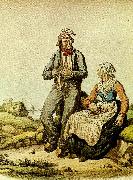 |
c. a. dahlstrom
|
|
Carl Petter Dahlström, född ca 1705, död 4 mars 1794, var en svensk möbelsnickare. Dahlström gesällvandrade 1745?C1755 i Nordeuropa och Frankrike, där han i Paris kom i lära hos den tidens främste ebenist Jean-François Oeben. Hos denne lärde sig Dahlström faneringstekniken marqueterie ?? fleurs eller blomsterintarsia, som var en metod för att möta rokokons krav på fanering av dubbelvälvda kroppar. Mycket tack vare rekommendationer av C.J. Cronstedt blev Dahlström efter hemkomsten till Sverige utnämnd till kunglig ebenist den 19 november 1756. Han finns representerad på Nationalmuseum med en byrå som han tillverkade tillsammans med Lorentz Nordin. Dahlström överlämnade 1769 sina privilegier till Niclas Palmgren och ägnade sig därefter åt restaurangverksamhet. |
|
|
|
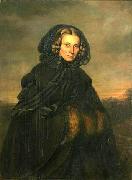 |
C. Grunewald
|
|
paint Portrait of Bertha Wehnert-Beckmann German photographer in 1858 |
|
|
|
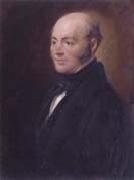 |
C.R. Leslie
|
|
English genre painter , 1794-1859
was an American artist best known for his cartoons and caricatures of actors and other celebrities. Though his work was heavily in demand through the 1920s and is often considered to epitomize the era, his personal life was troubled by mental illness, and he was nearly forgotten soon after his suicide, shortly before his fortieth birthday. English genre painter, was born in London on 19 October 1794. His parents were American, and when he was five years of age he returned with them to their native country. They settled in Philadelphia, where their son was educated and afterwards apprenticed to a bookseller. He was, however, mainly interested in painting and the drama, and when George Frederick Cooke visited the city he executed a portrait of the actor from recollection of him on the stage, which was considered a work of such promise that a fund was raised to enable the young artist to study in Europe. He left for London in 1811, bearing introductions which procured for him the friendship of West, Beechey, Allston, Coleridge and Washington Irving, and was admitted as a student of the Royal Academy, where he carried off two silver medals. At first, influenced by West and Fuseli, he essayed high art, and his earliest important subject depicted Saul and the Witch of Endor; but he soon discovered his true aptitude and became a painter of cabinet-pictures, dealing, not like those of David Wilkie, with the contemporary life that surrounded him, but with scenes from the great masters of fiction, from Shakespeare and Cervantes, Addison and Moliere, Swift, Sterne, Fielding and Smollett. Of individual paintings we may specify Sir Roger de Coverley going to Church (1819); May-day in the Time of Queen Elizabeth (1821); Sancho Panza and the Duchess (1824); Uncle Toby and the Widow Wadman (1831); La Malade Imaginaire, act iii. sc. 6 (1843); and the Dukes Chaplain Enraged leaving the Table, from Don Quixote (1849). |
|
|
|
 |
Caesar van Everdingen
|
|
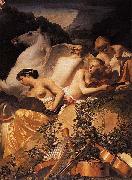
(1616/17, Alkmaar - buried October 13, 1678, Alkmaar), older brother of Allart van Everdingen and Jan van Everdingen, was a Dutch Golden Age portrait painter.
Caesar Pietersz van Everdingen also known as Caesar Boetius van Everdingen was educated in Utrecht, where he learned to paint from Jan Gerritsz van Bronckhorst.Caesar became a member of the painter's guild in Alkmaar in 1632. His first known painting dates from 1636. In 1648 he moved to Haarlem, where he joined the Haarlem Guild of St. Luke and the civic guard (or schutterij) there, where he met Jacob van Campen. From 1648 to 1650 He helped him with the decoration of the Oranje Zaal (Orange room) in Huis ten Bosch. In 1658 he moved back to Alkmaar where he started a workshop and took on pupils.
Many of his pictures are to be seen in the museums and private houses of the Netherlands. His pupils were Jan Theunisz Blanckerhoff, Adriaen Dekker, Hendrik Graauw, and Thomas Heeremans.Houbraken also lists two other pupils; Adriaen Warmenhuizen, and Laurens Oosthoorn.
|
|
|
|
|