|
|
 |
Johann Gottfried Schadow
|
|
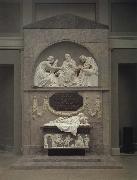
1764-1850 Berlin, He was a German sculptor. He was born in Berlin, where his father was a poor tailor. Friederike von Preuben.His first teacher was an inferior sculptor, Tassaert, patronized by Frederick the Great; the master offered his daughter in marriage, but the pupil preferred to elope with a girl to Vienna, and the father-in-law not only condoned the offence but furnished money wherewith to visit Italy. Three years' study in Rome formed his style, and in 1788 he returned to Berlin to succeed Tassaert as sculptor to the court and secretary to the Academy. Over half a century he produced upwards of two hundred works, varied in style as in subjects. |
|
 |
Johann Gottfried Steffan
|
|
1815-1905
Swiss painter. He moved to Munich in 1833 after an apprenticeship as a lithographer in Wedenswil. He studied at the Akademie der Bildenden Kenste and the Polytechnikum in Munich. He was impressed by Carl Rottmann's Italian landscapes and decided to devote himself to landscape painting. He travelled to Italy in 1845 and to Paris in 1855; he subsequently began to concentrate on painting lake and mountain scenes, for example Lake Starnberg in a Storm (1873; Zurich, Ksthaus), at which he was highly successful. He undertook numerous study-visits to Bavaria and Switzerland, often accompanied by his pupils Traugott Schiess (1834-69) and Otto Frölicher. In Munich Steffan became friendly with Rudolf Koller, Johann Caspar Bosshardt (1823-87) and Arnold Becklin, and under his leadership the 'Schweizer', as these artist-friends were known collectively, formed their own group. |
|
|
|
 |
Johann Kaspar Scherrer
|
|
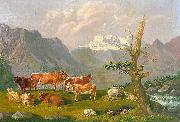
painted Weidelandschaft in den Schweizer Bergen mit Katarakt und Gebirgshorizont in 1739 - 1806 |
|
|
|
 |
Johann Michael Sattler
|
|
(28 September 1786, Herzogenburg, Lower Austria - 28 September 1847, Mattsee, Salzburg) was an Austrian portrait and landscape painter, best known for his large-scale panoramas.
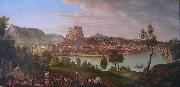
Sattler attended the Vienna Academy beginning in 1804 under the tutelage of Hubert Maurer. In 1819 Sattler moved to Salzburg, where in 1824 he began to paint a 360-degree panorama of the city as seen from the top of Salzburg's castle. The massive work covered 125 square metres and was first exhibited in 1829. Salzburg made him an honorary resident. Stattler toured across Europe with the painting for ten years, writing about his return in 1838, "with 30 tons and crossing approximately 30,000 kilometres of land and water, a feat no one had ever done before me and one which would be difficult to repeat in the future." Satler's son, the artist Hubert Sattler, donated the work to the city in 1870. The painting is now on display at the Salzburg Museum in a specially designed area called the Panorama Museum. |
|
 |
Johann Wilhelm Schirmer
|
|
Julich 1807-1863 Karlsruhe,was a German landscape artist from Julich, within the Prussian Duchy of Julich. The artist, a namesake of Friedrich Wilhelm Schirmer, had a similar aim and career. He first was a student, and subsequently became a professor in the academy of Dusseldorf. He became known as one of the first of the so-called Dusseldorf landscape school. In 1854 he was made director of the art school at Karlsruhe, where he died. |
|
 |
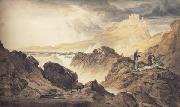
John warwick smith
|
|
English Painter, 1749-1831
English painter. The son of a gardener to the Gilpin family, he studied under the animal painter Sawrey Gilpin. During a trip to Derbyshire with Gilpin he met George Greville, 2nd Earl of Warwick, who gave him financial support to go to Italy between 1776 and 1781. Smith spent 1778-9 in Naples and was otherwise based in Rome, where he explored the Campagna and made sketches with William Pars and Francis Towne. The strong greens and purples and crisp pen outlines of some of Smith's watercolours are strongly influenced by Towne's style. Smith and Towne travelled together across the Alps on their way back to England in 1781, after which Smith settled in Warwick. He contributed six views to Samuel Middiman's Select Views in Great Britain (1784-5) and between 1784 and 1806 toured Wales 13 times in search of Picturesque and Sublime scenery. He also visited the Lake District between 1789 and 1792, which resulted in the publication of Twenty Views of the Lake District (1791-5); he appears to have been in Devon and Worcestershire as well. Aquatints after Smith were used to illustrate William Sotheby's Tour through Parts of Wales (1794), |
|
 |
John Christian Schetky
|
|
(1778-1874)
Scottish painter. Schetky came from a cultured family: his father, Johann (1737-1824), was a German composer, and his mother, Maria, was the trumpeter Joseph Reinagle's sister. He took drawing lessons from Alexander Nasmyth and received a good education in Edinburgh before embarking on a Continental tour in 1801. After a spell as a drawing-master at the Royal Military College, Great Marlow, he was appointed Professor of Drawing at the Royal Naval College, Portsmouth, in 1811, a post he held for 25 years. He exhibited regularly at the Royal Academy between 1805 and 1872, his subjects ranging from ship portraits and royal embarkations to reconstructions of earlier sea battles of the time of Nelson. In 1820 he was made Marine Painter in Ordinary to George IV and was granted the same title by Queen Victoria in 1844. |
|
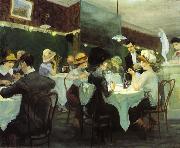 |
John French Sloan
|
|
(August 2, 1871 - September 7, 1951) was a U.S. artist. As a member of The Eight, a group of American artists, he became a leading figure in the Ashcan School of realist artists. He was known for his urban genre painting and ability to capture the essence of neighborhood life in New York City, often through his window. Sloan has been called "the premier artist of the Ashcan School who painted the inexhaustible energy and life of New York City during the first decades of the twentieth century",and an "early twentieth-century realist painter who embraced the principles of socialism and placed his artistic talents at the service of those beliefs." |
|
|
|
|
|
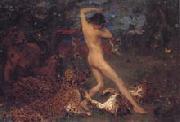 |
John Macallan Swan
|
|
British Academic Painter, 1847-1910
was an English painter and sculptor. John Macallan Swan was born in Brentford, Middlesex in 1847. He received his art training first in England at the Worcester and Lambeth schools of art and the Royal Academy schools, and subsequently in Paris, in the studios of Jean-L??on G??rôme and Emmanuel Fr??miet. He began to exhibit at the Academy in 1878, and was elected associate in 1894 and academician in 1905. He was appointed a member of the Dutch Water-Colour Society in 1885; and associate of the Royal Society of Painters in Water Colours in 1896 and full member in 1899. A master of the oil, water-colour and pastel mediums, an accomplished painter and a skilful draughtsman, he ranks also as a sculptor of distinguished ability. He has treated the human figure with notable power, but it is by his representations of the larger wild animals, mainly the felidae, that he chiefly established his reputation; in this branch of practice he has scarcely a rival. His picture "The Prodigal Son," bought for the Chantrey collection in 1889, is in the National Gallery of British Art. |
|
|
|
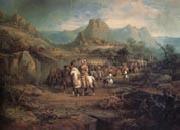 |
John Mix Stanley
|
|
A famous painter of Indians and Indian scen .
American , 1814-1872
American , 1814-1872,was an American painter of landscapes, portraits and Native American life. He was born in Canandaigua, New York and orphaned at the age of 12. At age 14, Stanley became an apprentice to a coach maker. Looking for better work, he moved to west in 1832 and became a painter of signs and portraits. In spring 1843 Stanley accompanied the party of Indian agent Pierce M. Butler to the Tehuacana Creek Council. At the outbreak of the Mexican War in 1845, John Mix Stanley joined Colonel Stephen Watts Kearney's expedition to California and produced many sketches and paintings of the campaign. He traveled to Hawaii in 1848 and spent a year painting portraits of members of the royal family. He traveled across the Isthmus of Panama in 1853. He also painted Comanche warriors in their natural environment. He moved to Detroit in 1864 and remained there for the rest of his life. Stanley helped to found a forerunner of the Detroit Institute of Arts and to incorporate the National Gallery and School of Arts. Stanley's primary interests and sympathies were with the Indians. The Smithsonian exhibited his pictures, but Congress never appropriated monies for them. More than 200 of his works were destroyed in the Smithsonian fire of 1865. |
|
|
|
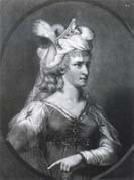 |
John Raphael Smith
|
|
English Painter, 1752-1812,English printmaker, publisher and painter. The youngest son of the landscape artist Thomas Smith of Derby (d Bristol, 12 Sept 1767), he was apprenticed to a linen draper at the age of ten and around 1767 became a linen draper's assistant in London. He seems to have taught himself to paint miniatures and produced his first mezzotint in 1769, from Henry Benbridge's portrait of General Pascal Paoli (San Francisco, CA Pal. Legion of Honor). Smith married and opened a draper's shop in Exeter Exchange; about 1773 he began to engrave professionally and sold prints from the same shop. |
|
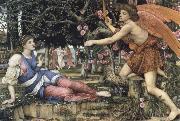 |
John Roddam Spencer Stanhope
|
|
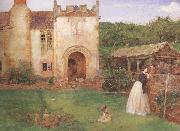
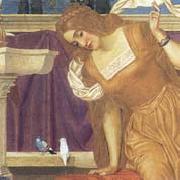
English Pre-Raphaelite Painter, 1829-1908,English painter. The second son of Yorkshire landed gentry, he was educated at Rugby and Christ Church, Oxford. In 1850 he studied in London with G. F. Watts, through whom he entered the artistic circle at Little Holland House, where he met D. G. Rossetti and Edward Burne-Jones. In 1857 Rossetti invited him to paint at the Oxford Union (Sir Gawaine and the Damsels at the Fountain), and in 1858 Stanhope occupied a studio next to Rossetti's at Chatham Place, Blackfriars (London), where he painted Thoughts of the Past (London, Tate); a modern-life subject indebted to Rossetti, it shows a prostitute recalling her former life. Stanhope's close friendship with Burne-Jones proved a more decisive influence on his work that, in the 1860s, consisted of dreamlike poetic and mythological subjects often set in quaint, enclosed spaces, as in I Have Trod the Winepress Alone |
|
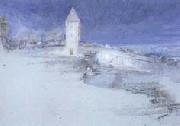 |
John Ruskin,HRWS
|
|
1819-1900
English academic and critic, who had an enormous influence not only on architectural style but on the ways in which standards of aesthetics were judged. He used an Evangelical and polemical tone in his writings that not only reached a mass audience but received the approval of the Ecclesiologists. Initially encouraged by J. C. Loudon, he contributed to some of Loudon's publications, but his key works date from the late 1840s and 1850s. The Gothic Revival was well established when Ruskin published The Seven Lamps of Architecture (1849), which was an immediate success, encapsulating the mood of the period rather than creating new ideas. He argued that architecture should be true, with no hidden structure, no veneers or finishes, and no carvings made by machines, and that Beauty in architecture was only possible if inspired by nature. As exemplars worthy of imitation (he argued that the styles known to Man were quite sufficient, and that no new style was necessary) he selected Pisan Romanesque, early Gothic of Western Italy, Venetian Gothic, and English early Second Pointed as his paradigms. In the choice of the last, the style of the late C13 and early C14, he was echoing A. W. N. Pugin's preferences as well as that of most ecclesiologically minded Gothic Revivalists such as G. G. Scott. The Stones of Venice (1851C3) helped to promote that phase of the Gothic Revival in which Continental (especially Venetian) Gothic predominated. Deane and Woodward's University Museum, Oxford (1854C60), is an example of Venetian or Ruskinian Gothic. In particular, structural polychromy, featuring colour in the material used, rather than applied, was popularized by Ruskin's writings. |
|
|
|
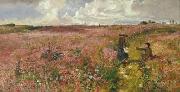 |
John Samuel Raven
|
|
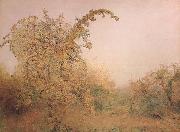
(1829-1877) was an English landscape painter.
Raven was born in Suffolk in 21 Aug. 1829. He was the son of the Rev. Thomas Raven, a clergyman of the Church of England, who had considerable talent as an amateur artist, as may be seen from six water-colour drawings by him in the South Kensington Museum.
John Raven was, however, almost entirely self-taught, initially by studying the works of John Crome and John Constable. He exhibited at the Academy as early as 1845, and his works also appeared at the British Institution. This part of his career was focused on views of the area where he lived, near St. Leonards[disambiguation needed]. He at first fell under the influence of the Norwich school, but his maturer works, which show much poetic feeling, bear traces of pre-Raphaelitism. It was his custom to prepare elaborate cartoons for his pictures. He was drowned while bathing at Harlech in 13 June 1877.
He married Margaret Sinclair Dunbar in 1869. |
|
|
|
 |
john scarlett davis
|
|
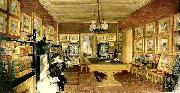
John Scarlett Davis (1 September 1804 - 29 September 1845), or Davies, was an English painter of the first half of the nineteenth century.
Davis was born in Leominster, the son of James Davis, a watchmaker; Scarlett was his mother's maiden name. At the age of eleven, Davis won an award from the local society for the encouragement of the arts. He was educated at the Royal Academy of Art School in London, and began exhibiting his works at the annual Royal Academy shows in 1825. He was influenced by the work of his contemporary, Richard Parkes Bonington.
Davis painted portraits, landscapes, and church interiors, and developed a distinctive specialty in painting the interiors of art galleries. His picture The Interior of the British Institution Gallery (1829) records a collection of Old Masters. His watercolor of the collection of Benjamin Godfrey Windus (1835) shows the Turner pictures on the walls. (John Ruskin studied those Turners while writing his Modern Painters.) Davis painted the interiors of the Louvre as well. Between 1842 and 1845 he was commissioned to draw copies of the paintings in the collections of the British royal palaces.
Davis painted scenes on the Continent during his travels there. He was in Florence in 1834, and Amsterdam in 1841. He painted the interior of the Uffizi Gallery.
Davis's later years were marred by alcoholism and spells of imprisonment. His posthumous reputation suffered as a result.
Davis's name is almost identical to that of John Scarlett-Davies, a modern video artist and director. |
|
 |
John sell cotman
|
|
English Romantic Painter, 1782-1842
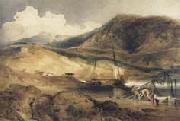
English painter and etcher. Cotman was born in the parish of St Mary Coslany, Norwich, the son of Edmund Cotman, a hairdresser, later a haberdasher, and Ann Sell. In 1793 he entered Norwich Grammar School as a 'freeplacer'. In 1798 he moved to London, where he worked as an assistant to the publisher Rudolph Ackermann. Following in the footsteps of Turner and Thomas Girtin he joined Dr Monro's 'Academy' in 1799 and became a member of the sketching society that had developed around the personality and talent of Girtin. |
|
 |
John Seymour Lucas
|
|
(21 December 1849 - 8 May 1923) was a Victorian English historical and portrait painter as well as an accomplished theatrical costume designer. He was born into an artistic London family, and originally trained as a woodcarver, but turned his attention to portrait painting and entered first the St. Martin's Lane Art School and later the Royal Academy Schools. Here he met his French wife, fellow artist Marie Cornelissen, whom he married in 1877. Lucase artistic education included extensive travels around Europe, particularly Holland and Spain, where he studied the Flemish and Spanish Masters. He first started exhibiting in 1872, was elected an associate member of the Royal Academy in 1876 and a full Royal Academician in 1898.
John Seymour Lucas was first and foremost a historical genre painter with a particular talent for realism in the depiction of costumes and interiors. Inspired by van Dyck and particularly Diego Velezquez, he excelled in depicting scenes from the English 16th to 18th century Tudor and Stuart periods, including in particular the Spanish Armada, Preparing for the Voyage, the English Civil War and the Jacobite rebellions.
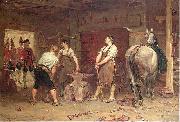
His first major work to achieve widespread public acclaim was Rebel Hunting after Culloden, executed in 1884. It was praised not only for the obvious tension between the muscular blacksmiths and the redcoated forces of law and order (or repression) but for the extraordinary realism in the depiction of the rough smithy and glowing horsehoe on the anvil. In 1885 his next major work whas "Preparing for the Voyage".
As his reputation grew, Lucas increasingly mixed in society circles, and became firm friends with the famous society portrait painter John Singer Sargent who was his almost exact contemporary. A portrait of Lucas executed by John Singer Sargent is displayed in Tate Britain. Towards the 1890s John Seymour Lucas executed a number of major works for prestigious public buildings or royal clients. These include: The Flight of the Five Members (Houses of Parliament), The Granting of the Charter of the City of London (Royal Exchange), Reception by HM King Edward VII of the Moorish Ambassador (Royal Collection), HRH the Prince of Wales in German Uniform (Royal Collection)
Apart from executing over 100 major oil paintings and a host of drawings, Lucas was renowned as a set and costume designer for the historical dramas popular on the late Victorian and early Edwardian stages. One of his more unusual commissions was the "Duke of Normandy" costume for the ill-fated prince Alfred of Saxe Coburg-Gotha for the Devonshire House Ball in 1897. Lucas was also a prolific watercolour painter and was elected a member of the Institute of Painters in Water Colours in 1877.
During most of his artistic career, John Seymour Lucas lived in a purpose-built studio in South Hampstead, London, designed for him by his friend and fellow artist, architect Sydney Williams-Lee.
He retired from painting towards the end of World War I, and moved to Blythburgh, Suffolk, where re-designed a house next to the church known as 'The Priory'. Lucas died in 1923 and is interred in Blythburgh church yard. His son, Sydney Seymour Lucas, was also an artist, and illustrator.
|
|
 |
John Shackleton
|
|
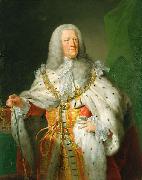
was a British painter and draughtsman who produced history paintings and portraits. His parents and origins are unknown.
Shackleton painted several surviving portraits, for example of Henry Pelham (National Portrait Gallery), William Windham (1717 - 1761; now at Felbrigg Hall, Norfolk), and of John Bristowe, steward to the first duke of Newcastle (now in the Reitlinger Museum of Fine Art, Maidenhead).
From 1749 he was Principal Painter in Ordinary to George II and George III. He continued to be paid for portraits of the king and queen up even during 1765 - 6, when their official portraits were being done by Allan Ramsay. Several examples of his and his studio's output of royal portraits survive - one of George II dated 1755 is in the Scottish National Portrait Gallery, Edinburgh; another of George II in Room 2 of the British Museum, London (commissioned by the museum in 1759 - the Museum also holds engravings after his paintings), along with two more of George II in the Royal Collection and others in Fishmongers' Hall, London, and Maidenhead Museum.
|
|
 |
John Sherrin
|
|
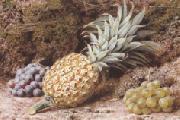
1819-1896
Pencil and watercolour heightened with bodycolour
12x16in
30.5x40.6cm
|
|
 |
John Singer Sargent
|
|
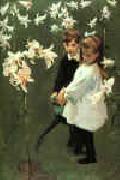
1856-1925
John Singer Sargent Locations
John Singer Sargent (January 12, 1856 ?C April 14, 1925) was the most successful portrait painter of his era. During his career, he created roughly 900 oil paintings and more than 2,000 watercolors, as well as countless sketches and charcoal drawings. His oeuvre documents worldwide travel, from Venice to the Tyrol, Corfu, the Middle East, Montana, Maine, and Florida.
Before Sargent??s birth, his father FitzWilliam was an eye surgeon at the Wills Hospital in Philadelphia. After his older sister died at the age of two, his mother Mary (n??e Singer) suffered a mental collapse and the couple decided to go abroad to recover. They remained nomadic ex-patriates for the rest of their lives. Though based in Paris, Sargent??s parents moved regularly with the seasons to the sea and the mountain resorts in France, Germany, Italy, and Switzerland. While she was pregnant, they stopped in Florence, Italy because of a cholera epidemic, and there Sargent was born in 1856. A year later, his sister Mary was born. After her birth FitzWilliam reluctantly resigned his post in Philadelphia and accepted his wife??s entreaties to remain abroad. They lived modestly on a small inheritance and savings, living an isolated life with their children and generally avoiding society and other Americans except for friends in the art world. Four more children were born abroad of whom two lived past childhood.
Though his father was a patient teacher of basic subjects, young Sargent was a rambunctious child, more interested in outdoor activities than his studies. As his father wrote home, ??He is quite a close observer of animated nature.?? Contrary to his father, his mother was quite convinced that traveling around Europe, visiting museums and churches, would give young Sargent a satisfactory education. Several attempts to give him formal schooling failed, owning mostly to their itinerant life. She was a fine amateur artist and his father was a skilled medical illustrator. Early on, she gave him sketchbooks and encouraged drawing excursions. Young Sargent worked with care on his drawings, and he enthusiastically copied images from the Illustrated London News of ships and made detailed sketches of landscapes. FitzWilliam had hoped that his son??s interest in ships and the sea might lead him toward a naval career.
At thirteen, his mother reported that John ??sketches quite nicely, & has a remarkably quick and correct eye. If we could afford to give him really good lessons, he would soon be quite a little artist.?? At age thirteen, he received some watercolor lessons from Carl Welsch, a German landscape painter. Though his education was far from complete, Sargent grew up to be a highly literate and cosmopolitan young man, accomplished in art, music, and literature. He was fluent in French, Italian, and German. At seventeen, Sargent was described as ??willful, curious, determined and strong?? (after his mother) yet shy, generous, and modest (after his father). He was well-acquainted with many of the great masters from first hand observation, as he wrote in 1874, ??I have learned in Venice to admire Tintoretto immensely and to consider him perhaps second only to Michael Angelo and Titian.?? |
|
 |
John Singleton Copley
|
|
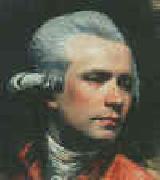
American Colonial Era Painter, 1738-1815
John Singleton Copley (1738[1] - 1815) was an American painter, born presumably in Boston, Massachusetts and a son of Richard and Mary Singleton Copley, both Irish. He is famous for his portrait paintings of important figures in colonial New England, depicting in particular middle-class subjects. His paintings were innovative in their tendency to depict artifacts relating to these individuals' lives. |
|
 |
John Skinner Prout
|
|
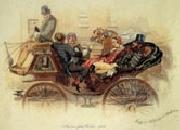
(1805-76), nephew of the famous English watercolourist Samuel Prout (1783-1852) |
|
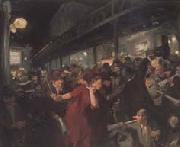 |
John sloan
|
|
American Ashcan School Painter, 1871-1951
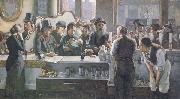
American painter and etcher, b. Lock Haven, Pa. He studied at the Pennsylvania Academy of the Fine Arts and worked for 12 years as an illustrator on the Philadelphia Inquirer and Philadelphia Press. In 1905 he went to New York City, where he worked as an illustrator. A member of the Eight, he was active in organizing the Society of Independent Artists and was its president from 1918. Long a popular teacher at the Art Students League of New York City, he was elected president in 1930. His scenes of city life and his nude studies are in leading museums throughout the United States. Characteristic are McSorley's Bar (Detroit Inst. of Arts); Renganeschi's, Saturday Night (Art Inst., Chicago); Wake of the Ferry (Phillips Memorial Gall., Washington, D.C.); and Nude with Nine Apples (Whitney Mus., New York City). |
|
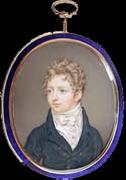 |
John Smart
|
|
English Rococo Era Miniaturist, ca.1741-1811,English miniature painter, was born in Norfolk; he became a pupil of Cosway, and is frequently alluded to in his correspondence.
This artist was director and vice-president of the Incorporated Society of Artists, and exhibited with that society. He went to India in 1788 and obtained a number of commissions in that country. He settled down in London in 1797 and there died. He married Edith Vere, and is believed to have had only one son, who died in Madras in 1809.
He was a man of simple habits, and a member of the Society of Sandemanians. Many of his pencil drawings still exist in the possession of the descendants of a great friend of his only sister. Several of his miniatures are in Australia and belong to a cadet branch of the family.
His work is entirely different from that of Cosway, quiet and grey in its colouring, with the flesh tints elaborated with much subtlety and modelled in exquisite fashion. He possessed a great knowledge of anatomy, and his portraits are drawn with greater anatomical accuracy and possess more distinction than those of any miniature painter of his time.
|
|
 |
John Smibert
|
|
1688-1751
John Smibert Gallery
John Smybert (or Smibert) (1688 - 1751), Scottish American artist, was born in Edinburgh and died in Boston, Massachusetts.
He studied under Sir James Thornhill, and in 1728 accompanied Bishop Berkeley to America, with the intention of becoming professor of fine arts in the college which Berkeley was planning to found in Bermuda. The college, however, was never established, and Smybert settled in Boston, where he married in 1730.
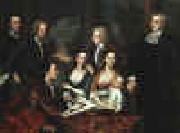
In 1731 he painted "Dean George Berkeley and His Family," also called "The Bermuda group", now in the Yale University Art Gallery, Yale University, a group of eight figures; it is maintained that the person furthest to the left is actually the artist himself. He painted portraits of Jonathan Edwards and Judge Edmund Quincy (in the Boston Art Museum), Mrs Smybert, Peter Faneuil and Governor John Endecott (in the Massachusetts Historical Society), John Lovell (Memorial Hall, Harvard University), and probably one of Sir William Pepperrell; and examples of his works are owned by Harvard and Yale Universities, by Bowdoin College, by the Massachusetts Historical Society, and by the New England Historical and Genealogical Society.
Portrait of Edmund Quincy, attributed to John Smybert
Plaque at Granary Burying Ground in Boston commemorating SmybertBetween 1740-42, he served as architect for the original Faneuil Hall, which he designed in the style of an English country market. The hall burned down in 1761 but was restored, and then in 1806 greatly expanded and modified by Charles Bulfinch.
His son Nathaniel was also a painter. Smybert lies in an unmarked grave in the Granary Burying Ground in Boston. |
|
 |
John Steuart Curry
|
|
American Regionalist Painter,
b.1897 d.1946
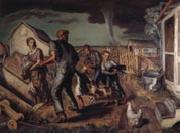
American painter and illustrator. As one of the 'Regionalist triumvirate', with Thomas Hart Benton and Grant Wood, he has been most often characterized as a faithful chronicler of rural life in Kansas. From 1916 to 1918 he was at the School of the Art Institute of Chicago. In 1919 he began study in the studio of Harvey Dunn (1884-1952) in Tenafly, NJ. After seven years as an illustrator in and around New York, he went to Paris in 1926 to study with the Russian Academician Vasily Shukhayev. Ironically, it was on Curry's return to the East Coast the following year that he began to earn his reputation as a Regionalist by painting memories of Kansas from his studio in the fashionable art colony of Westport, CT. Baptism in Kansas |
|
 |
John sturgess
|
|
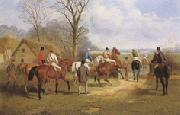
fl.1864-1903
was a hunting and racing artist and lithographer who worked mainly for the Illustrated London News between 1875 and 1885, and also exhibited widely in the London galleries, in particular at the Royal Society of British Artists and also at the Royal Hibernian Society in Dublin. He was known for being an accomplished illustrator of books and magazines, but is probably best remembered for his portrait of Blair Athol, the winner of the Derby in 1864. |
|
 |
John Thomas Serres
|
|
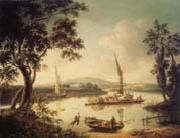
1759-1825 English painter, born in London in December 1759. He was the eldest son of Dominic (1722-93), a successful marine painter who was to be one of the founder members of the Royal Academy.Son of Dominic Serres. John Thomas Serres's colourful career began with landscape painting. He later travelled extensively, spending periods in Paris (1789), Rome and Naples (1790-91), before succeeding his father to the office of Marine Painter to George III in 1793. He worked promisingly as a painter (in both oils and watercolour) of sea-pieces in the European tradition, advanced in England by Phillipe Jacques de Loutherbourg. After becoming Marine Draughtsman to the Admiralty in 1800 he took on the less challenging employment of making drawings and elevations of the west coasts of France and Spain. This connection with the Navy was probably related to his appointment as drawing instructor at Chelsea Naval School, London. |
|
|
|
|
|
 |
Joris van Son
|
|
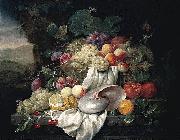
1623-1667) was a highly popular Flemish Baroque painter of fruit and flowers, in banquet style on a plank, but also in garland form.
He seems to have been influenced by Jan Davidszoon de Heem, since his subjects follow his style quite closely. According to Houbraken his paintings were prized for preserving summer plenty in the middle of winter. In a poem by Cornelis de Bie, it is written that his fruits would tempt a pregnant woman. His paintings hang in many european museums, and the Dutch RKD has over 70 known works by him on record. He signed his works JORIS VAN SON. His students were Frans van Everbroeck, Jan Pauwel Gillemans II, and Norbert Montalie. |
|
|
|
|
|
 |
Josef Schmitz
|
|
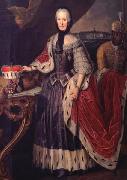
Johann Josef Schmitz (1784-)Aliases: Johan Joseph SchmitzProfessions: Landscape painter. |
|
|
|
|
|
|
|
 |
Joseph Karl Stieler
|
|
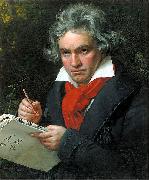
(1 November 1781 - 9 April 1858) was a German painter. Born in Mainz to a family of engravers and die-cutters, Stieler received some artistic training from his father, August Friedrich Stieler (1736 - 1789). Stieler began his career as a painter of miniatures.
His portrait style was most especially shaped during his work in the Parisian atelier of Francois Gerard, a student of Jacques-Louis David. In 1808, he established himself as an independent portraitist in Frankfurt am Main. He traveled through Italy in 1810. In 1816, he traveled to Vienna to paint the portrait of Emperor Francis I of Austria. Between February and April 1820, he worked on his portrait of Beethoven, which is probably the most well-known representation of the composer today.
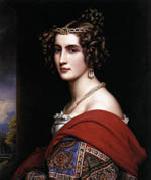
Stieler worked mainly in the service of the Bavarian court. His painted likenesses in Schloss Nymphenburg, Schönheitengalerie, the so-called Gallery of Beauties, were commissioned by King Ludwig I. Stieler also painted the portraits of Goethe, Amalia of Greece, Friedrich Wilhelm Joseph von Schelling, Johann Ludwig Tieck, and Alexander von Humboldt.
The most distinguishing feature of Stieler's portraits is his utter focus on the sitter. Decorative additions are left out, and there is nothing that distracts the viewer's scrutiny. Stieler accomplished this concentration through deliberate light - dark contrast, which above all highlights the accurately characterized facial features.
He died in Loytown.
|
|
 |
Joseph Severn
|
|
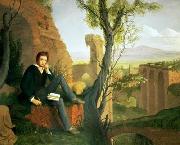
(7 December 1793 - 3 August 1879) was an English portrait and subject painter and a personal friend of the famous English poet John Keats. He exhibited portraits, Italian genre, literary and biblical subjects, and a selection of his paintings can today be found in some of the most important museums in London, including the National Portrait Gallery, the Victoria and Albert Museum and the Tate Britain.
The eldest son of a music teacher, Severn was born at Hoxton, near London, and apprenticed at the age of 14 to William Bond, an engraver. Severn was one of seven children; two of his brothers, Thomas (1801-1881) and Charles (1806-1894), became professional musicians, and Severn himself was an adroit pianist. During his early years he practised portraiture as a miniaturist.
|
|
 |
Joseph Siffred Duplessis
|
|
French Painter, 1725-1802
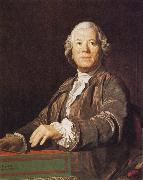
was a French painter, known for the clarity and immediacy of his portraits. He was born into a family with an artistic bent and received his first training from his father, a surgeon and talented amateur, then with Joseph-Gabriel Imbert (1666?C1749), who had been a pupil of Charles Le Brun. From 1744-47 or later he worked in Rome, in the atelier of Pierre Subleyras, who was also from the south of France, who died in 1749. In Italy Duplessis became fast friends with Joseph Vernet, another Occitan. He returned to Carpentras, spent a brief time in Lyon then arrived about 1752 in Paris, where he was accepted into the Academie de Saint-Luc and exhibited some portraits, which were now his specialty, in 1764, but did not achieve much notice until his exhibition of ten paintings at the Paris salon of 1769, very well received and selected for special notice by Denis Diderot; the Academie de peinture et de sculpture accepted him in the category of portraitist, considered a lesser category at the time. He continued to exhibit at the Paris salons, both finished paintings and sketches, until 1791, and once more, in 1801. His portrait of the Dauphine in 1771 and his appointment as a peintre du Roi assured his success: most of his surviving portraits date from the 1770s and 1780s. He received privileged lodgings in the Galeries du Louvre. In the Revolution, he withdrew to safe obscurity at Carpentras during the Reign of terror. Afterwards, from 1796, he served as curator at the newly-founded museum formed at Versaillles, so recently emptied of its furnishings at the Revolutionary sales. His uncompromising self-portrait at this time of his life is at Versailles. His adjusted his style to the social condition of his sitter: his portrait of Charles-Claude, comte d'Angiviller, director of the Batiments du Roi, is as distant and conventional as his state portrait of Louis XVI in coronation robes (1776), while his realistic and intimate portrait of the opera composer Christoph Willibald Gluck (Kunsthistorisches Museum, Vienna) catches the composer at the keyboard in a moment of inspiration and his penetrating portrait of the sculptor Christophe Gabriel Allegrain (Louvre Museum, illustration) shows him having just laid down his chisel: this was the morceau de reception that gained him admittance to the Academie. Duplessis' Benjamin Franklin on the U.S. hundred dollar billHis portrait of Benjamin Franklin (1778), |
|
 |
Joseph Stella
|
|
1877-1946
Joseph Stella Gallery
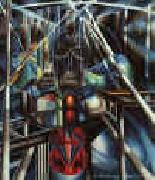
Joseph Stella (June 13, 1877 - November 5, 1946) was an Italian-born, American Futurist painter best known for his depictions of industrial America. He is associated with the American Precisionism movement of the 1910s-1940s. He was born in Muro Lucano, Italy but came to New York City in 1896. He studied at the Art Students League of New York under William Merritt Chase. His first paintings are Rembrandtesque depictions of city slum life. In 1908, he was commissioned for a series on industrial Pittsburgh later published in The Pittsburgh Survey.
It was his return to Europe in 1909, and his first contact with modernism, that would truly mold his distinctive personal style.
Returning to New York in 1913, he painted Battle of Lights, Mardi Gras, Coney Island, which is one of the earliest American Futurist works. He is famous for New York Interpreted, a five-paneled work patterned after a religious altarpiece, but depicting bridges and skyscrapers instead of saints. This piece reflects the belief, common at the time, that industry was displacing religion as the center of modern life. It is currently owned by the Newark Museum.
A famous Stella quote is: "I have seen the future and it is good. We will wipe away the religions of old and start anew." |
|
 |
Joseph Stieler
|
|
German Painter, 1781-1858,German painter. In 1798 he studied under Christoph Fesel (1737-1805) in Werzburg and in 1800 with Heinrich Feger in Vienna, where his style was strongly influenced by English portraiture. After he studied in Paris (1807-8) with Fran?ois G?rard the influence of Neo-classicism became apparent in his work. He visited Italy in 1809, 1810 and 1812 to do commissioned portraits for various patrons, among them Prince Eugene de Beauharnais (1809; Munich, Bayer. Nmus.) and Joachim Murat, King of Naples (reg 1808-15). In 1812 he went to Munich where he did work for middle-class clients, the nobility and the royal family of Bavaria (e.g. the portrait of Maximilian I Joseph, 1816; Ellingen, Schloss). In 1820 he was appointed court painter to Ludwig I, King of Bavaria (reg 1825-48), and painted several portraits of him. In 1823 he helped co-found the Kunstverein in Munich. He was one of the most important portrait painters in the Neo-classical style, specializing particularly in studies of women, as seen in the 36 portraits commissioned by Ludwig I for the Schenheitsgalerie (1827-42; Munich, Schloss Nymphenburg). In his portraits for the middle classes and for the court he devised certain peculiarities of form. He painted various members of the royal houses of Austria, Prussia and Sweden, as well as members of the nobility in the duchies of Saxe-Altenberg, Saxe-Coburg and Hesse. His sitters also included some of the most important figures in the political and intellectual life of Germany in the first half of the 19th century. He painted the pendant portraits of Franz Brentano and Antonie Brentano (both 1808; Winkel, Brentanohaus), Johann Wolfgang von Goethe (1828; Munich, Neue Pin.) and Ludwig Tieck (1838; Berlin, Schloss Charlottenburg), the geographer and botanist Alexander von Humboldt (1843; Potsdam, Schloss Charlottenhof) and the musician Ludwig van Beethoven (Bonn, Beethoven-Haus). After 1845 the classical elements in his paintings were sometimes combined with an application of colour typical of plein-air studies. He also painted genre pictures and religious scenes. |
|
|