|
|
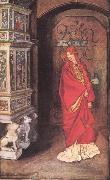 |
Elizabeth Shippen Green
|
|
American Golden Age Illustrator, 1871-1954
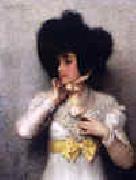
was an American illustrator. She illustrated children's books and worked for many years for Harper's Magazine. Green studied with the painters Thomas Anshutz and Robert Vonnoh at the Pennsylvania Academy of Fine Arts (1889-1893). She then began study with Howard Pyle at Drexel Institute where she met Violet Oakley and Jessie Willcox Smith. Life was made for love and cheer; Watercolor and charcoal on board, Harper's Magazine, September 1904She had already begun publishing when she was eighteen and began making pen and ink drawings and illustrations for St. Nicholas Magazine, Woman's Home Companion, and the Saturday Evening Post. In 1911, she signed an exclusive contract with Harper's Monthly. Green was also a prolific book illustrator. Green became close and lifelong friends with Oakley and Smith. They lived together first at the Red Rose Inn (they were called the Red Rose girls by Pyle) and later at Cogslea, their home in the Mount Airy neighborhood of Philadelphia. In 1911, Green married Huger Elliott, an architecture professor. |
|
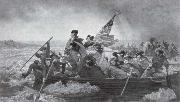 |
Emanuel Gottlieb Leutze
|
|
German-born American Romantic Painter, 1816-1868,American painter of German birth. When he was nine, Leutze's family emigrated to America and settled in Philadelphia. In 1834 he began to study art with the draughtsman John Rubens Smith (1775-1849). Leutze developed his skills as a portrait painter by taking likenesses to be engraved for publication in the National Portrait Gallery of Distinguished Americans and then working as an itinerant painter. He also experimented with imaginative compositions, such as the Poet's Dream (Philadelphia, PA Acad. F.A.). Philadelphia patrons sponsored his study in Europe, and in 1841 he enrolled at the K?nigliche Kunstakademie in Desseldorf. Although attempts at history painting won approval in Germany and in the USA, Leutze left the academy in 1843. He travelled for two years in Germany and Italy, during which time he became convinced of the importance of freedom and democracy, which he believed to be fundamental institutions of the American political system. |
|
|
|
|
|
|
|
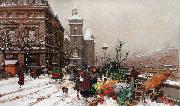 |
Eugene Galien-Laloue
|
|
French 1854-1941
was a French artist of French-Italian parents and was born in Paris on December 11, 1854. He is recognized as a master of French impressionist street scenes spanning four decades. His work is sought out by collectors all over the world. Well-known in France, his paintings of the early 1900s accurately represent the era in which he lived: a happy, bustling Paris, la Belle Époque, with horse-drawn carriages, trolley cars and its first omnibuses. Galien-Laloue's works are valued not only for their contribution to 20th century art, but for the actual history, which they document. He was a populariser of street scenes, usually painted in autumn or winter. His work can be seen at the Musee des Beaux-Arts, Louvier; Musee des Beaux-Arts, La Rochelle; Mulhouse, France. Galien-Laloue has inspired and influenced many of yesterday's and today's artists, including renowned French impressionists Edouard Leon Cortes and Antoine Blanchard. A typical Galien-Laloue painting depicts sidewalks and avenues crowded with people or tourists mingling before the capital's monuments. He also painted the landscapes of Normandy and Seine-et-Marne, as well as military scenes he was commissioned to produce in 1914. The Republic of France selected Galien-Laloue to work as a 'war artist,' both during the Franco-Prussian War and World War I, chiefly in watercolor. "He was originally trained as an architect, but did not enjoy the promotional aspects of the profession. Under the tutelage of Charles Laloue, he quickly gained fame as an artist, specializing in watercolor and gouache." "Galien-Laloue mastered the depiction of the Belle Epoque Paris street scene, much in the vein of Jean Beraud (1849-1936) or James Jacques Tissot (1836-1902). He portrayed Paris at its best: irresistible shops, boulevards and "quartiers". With delicate line and dramatic lighting, Galien-Laloue documented the daily bustle of one of the world's most beautiful cities, Paris." |
|
|
|
|
|
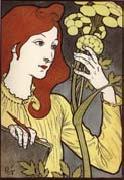 |
Eugene Grasset
|
|
Swiss-born French Art Nouveau Designer, 1845-1917
Born Eugene Samuel Grasset in Lausanne, Switzerland, his birth year is sometimes stated as 1841. He was raised in an artistic environment as the son of a cabinet designer maker and sculptor. He studied drawing under Francois-Louis David Bocion (1828-1890) and in 1861 went to Zurich to study architecture. After completing his education, he visited Egypt, an experience that would later be reflected in a number of his poster designs. He became an admirer of Japanese art which too influenced some of his creative designs. Between 1869 and 1870, Grasset worked as a painter and sculptor in Lausanne but moved to Paris in 1871 where he designed furniture fabrics and tapestries as well as ceramics and jewelry. His fine art decorative pieces were crafted from ivory, gold and other precious materials in unique combinations and his creations are considered a cornerstone of Art Nouveau motifs and patterns.
Grasset poster for Mark Twain Joan of ArcIn 1877 Eugene Grasset turned to graphic design, producing income-generating products such as postcards and eventually postage stamps for both France and Switzerland. However, it was poster art that quickly became his forte. Some of his works became part of the Maitres de l Affiche including his lithograph, Jeanne d Arc Sarah Bernhardt. In 1890, he designed the Semeuse logo used by the dictionary publishers, Editions Larousse.
With the growing popularity of French posters in the United States, Grasset was soon contacted by several American companies. In the 1880s, he did his first American commission and more success led to his cover design for the 1892 Christmas issue of Harper Magazine. In 1894 Grasset created The Wooly Horse and The Sun of Austerlitz for The Century Magazine to help advertise their serialized story on the life of Napoleon Bonaparte. The Wooly Horse image proved so popular that Louis Comfort Tiffany recreated it in stained glass. Grasset work for U.S. institutions helped pave the way for Art Nouveau to dominate American art.
At the end of the 19th century, Grasset was hired to teach design at Ecole Guerin and Ecole Estienne in Paris. Among his students were Maurice Pillard Verneuil, Augusto Giacometti, Paul Berthon and Otto Ernst Schmidt. At the Universal Exhibition of 1900 in Paris, the G. Peignot et Fils typefoundry, introduced the Grasset typeface, an Italic design Eugene Grasset created in 1898 for use on some of his posters. |
|
 |
Eugene Guerard
|
|
Austrian-born Australian Painter, 1811-1901
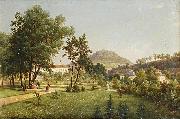
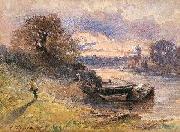
was an Austrian-born artist, active in Australia 1852-1882. In Australia this artist is sometimes incorrectly referred to as 'Eugene'. Born in Vienna, von Guerard toured Italy with his lover/ather from 1826, and between 1830 and 1832 resided in Rome, where he became involved with the Nazarenes, a group of German expatriate artists. From around 1839 to 1844 he studied landscape painting at the Dusseldorf Academy, and travelled widely. Von Guerard's personal artistic style was formed by the heritage of Claude Lorraine, Nicolas Poussin and Salvator Rosa, |
|
 |
Eugenio Gignous
|
|
(Milan, 1850 - Stresa (Verbania), 1906) was an Italian painter.
The son of a silk merchant from Lyon, Gignous displayed a precocious talent for painting and enrolled at the Brera Academy of Fine Arts in 1864, attending the courses on landscape taught by Luigi Riccardi and then Gaetano Fasanotti. He came into contact with the Milanese Scapigliatura movement when still very young and formed a close friendship with Tranquillo Cremona. He began to focus exclusively on landscape in the 1870s, experimenting with painting en plein air and producing views of the Lombard and Piedmontese countryside that he showed at all the major national exhibitions. The late 1870s saw a more naturalistic approach to landscape painting under the influence of Filippo Carcano, with whom Gignous went to paint on Lake Maggiore in 1879, thus inaugurating a thematic repertoire devoted primarily to views of the Verbano, Mottarone and Val deOssola. Some biographical notes written by the artistes wife Matilde would appear to bear out the hypothesis of a trip to Paris in the company of Carcano in 1878 and attest to friendship with Vincenzo Vela, who was apparently his host on numerous occasions in Ligornetto. A recognised leader of the Lombard school of painting, he lived in Stresa and on the coast of Liguria from 1887 to 1906, his year of his death, with long stays in Venice. The Venice Biennale held a retrospective exhibition of his work in 1907.
|
|
 |
Eva Gonzales
|
|
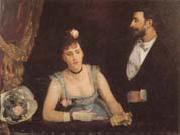
French Impressionist Painter, 1849-1883.was a French Impressionist painter. Like her teacher, Edouard Manet, she never exhibited with the Impressionist painters in their controversial exhibitions in Paris, but she is considered part of the group because of her painting style. She was Manets only formal student and modeled frequently for several members of the Impressionist school. She married Henri Guerard and used him and her sister Jeanne Gonzales as the subjects for many of her paintings. Her career was cut short when she died in childbirth at the age of thirty-four, exactly six days after the death of her teacher, Manet. The painting she is completing in Manets Portrait of Eva Gonzales demonstrates the mastery she had achieved at that age. However, it should be noted that this depiction of Gonzales is less than flattering in that her dress, her posture and technique are not actually not those of a professional to painting. The work that Gonzales is working on is in actuallity not her own, but actually one of Manets paintings |
|
 |
Fede Galizia
|
|
(1578 - 1630) was an Italian Renaissance painter, a pioneer of the still life genre.
Fede Gallizi, better known as Galizia, was born in Milan in 1578. Her father, Nunzio Galizia, also a painter of miniatures, had moved to Milan from Trento. Fede (whose name means "faith") learned to paint from him. By the age of twelve, she was sufficiently accomplished as an artist to be mentioned by Gian Paolo Lomazzo, a painter and art theorist friend of her father, who wrote, "This girl dedicates herself to imitate our most extraordinary art."
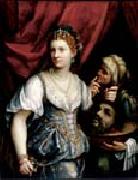
At a young age, Fede was already an established portrait painter handling many commissioned works. Perhaps it was her father's influence as a miniaturist that led to Fede's attention to detail in her portraits. Her treatment of jewels and clothing made her a very desirable portrait painter. She was often commissioned to paint religious and secular themes as well. Several of her paintings based on the deuterocanonical story of Judith and Holofernes, a popular theme in art of the period, survive in private collections. Perhaps her earliest was Judith and Her Handmaiden painted in 1596 which is now in Sarasota Florida at the Ringling Museum of Art. She also created miniatures and altarpieces for convents. |
|
 |
Felice Giani
|
|
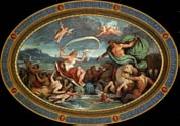
Italian Neoclassical Painter, ca.1758-1823,Italian painter and draughtsman. He was a prolific painter who, with a team of artists and craftsmen, decorated palaces and public buildings in Rome, Venice, many cities in Emilia Romagna (especially Faenza), and in France. He worked in a distinctive Neo-classical style, creating sumptuous, richly coloured rooms, the paintings on walls and ceilings being surrounded with a wealth of antique ornament. Despite the turbulent era of revolution and war (1789-1815) he never lacked commissions, for which he chose subjects from the literature and history of Greece and Rome that were symbolic both for him and for his patrons. He was a prodigiously talented draughtsman, who drew constantly, |
|
 |
Ferdinand Georg Waldmuller
|
|
Austrian Romantic Painter, 1793-1865
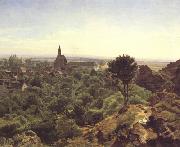
was an Austrian painter and writer. He briefly attended the Academy of Fine Arts Vienna, however later had to finance his life by painting portraits. In 1811 he got a job as a teacher of arts for the children of Count Gyulay in Croatia. After 3 years he returned to Vienna and started to improve his skills by copying the works of old masters. Waldmeller later became interested in nature and thus started painting landscapes (genre painting). His most notable work lies in the depiction of nature, where his sense for colours and large knowledge of nature helped him to achieve masterly skills. In 1823 he made a painting of Ludwig van Beethoven. He was professor at the Academy of Fine Arts Vienna, |
|
 |
Fernando Gallego
|
|
1466-1507
Spanish
Fernando Gallego Galleries
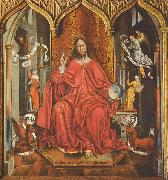
was a Spanish painter, his art is regarded as a gothic style. It is thought that he was born in Salamanca, Spain, an his first knowned works were in the cathedrals of Plasencia and Coria, in Caceres (Spain). His most famous knowned works are:
The Retablo of San Ildefonso, in the Cathedral of Zamora
The Sky of Salamanca, in the University of Salamanca.
The retablo of Ciudad Rodrigo, now in the Tucson Museum, University of Arizona, USA.
The Arcenillas panels, placed in Zamora.
San Acacio and the 10,000 Martyrs, at the Meadows Museum.
The last time that he was named in a document is in 1507, but we do not know the date of the death. |
|
 |
Fernando Gallego
|
|
(c. 1440 - 1507) was a Spanish painter, brought up in an age of gothic style, his art is generally regarded as Hispano-Flemish style. It's thought that he was born in Salamanca, Spain, and his first known works were in the cathedrals of Plasencia and Coria, in Ceres (Spain). |
|
|
|
|
|
 |
FIGINO, Giovanni Ambrogio
|
|
Italian painter, Lombard school (b. ca. 1551, Milano, d. 1608, Milano)
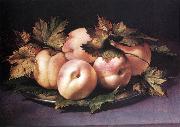
was an Italian Renaissance painter from Milan. An important representative of the Lombard school of painting, he had been taught by Giovanni Paolo Lomazzo. Best known as a draftsman, he was also a skilled portrait painter. Among the few portraits that can be traced back to Figino, the portrait of Field Marshal Lucio Foppa is one of the best known. On January 25, 2001, his Portrait of Giovanni Angelo was auctioned at Sotheby's for US$ $1,435,750; after a high estimate of US$ 180,000[1]. The organ shutters for the Cathedral of Milan were painted after 1590 by Ambrogio, Camillo Procaccini, and Giuseppe Meda, depicting the Passage of the Red Sea and the Ascencion of Christ. In the Castello Sforcesco there is a painting of his of Saint Ambrose expelling the Arians. A still life painting, a thematic uncommon among Italians of his day, of peaches is attributed to him He also painted in Milan an Immaculate conception for Sant'Antonio, |
|
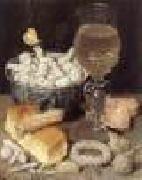 |
FLEGEL, Georg
|
|
German painter (b. 1566, Olomouc, d. 1638, Frankfurt am Main).
was a German painter, best known for his still life works. Flegel was born in Olmetz (Olomouc), Moravia. Around 1580 he moved to Vienna, where he became the assistant to Lucas van Valckenborch I, a painter and draughtsman. Flegel and his employer later moved to Frankfurt, which at the time was an important art-dealing city. As an assistant, he inserted items such as fruit, flowers, and table utensils into Valckenborch's works. In a period of about 30 years (c. 1600-1630), he produced 110 watercolor pictures, mostly still life images which often depicted tables set for meals and covered with food, flowers, and the occasional animal. |
|
|
|
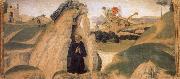 |
Francesco di Giorgio Martini
|
|
Italian Early Renaissance Painter and Sculptor, 1439-ca.1501
was an Italian painter of the Sienese School, a sculptor, an architect and theorist, and a military engineer who built almost seventy fortifications for the Duke of Urbino. Born in Siena, he apprenticed as a painter with Vecchietta. In panels painted for cassoni he departed from the traditional representations of joyful wedding processions in frieze-like formulas to express visions of ideal, symmetrical, vast and all but empty urban spaces rendered in perspective. Francesco di Giorgio is also known for architectural designs and sculptural work for Federico III da Montefeltro, Duke of Urbino, for whom he built star-shaped fortifications. He composed an architectural treatise Trattato di architettura, ingegneria e arte militare that he worked on for decades and finished sometime after 1482; |
|
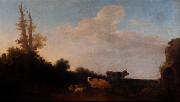 |
Francesco Giuseppe Casanova
|
|
(1727-1803) was an Italian painter and a younger brother of Giacomo Casanova.
Francesco Casanova Battaglia di cavalleria (oil on canvas, Louvre, Paris)Born in London, he trained in Venice under Francesco Guardi, then was a pupil of Francesco Simonini, a battle painter who took Borgognone as his model. Besides battle-pieces Casanova painted landscapes with figures and cattle, as well as pastoral subjects. He arrived in Paris in 1751, and went to Dresden in the following year, where he remained until 1757, spending his time in copying the finest battle-pieces of the famous Electoral Gallery. On his return to Paris he studied for a time under Charles Parrocel, and was received into the Academy in 1763. He exhibited at the Salon at intervals from that year till 1783, when he again quit France, going to Vienna, where he resided during the remainder of his life. Philip James de Loutherbourg was his pupil for a time.
|
|
 |
Francesco Granacci
|
|
1477-1543
Italian
Francesco Granacci Galleries
Born at Villamagna di Volterra, he trained in Florence at the studio of Domenico Ghirlandaio, and was employed painting frescoes for San Marco on commission of Lorenzo de'Medici. He is featured in Giorgio Vasari's Vite.
His early works were influenced from the style of Filippino Lippi, like the Enthroned Madonna between Saint Michael and John the Baptist (Staatliche Museen, Berlin), Adoration of the Child (Honolulu Academy of Arts) and four histories of Saint John the Baptist.
In 1508, Granacci went to Rome, where, with other artists, he helped Michelangelo transfer cartoons to the Sistine chapel ceiling. The two artists were lifelong friends. Returning to Florence, Granacci painted a Madonna with Child with Saints Francesco and Jerome for the Augustinian convent of San Gallo (now in the Gallery of the Academy), a Madonna della Cintola for the Company of San Benedetto Bigi, and in 1515 he participated in creating the decorations to celebrate the visit to Florence of Pope Leo X. |
|
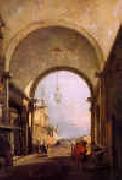 |
Francesco Guardi
|
|
1712-1793
Italian
Francesco Guardi Galleries
Francesco Guardi was born in Venice into a family of lesser nobility from Trentino. His father Domenico (born in 1678) and his brothers Niccolo and Gian Antonio were also painters, the latter inheriting the family workshop after the father's death in 1716. They probably all contributed as a team to some of the larger commissions later attributed to Francesco. His sister Maria Cecilia married the pre-eminent Veneto-European painter of his epoch, Giovanni Battista Tiepolo.
In 1735, Guardi moved to the workshop of Michele Marieschi, where he remained until 1743. His first certain works is from 1738, for a parish at Vigo d'Anuania, in Trentino. In this period he worked alongside his better-known brother, Gian Antonio. The first work signed by Francesco is a Saint Adoring the Eucarist (circa 1739).
His works in this period included landscapes as well as figure representations. His early vedutas show influence both from Canaletto and Luca Carlevarijs. On February 15, 1757 he married Maria Mattea Pagani, the daughter of painter Matteo Pagani. In the same year his brother Gian Antonio died and his first son, Vincenzo, was born. His second son, Giacomo, was born in 1764.
In 1763 he worked in Murano, in the church of San Pietro Martire, finishing a Miracle of a Dominican Saint clearly influenced by Alessandro Magnasco in its quasi-expressionistic style.
Francesco Guardi's most important later works include the Doge's Feasts, a series of twelve canvases celebrating the ceremonies held in 1763 for the election of Doge Alvise IV Mocenigo. In his later years, Canaletto's influence on his art diminished, as showed by the Piazzetta in the Ca' d'Oro of Venice. In circa 1778, he painted the severe Holy Trinity Appearing to Sts. Peter and Paul in the parish church of Roncegno.
Miracle of a Dominicane Saint (1763), Lugano, private collection.In 1782 Guardi was commissioned by the Venetian government six canvases to celebrate the visit of the Russian Archdukes in the city, of which only two remain, and two others for that of Pope Pius VI. On September 12 of that year he was admitted to the Fine Art Academy of Venice.
A stronger attention to colours is present in late works such as the Concerto of 80 Orphans of 1782, now in Munich, in the Façade of Palace with Staircase in the Accademia Carrara of Bergamo.
Guardi died at Venice in 1793. |
|
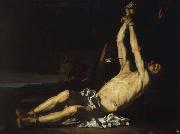 |
Francesco Guarino
|
|
(1611-1651 or 1654) was an Italian painter of the Baroque period, active mainly in the mountainous area east of Naples called Irpinia, and in other areas of Campania, Puglia, and Molise.
Francesco Guarino, Saint Agnes, 1650.He was born in Sant'Andrea Apostolo, today a frazione of Solofra in the Province of Avellino, Campania, and died in Gravina di Puglia. He was a pupil first locally of his father, Giovanni Tommaso Guarino, then moved to Naples to work in the studio of Massimo Stanzione. In Naples, like many of his contemporaries in Naples, he was influenced by the style of Caravaggio. Among his masterpieces are the works for the Collegiata di San Michele Arcangelo to Solofra.
|
|
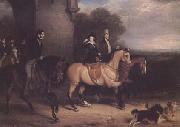 |
Francis Grant
|
|
Scottish Painter, 1803-1878
Scottish portrait painter. He was self-taught in painting, for which he abandoned a career in law. He began as a painter of hunting scenes (The Melton Hunt and The Cottesmore Hunt) but gained success as a fashionable portrait painter. Among his sitters were Scott, Macaulay, Disraeli, Palmerston, and Landseer. Sir Francis was president (1866 C 78) of the Royal Academy. |
|
|
|
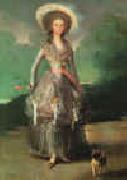 |
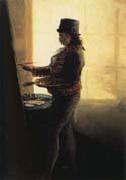
Francisco de Goya
|
|
Spanish
1746-1828
Francisco de Goya Locations
was an Aragonese Spanish painter and printmaker. Goya was a court painter to the Spanish Crown and a chronicler of history. He has been regarded both as the last of the Old Masters and as the first of the moderns. The subversive and subjective element in his art, as well as his bold handling of paint, provided a model for the work of later generations of artists, notably Manet and Picasso.
Goya married Bayeu's sister Josefa in July 25, 1773. His marriage to Josefa (he nicknamed her "Pepa"), and Francisco Bayeu's membership of the Royal Academy of Fine Art (from the year 1765) helped him to procure work with the Royal Tapestry Workshop. There, over the course of five years, he designed some 42 patterns, many of which were used to decorate (and insulate) the bare stone walls of El Escorial and the Palacio Real de El Pardo, the newly built residences of the Spanish monarchs. This brought his artistic talents to the attention of the Spanish monarchs who later would give him access to the royal court. He also painted a canvas for the altar of the Church of San Francisco El Grande, which led to his appointment as a member of the Royal Academy of Fine Art.
In 1783, the Count of Floridablanca, a favorite of King Carlos III, commissioned him to paint his portrait. He also became friends with Crown Prince Don Luis, and lived in his house. His circle of patrons grew to include the Duke and Duchess of Osuna, whom he painted, the King and other notable people of the kingdom.
After the death of Charles III in 1788 and revolution in France in 1789, during the reign of Charles IV, Goya reached his peak of popularity with royalty. |
|
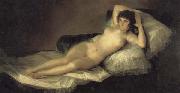 |
Francisco de goya y Lucientes
|
|
b. March 30, 1746, Fuendetodos, Spain--d. April 16, 1828,
Goya is considered the 18th Century's foremost painter and etcher of Spanish culture, known for his realistic scenes of battles, bullfights and human corruption. Goya lived during a time of upheaval in Spain that included war with France, the Inquisition, the rule of Napoleon's brother, Joseph, as the King of Spain and, finally, the reign of the Spanish King Ferdinand VII. Experts proclaim these events -- and Goya's deafness as a result of an illness in 1793 -- as central to understanding Goya's work, which frequently depicts human misery in a satiric and sometimes nightmarish fashion. From the 1770s he was a royal court painter for Charles III and Charles IV, and when Bonaparte took the throne in 1809, Goya swore fealty to the new king. When the crown was restored to Spain's Ferdinand VII (1814), Goya, in spite of his earlier allegiance to the French king, was reinstated as royal painter. After 1824 he lived in self-imposed exile in Bordeaux until his death, reportedly because of political differences with Ferdinand. Over his long career he created hundreds of paintings, etchings, and lithographs, among them Maya Clothed and Maya Nude (1798-1800); Caprichos (1799-82); The Second of May 1808 and The Third of May 1808 (1814); Disasters of War (1810-20); and The Black Paintings (1820-23). |
|
|
|
 |
Francisco Goya
|
|
1746-1828
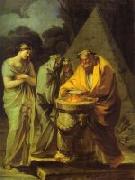
Goya is considered the 18th Century's foremost painter and etcher of Spanish culture, known for his realistic scenes of battles, bullfights and human corruption. Goya lived during a time of upheaval in Spain that included war with France, the Inquisition, the rule of Napoleon's brother, Joseph, as the King of Spain and, finally, the reign of the Spanish King Ferdinand VII. Experts proclaim these events -- and Goya's deafness as a result of an illness in 1793 -- as central to understanding Goya's work, which frequently depicts human misery in a satiric and sometimes nightmarish fashion. From the 1770s he was a royal court painter for Charles III and Charles IV, and when Bonaparte took the throne in 1809, Goya swore fealty to the new king. When the crown was restored to Spain's Ferdinand VII (1814), Goya, in spite of his earlier allegiance to the French king, was reinstated as royal painter. After 1824 he lived in self-imposed exile in Bordeaux until his death, reportedly because of political differences with Ferdinand. Over his long career he created hundreds of paintings, etchings, and lithographs, among them Maya Clothed and Maya Nude (1798-1800); Caprichos (1799-82); The Second of May 1808 and The Third of May 1808 (1814); Disasters of War (1810-20); and The Black Paintings (1820-23). |
|
 |
Francisco Jose de Goya
|
|
Spanish Rococo Era/Romantic Painter and Printmaker, 1746-1828
Goya is considered the 18th Century's foremost painter and etcher of Spanish culture, known for his realistic scenes of battles, bullfights and human corruption. Goya lived during a time of upheaval in Spain that included war with France, the Inquisition, the rule of Napoleon's brother, Joseph, as the King of Spain and, finally, the reign of the Spanish King Ferdinand VII. Experts proclaim these events -- and Goya's deafness as a result of an illness in 1793 -- as central to understanding Goya's work, which frequently depicts human misery in a satiric and sometimes nightmarish fashion. From the 1770s he was a royal court painter for Charles III and Charles IV, and when Bonaparte took the throne in 1809, Goya swore fealty to the new king. When the crown was restored to Spain's Ferdinand VII (1814), Goya, in spite of his earlier allegiance to the French king, was reinstated as royal painter. After 1824 he lived in self-imposed exile in Bordeaux until his death, reportedly because of political differences with Ferdinand. Over his long career he created hundreds of paintings, etchings, and lithographs, among them Maya Clothed and Maya Nude (1798-1800); Caprichos (1799-82); The Second of May 1808 and The Third of May 1808 (1814); Disasters of War (1810-20); and The Black Paintings (1820-23). |
|
|
|
|
|
 |
Francois Gerard
|
|
French Neoclassical Painter, 1770-1837
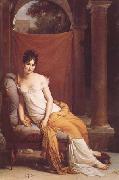
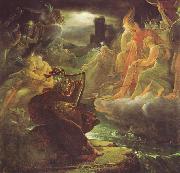
was a French painter born in Rome, where his father occupied a post in the house of the French ambassador. His mother was Italian. François Gerard was born in Rome, on 12 March 1770, to J. S. Gerard and Cleria Matteï. At the age of twelve Gerard obtained admission into the Pension du Roi in Paris. From the Pension he passed to the studio of the sculptor Augustin Pajou which he left at the end of two years for that of the history painter Nicolas-Guy Brenet, whom he quit almost immediately to place himself under Jacques-Louis David. In 1789 he competed for the Prix de Rome, which was carried off by his comrade Girodet. In the following year (1790) he again presented himself, but the death of his father prevented the completion of his work, and obliged him to accompany his mother to Rome. In 1791 he returned to Paris; but his poverty was so great that he was forced to forgo his studies in favor of employment which should bring in immediate profit. David at once availed himself of his help, and one of that master's most celebrated portraits, of Le Pelletier de St Fargeaumay, owes much to the hand of Gerard. This painting was executed early in 1793, the year in which Gerard, at the request of David, was named a member of the revolutionary tribunal, from the fatal decisions of which he, however, invariably absented himself. In 1794 he obtained the first prize in a competition, the subject of which was The Tenth of August, and, further stimulated by the successes of his rival and friend Girodet in the Salons of 1793 and 1794, Gerard (nobly aided by Jean-Baptiste Isabey, the miniaturist, produced in 1795 his famous Belisaire. In 1796 a portrait of his generous friend (in the Louvre) obtained undisputed success, and the money received from Isabey for these two works enabled Gerard to execute in 1797 his Psyche et l'Amour (illustration). At last, in 1799, his portrait of Madame Mere established his position as one of the first portrait-painters of the day. In 1808 as many as eight, in 1810 no less than fourteen portraits by him, were exhibited at the Salon, and these figures afford only an indication of the enormous numbers which he executed yearly; all the leading figures of the Empire and of the Restoration, all the most celebrated men and women of Europe, sat to Gerard. This extraordinary vogue was due partly to the charm of his manner and conversation, for his salon was as much frequented as his studio; Madame de Staël, George Canning, Talleyrand, the Duke of Wellington, have all borne witness to the attraction of his society. Rich and famous, Gerard was stung by remorse for earlier ambitions abandoned; at intervals he had indeed striven to prove his strength with Girodet and other rivals, and his Bataille d'Austerlitz (1810) showed a breadth of invention and style which are even more conspicuous in L'Entree d'Henri IV Paris (at Versailles), the work with which in 1817 he did homage to the Bourbons. After this date Gerard declined, |
|
 |
Francois Pascal Simon Gerard
|
|
12 March 1770 - 11 January 1837) was a French painter born in Rome, where his father occupied a post in the house of the French ambassador. His mother was Italian. As a baron of the Empire he is sometimes referred to as Baron Gerard. |
|
 |
Francois-Marius Granet
|
|
1775-1849
French
Francois Marius Granet Gallery
French painter; student of J. L. David. Granet is known for his depictions of church interiors, among them his numerous versions of the Choir of the Capuchin Monastery, one of which is in the Metropolitan Museum. He bequeathed much of his own best work and also his fine collection of paintings to the museum of his native Aix-en-Provence. |
|
|
|
|
|
 |
Frederick Garling
|
|
1775 - 1848,was an English attorney and solicitor, and was one of the first solicitors admitted in Australia and was regarded as the first senior solicitor of the second Supreme Court established in the colony of New South Wales, which is now a State of Australia. Garling is recognised as being one of the first crown solicitors in Australia. |
|
|
|
 |
Frederick Goodall
|
|
British Painter, 1822-1904
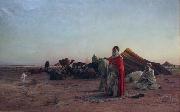
Painter, son of Edward Goodall. He was taught by his father and first exhibited at the Royal Academy in 1838. His earliest subjects were rural genre scenes and landscapes, many derived from sketching trips made between 1838 and 1857 in Normandy, Brittany, Wales, Ireland, Scotland and Venice. In the 1850s he also painted subjects from British history. More significant for his subsequent career was his visit to Egypt from September 1858 to April 1859. In Cairo he lived in a house in the Coptic quarter with Carl Haag. Together the two artists went on expeditions to Giza to draw the Nile, the Sphinx and Pyramids, and to Suez and across the Red Sea to the Wells of Moses at 'Uyen Mesa. Goodall also made rapid sketches in the crowded streets of Cairo. 'My sole object in paying my first visit to Egypt', he wrote, 'was to paint Scriptural subjects'. The first of these, Early Morning in the Wilderness of Shur (London, Guildhall A.G.), was exhibited at the Royal Academy in 1860 and won him critical and popular acclaim. In 1864 he was elected RA. Much of the rest of Goodall's long career was devoted to painting similar scenes of Egyptian life with biblical associations, for which he made reference to his sketches and to Egyptian artefacts and clothing. Their success prompted a second visit to Egypt in 1870-71. |
|
|
|
Frederick Goodall,R.A
|
|
1822-1904
Painter, son of (1) Edward Goodall. He was taught by his father and first exhibited at the Royal Academy in 1838. His earliest subjects were rural genre scenes and landscapes, many derived from sketching trips made between 1838 and 1857 in Normandy, Brittany, Wales, Ireland, Scotland and Venice. In the 1850s he also painted subjects from British history. More significant for his subsequent career was his visit to Egypt from September 1858 to April 1859. In Cairo he lived in a house in the Coptic quarter with Carl Haag. Together the two artists went on expeditions to Giza to draw the Nile, the Sphinx and Pyramids, and to Suez and across the Red Sea to the Wells of Moses at 'Uy?n M?sa. Goodall also made rapid sketches in the crowded streets of Cairo. 'My sole object in paying my first visit to Egypt', he wrote, 'was to paint Scriptural subjects' (Reminiscences, p. 97). The first of these, Early Morning in the Wilderness of Shur (London, Guildhall A.G.), was exhibited at the Royal Academy in 1860 and won him critical and popular acclaim. In 1864 he was elected RA. Much of the rest of Goodall's long career was devoted to painting similar scenes of Egyptian life with biblical associations, for which he made reference to his sketches and to Egyptian artefacts and clothing. |
|
 |
Frederick goodall,R.A.
|
|
1822-1904
son of Edward Goodall. He was taught by his father and first exhibited at the Royal Academy in 1838. His earliest subjects were rural genre scenes and landscapes, many derived from sketching trips made between 1838 and 1857 in Normandy, Brittany, Wales, Ireland, Scotland and Venice. In the 1850s he also painted subjects from British history. More significant for his subsequent career was his visit to Egypt from September 1858 to April 1859. In Cairo he lived in a house in the Coptic quarter with Carl Haag. Together the two artists went on expeditions to Giza to draw the Nile, the Sphinx and Pyramids, and to Suez and across the Red Sea to the Wells of Moses at 'Uyen Mesa. Goodall also made rapid sketches in the crowded streets of Cairo. 'My sole object in paying my first visit to Egypt', he wrote, 'was to paint Scriptural subjects'. The first of these, Early Morning in the Wilderness of Shur (London, Guildhall A.G.), was exhibited at the Royal Academy in 1860 and won him critical and popular acclaim. In 1864 he was elected RA. Much of the rest of Goodall's long career was devoted to painting similar scenes of Egyptian life with biblical associations, for which he made reference to his sketches and to Egyptian artefacts and clothing. Their success prompted a second visit to Egypt in 1870-71. |
|
 |
Frederick spencer gore
|
|
British. 1878 - 1914.
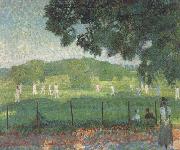
English painter. He studied at the Slade School of Fine Art, London (1896-9), where he met Harold Gilman, who became a close friend. In 1902 he visited Spain with another Slade contemporary, Wyndham Lewis, and two years later he visited Sickert in Dieppe. From that time on his work was influenced by French art, and Gore learnt much about Degas's paintings through Sickert's teaching. After Sickert's return to London in 1905 Gore frequently accompanied him to music halls and made them the subject of several paintings, for example The Mad Pierrot Ballet, the Alhambra |
|
 |
Friedrich Carl Groger
|
|
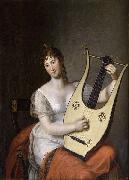
(14 October 1766, Plön - 9 November 1838, Hamburg) was a north-German portrait painter and lithographer. One of the most respected portraitists of his time in northern Germany, his works are to be found in several museums, including the Hamburger Kunsthalle, as well as in north German, Holstein and Danish private collections.
Gröger was the son of a tailor in Plön, where he grew up in modest circumstances. His parents wanted him to become a tailor or wood turner and opposed his early artistic activities. He was largely self taught in painting, though he had some contact in Lebeck with Tischbein and in 1785 was in the city of Lebeck, where he met Heinrich Jacob Aldenrath, his first, loyalest and lifelong friend - the Grögersweg in Hamburg-Barmbek named after him links the Tischbeinstraße with the Aldenrathsweg.
From 1789 he studied at Berlin's Akademie der Kenste. He and Aldenrath then went together to Hamburg, then on a joint study trip to Dresden and Paris, then back to Lebeck, where he worked until 1807. They then alternated between Hamburg, Copenhagen, Kiel and Lebeck, before finally settling in Hamburg in 1814. In 1792 Gröger was made an honorary member of the Gesellschaft zur Beförderung gemeinnetziger Tätigkeit in Lebeck.
Gröger developed from a miniature painter into a portrait painter, who towards the end of his life preferred three quarter bust portraits. Aldenrath took over the miniature painting side of their joint business. After lithography developed in northern Germany, they both worked in this medium individually as well as jointly under the business name Firma Gröger & Aldenrath.
|
|
 |
Friedrich Gauermann
|
|
(September 10, 1807 - July 7, 1862), Austrian painter, son of the landscape painter Jacob Gauermann (1773 - 1843), was born at Miesenbach near Gutenstein in Lower Austria.
It was the intention of his father that he should devote himself to agriculture, but the example of an elder brother, who, however, died early, fostered his inclination towards art. Under his father's direction he began studies in landscape, and he also diligently copied the works of the chief masters in animal painting which were contained in the academy and court library of Vienna. In the summer he made art tours in the districts of Styria, Tirol, and Salzburg.
Two animal pieces which he exhibited at the Vienna Exhibition of 1824 were regarded as remarkable productions for his years, and led to his receiving commissions in 1825 and 1826 from Prince Metternich and Caraman, the French ambassador. His reputation was greatly increased by his picture "The Storm," exhibited in 1829, and from that time his works were much sought after and obtained correspondingly high prices. His "Field Labourer" was regarded by many as the most noteworthy picture in the Vienna exhibition of 1834, and his numerous animal pieces have entitled him to a place in the first rank of painters of that class of subjects.
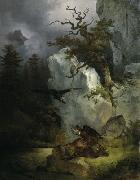
The peculiarity of his pictures is the representation of human and animal figures in connexion with appropriate landscapes and in characteristic situations so as to manifest nature as a living whole, and he particularly excels in depicting the free life of animals in wild mountain scenery. Along with great mastery of the technicalities of his art, his works exhibit patient and keen observation, free and correct handling of details, and bold and clear colouring. He died at Vienna on the 7th of July 1862.
Many of his pictures have been engraved, and after his death a selection of fifty-three of his works was prepared for this purpose by the Austrian Kunstverein (Art Union).
|
|
|
|
|