|
|
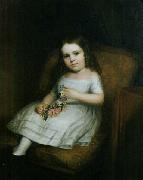 |
Albert Gallatin Hoit
|
|
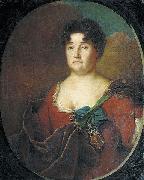
Albert Gallatin Hoit (December 13, 1809 - December 18, 1856) was an American painter who lived in Boston, Massachusetts. He painted portraits of William Henry Harrison, Daniel Webster and Brenton Halliburton.
Hoit was born in Sandwich, New Hampshire, December 13, 1809, to Gen. Daniel Hoit and Sally Flanders. Siblings included William Henry Hoit. Hoit graduated from Dartmouth College in 1829. He married Susan Hanson in 1838; children included Anna M. Hoit.
Hoit "devoted his life to portrait painting, first at Portland, Maine, in 1831, and then in Bangor and Belfast, Maine, and St. John's, N.B. until Boston, Mass., became his permanent home in 1839." He also travelled in Europe, "Oct. 1842 to July 1844, ... enjoying the galleries of art in Italy, Paris, and London." He created portraits of Pietro Bachi, Johanna Robinson Hazen, J. Eames, and others. He painted a portrait of Daniel Webster "for Paran Stevens, which hung for years in the Revere House, Boston, and now belongs to the Union League Club, New York."
He was affiliated with the Boston Artists' Association; and exhibited at the gallery of the New England Art Union in the 1850s. In 1848, he kept a studio on Tremont Row in Boston, and lived in Roxbury. By 1852, he'd moved his studio to Washington Street.
Hoit died in Jamaica Plain, December 18, 1856, at age 47.
|
|
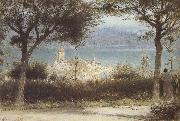 |
Albert goodwin,r.w.s
|
|
1845-1932
English painter. During the early 1860s Goodwin studied with Arthur Hughes and Ford Madox Brown, who predicted that his pupil would become 'one of the greatest landscape painters of the age'. Hughes and Brown impressed on Goodwin the Pre-Raphaelite principles of high finish, vivid colour and working directly from nature that inform his early landscape style, |
|
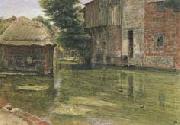 |
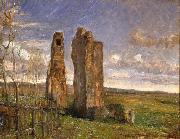
Albert Goodwin,RWS
|
|
1845-1932
English painter. During the early 1860s Goodwin studied with Arthur Hughes and Ford Madox Brown, who predicted that his pupil would become 'one of the greatest landscape painters of the age'. Hughes and Brown impressed on Goodwin the Pre-Raphaelite principles of high finish, vivid colour and working directly from nature that inform his early landscape style |
|
 |
Albert Gottschalk
|
|
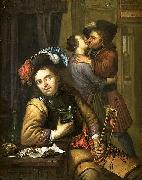
(3 July 1866 - 13 February 1906) was a Danish painter. He had a close connection, personally and artisticly, to the poets Johannes Jørgensen, Viggo Stuckenberg and Sophus Claussen.
Albert Gottschalk was born in Stege on the island of Møn. but later moved to Copenhagen. He was educated at the Royal Danish Academy of Fine Arts from 1882 to 1883 and under Peder Severin Krøyer at the Artists Studio Schools from hos from 1883 to 1888. He also studied privately with Karl Jensen and Karl Madsen.
Gottschalk was inspired by the Danish painter P.S. Krøyer as well as French art.
Gottschalk was ambitious, technically skilled, and he worked a long time with his motifs in his mind before painting them. He searched for his motifs in Denmark on his bicycle, and he found them often around Copenhagen. The paintings often look like they are quickly made sketches which was not recognised in Gottschalkes time. But today people find his works fresher and more timeless than art from that time normally is.
|
|
|
|
|
|
 |
Albert Joseph Moore Prints
|
|
English Classicist Painter, 1841-1893
Albert Joseph Moore (4 September 1841 ?C 25 September 1893) was an English painter, known for his depictions of langorous female figures set against the luxury and decadence of the classical world.
SilverHe was born in York in 1841, the youngest of the fourteen children of the artist William Moore of York who in the first half of the 19th century enjoyed a considerable reputation in the North of England as a painter of portraits and landscape.
In his childhood Albert Moore showed an extraordinary love of art, and as he was encouraged in his tastes by his father and brothers, two of whom afterwards became famous as artists ?? John Collingham Moore and Henry Moore, and he was able to begin the active exercise of his profession at an unusually early age.
His first exhibited works were two drawings which he sent to the Royal Academy in 1857. A year later he became a student in the Royal Academy schools; but after working in them for a few months only he decided that he would be more profitably occupied in independent practice. During the period that extended from 1858 to 1870, though he produced and exhibited many pictures and drawings, he gave up much of his time to decorative work of various kinds, and painted, in 1863, a series of wall decorations at Coombe Abbey, the seat of the Earl of Craven; in 1865 and 1866 some elaborate compositions: The Last Supper and The Feeding of the Five Thousand on the chancel walls of the church of St. Alban's, Rochdale; and in 1868 A Greek Play, an important panel in tempera for the proscenium of the Queen's Theatre in Long Acre.
His first large canvas, Elijah's Sacrifice, was completed during a stay of some five months in Rome at the beginning of 1863, and appeared at the Academy in 1865. A still larger picture, The Shunamite relating the Glories of King Solomon to her Maidens, was exhibited in 1866, and with it two smaller works, Apricots and Pomegranates. In these Albert Moore asserted plainly the particular technical conviction that for the rest of his life governed the whole of his practice, and with them he first took his place definitely among the most original of British painters. |
|
 |
Albert Joseph Moore,ARWS
|
|
181-1893
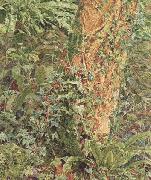
He showed precocious artistic talent as a child and entered the Royal Academy Schools in London in 1858. His early work shows a Pre-Raphaelite influence common to his generation. The watercolour Study of an Ash Trunk (1857; Oxford, Ashmolean) is very Ruskinian in its precise handling of naturalistic detail. Moore made two visits abroad: in 1859 to France with the architect William Eden Nesfield and in the winter of 1862-3 to Rome with his brother John Collingham Moore. Elijah's Sacrifice (1863; exh. RA 1865; Bury St Edmunds, A.G.), one of Moore's earliest large-scale oil paintings, was executed while he was in Rome. Its biblical subject and sombre tone are typical of his output in the early 1860s and relate to the work of Ford Madox Brown and Edward Armitage. |
|
 |
Albert Lebourg
|
|
Montfort-sur-Risle 1849-Rouen 1928
French painter. He had an early interest in architecture and studied under the architect Drouin at the Ecole Municipale de Dessin in Rouen. He became increasingly interested in art and through Drouin met the landscape painter Victor Delamarre (1811-68) who advised and taught him. Giving up architecture altogether, he then attended the Ecole Municipale de Peinture et de Dessin in Rouen under Gustave Morin (1809-86). In 1871 he met the collector Laperlier through whom he obtained the post of professor of drawing at the Societe des Beaux-Arts in Algiers. He remained there from 1872 to 1877, producing works such as Street in Algiers (1875; Rouen, Mus. B.-A.). He also experimented with depicting a single site in a variety of different lights, in a manner similar to the late works of Monet. After giving up his teaching post in Algeria in 1877 he returned to Paris where he attended Jean-Paul Laurens's studio from 1878 to 1880. It was at this point that he became aware of Impressionism; later he became friendly with Degas, Monet and Sisley. He first exhibited at the Salon de la Societe des Artistes Franeais in 1883 and again in 1886, |
|
 |
Albert Pinkham Ryder
|
|
1847-1917
Albert Pinkham Ryder Gallery
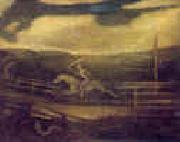
Albert Pinkham Ryder (March 19, 1847 ?C March 28, 1917) was an American painter best known for his poetic and moody allegorical works and seascapes, as well as his eccentric personality. While his art shared an emphasis on subtle variations of color with tonalist works of the time, it was unique for accentuating form in a way that some art historians regard as modernist.
After 1900, around the time of his father's death, Ryder's creativity fell dramatically. For the rest of his life he spent his artistic energy on occasionally re-working existing paintings, some of which lay scattered about his New York apartment. Visitors to Ryder's home were struck by his slovenly habits -- he never cleaned, and his floor was covered with trash, plates with old food, and a thick layer of dust, and he would have to clear space for visitors to stand or sit. He was shy and did not seek the company of others, but received company courteously and enjoyed telling stories or talking about his art. He gained a reputation as a loner, but he maintained social contacts, enjoyed writing letters, and continued to travel on occasion to visit friends.
While Ryder's creativity fell after the turn of the century, his fame grew. Important collectors of American art sought Ryder paintings for their holdings and often lent choice examples for national art exhibitions, as Ryder himself had lost interest in actively exhibiting his work. In 1913, ten of his paintings were shown together in the historic Armory Show, an honor reflecting the admiration felt towards Ryder by modernist artists of the time.
By 1915 Ryder's health deteriorated, and he died at the home of a friend who was caring for him. A memorial exhibition of his work was held in the Metropolitan Museum of Art in New York in 1918. While the works of many of Ryder's contemporaries were partly or mostly forgotten through much of the 20th century, Ryder's artistic reputation has remained largely intact owing to his unique and forward-looking style. Ryder was along with Thomas Hart Benton, David Siqueiros and Pablo Picasso an important influence on Jackson Pollock's paintings. |
|
|
|
 |
Albert van Ouwater
|
|
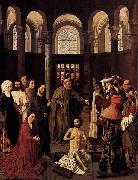
Albert van Ouwater (c. 1410/1415-1475) was one of the earliest artists of Early Netherlandish painting working in the Northern Netherlands, as opposed to Flanders in the South of the region.
[edit] BiographyHe was probably born in Oudewater, and is mentioned by Karel van Mander (1604) as a reputable painter at the time in which he lived.[1] According to Karel van Mander he was possibly a contemporary of Jan van Eyck and had been the teacher of Geertgen tot Sint Jans, though he was quick to qualify this statement with the eye-witness account of an old man named Albert Simonsz who had been a pupil of Jan Mostaert and claimed neither he nor Mostaert had ever even heard of this Albert van Ouwater or Geertgen tot Sint Jans.[1] Van Mander highly commends an altarpiece by Van Ouwater in the principal church in Haarlem, the Grotekerk or Sint-Bavokerk, representing St. Peter and St. Paul, in which the figures are carefully and correctly designed, and richly coloured.[1] Van Mander posits Van Ouwater as the founder of the Haarlem school of painting, making him the first major Dutch (as opposed to Flemish) artist. According to Van Mander, landscape painting was a particular specialty of this Dutch school, although none of Van Ouwater's surviving works exhibit this tendency. Van Ouwater seems to have been a contemporary of Dirk Bouts in mid-15th-century Haarlem, and Geertgen tot Sint Jans may have been his pupil. |
|
 |
Albert von Keller
|
|
Albert von Keller (April 27, 1844 - July 14, 1920) was a German painter.
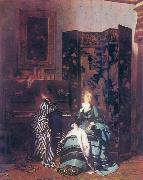
He was born at Gais, in Switzerland; he studied at the Munich Academy under Lenbach and Ramberg, and must be counted among the leading colorists of the modern German school. Travels in Italy, France, England and Holland, and a prolonged sojourn in Paris, helped to develop his style. His scenes of society life, such as the famous "Dinner" (1890), are painted with thoroughly Parisian esprit, and his portraits are marked by the same elegant distinction. He was particularly successful in the rendering of rustling silk and satin dresses and draperies. His historical and imaginative works were as modern in spirit and as unacademical as his portraits. As of 1911, at the Munich Pinakothek was his painting "Jairi Töchterlein" (1886), while the Königsberg Museum contained his "Roman Bath", and the Liebieg collection in Reichenberg the "Audience with Louis XV", the first picture that drew attention to his talent. Among other important works he painted "Faustina in the Temple of Juno at Praeneste", "The Witches Sleep" (1888), "The Judgment of Paris", "The Happy Sister", "Temptation" (1892), "Autumn" (1893), "An Adventure" (1896), and "The Crucifixion". |
|
 |
Albert Weisgerber
|
|
German, 1878-1915
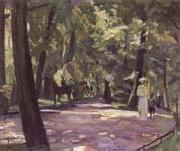
German painter and printmaker. He studied decoration at the Kreisbaugewerksschule in Kaiserlautern (1891-3) and began work in a decorator studio in Frankfurt am Main. However, in 1894 he moved to Munich to resume his studies, first at the Kunstgewerbeschule and later under Franz von Stuck at the Akademie der Bildenden Kenste (1897-1901). For some years he concentrated on poster design and book illustration, contributing a total of 500 drawings to Jungend: Illustrierte Wochenschrift for Kunst und Leben from 1899. His early paintings such as the portrait of Ludwig Scharf II (c. 1905; Munich, Staatsgal. Mod. Kst) were executed in dark-toned academic style, but an exhibition of French Impressionism in Berlin in 1905 so impressed him that he went to Paris for nearly a year (until May 1906). Despite his association with the circle of artists around Matisse, he was more influenced by the work of Cezanne. In 1907 he made a second visit to Paris and joined Phalanx in 1909. In the latter year he was visited by Hans Purrmann and Matisse. By 1911 with a third visit to Paris and travels to Rome and Naples, he had established himself as one of the foremost German Impressionists. As well as such lyrical scenes as Munich Hofgarten (1911; Munich, Lenbachhaus), in common with many of his German contemporaries, Weisgerber reconceived classical scenes in an energetic style, for example in Amazon Camp (1910; Stuttgart, Staatsgal.). In 1912 he had a one-man show in the Kunsthaus, Zurich, and a year later participated in the annual Kunstausstellung in Munich. Although using an Impressionist style, he was equally at home in Expressionist circles, and this undoubtedly influenced his election to the presidency of the Neuen Menchner Sezession (1913). In the last four years of his career he was obsessed with sacrificial subject-matter from the Old and New Testaments, which he had originated in the theme of St Sebastian (e.g. St Sebastian Felled by Arrows, 1910; Munich, Staatsgal. Mod. Kst). While not exclusively tragic (e.g. David and Goliath, 1914; Saarbrecken, Saarland-Mus.), these final works strip away historical references to concentrate upon the fate of the isolated individual, as in Absalom (1914; Hamburg, Ksthalle). |
|
|
|
 |
ALBERTINELLI Mariotto
|
|
Italian Early Renaissance Painter, 1474-1515
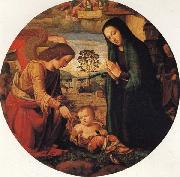
Already as a 12-year old boy, he became a pupil of Cosimo Rosselli, and a fellow-pupil with Fra Bartolomeo with whom he formed such an intimate brotherly rapport that in 1494 the two started their own studio in Florence. Vasari's opinion was that Mariotto was not so well grounded in drawing as Bartolomeo, and he tells that, to improve his hand he had taken to drawing the antiquities in the Medici garden, where he was encouraged by Madonna Alfonsina, the mother of Duke Lorenzo II de' Medici. When the Medici were temporarily banished in 1494, he returned to his friend, whose manner he copied so assiduously, according to Vasari, that his works were taken for Baccio's. When, in the wake of Savonarola's morality campaign, Baccio joined the Dominican order as Fra Bartolomeo in 1500 and gave up painting, Albertinelli, beside himself with the loss, would have joined him; but, spurred by his success in completing an unfinished Last Judgment of Bartolomeo's, he resolved to carry on alone. Among his many students were Jacopo da Pontormo, Innocenzo di Pietro Francucci da Imola and Giuliano Bugiardini.
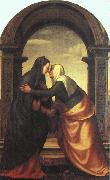
Albertinelli's paintings bear the imprint of Perugino's sense of volumes in space and perspective, Fra Bartolomeo's coloring, the landscape portrayal of Flemish masters like Memling, and Leonardo's Sfumato technique. His chief paintings are in Florence, notably his masterpiece, the Visitation (1503) at the Uffizi. |
|
 |
ALBERTINELLI Mariotto
|
|
Italian Early Renaissance Painter, 1474-1515
Italian painter. Albertinelli's contribution to the Florentine High Renaissance was inspired by the work of FRA BARTOLOMMEO, and the two artists worked together in a partnership, their paintings appearing to be the product of a single hand. Albertinelli, however, always retained artistic independence, as is revealed in certain paintings that are eccentrically archaic and in others that show a preference for conventions more typical of the early Renaissance. |
|
 |
Albertinelli, Mariotto
|
|
Italian Early Renaissance Painter, 1474-1515] Studied under Cosimo Rosselli. Albertinelli's students included Pontormo . Italian painter. Albertinelli's contribution to the Florentine High Renaissance was inspired by the work of FRA BARTOLOMMEO, and the two artists worked together in a partnership, their paintings appearing to be the product of a single hand. Albertinelli, however, always retained artistic independence, as is revealed in certain paintings that are eccentrically archaic and in others that show a preference for conventions more typical of the early Renaissance. |
|
|
|
|
|
 |
Albertus Pictor
|
|
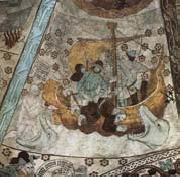
c.1440-1509,English also called Albert Pictor, Albert Målare and Albrekt Pärlstickare (Swedish), is the most famous late medieval Swedish painter, known for his wallpaintings surviving in numerous churches in southern and central Sweden. Albertus was originally called Albertus Immenhusen, after the German town in Hessen of which he was a native. He occurs in Swedish historical sources from 1465, when he was admitted a burgher of Arboga. Eight years later he moved to Stockholm, where, in accordance with current practice, he took over the workshop as well as the widow of a deceased painter. He was a versatile and prolific artist, known to his contemporaries not only for his church wallpaintings, but also as an organist and embroiderer (hence his nickname of Parlstickare, Pearl-embroiderer). More than thirty of his schemes, mostly in a secco technique, are extant, many in the Lake Malaren region, about a third of which bear his signature. Notable examples include wallpaintings at Bromma kyrka, near Stockholm, Lid kyrka, in Sodermanland and Taby Kyrkby kyrka in Taby. Part of his life and work are depicted in the illustrated book, Albert malare och sommaren i Harkeberga (Albert the Painter and the summer in Harkeberga), which describes his painting of the small church of Harkeberga in Uppland (see below). |
|
|
|
 |
Albin Egger Lienz
|
|
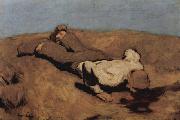
Albin Egger-Lienz (29 January 1868 - 4 November 1926) was an Austrian painter.
He was born in Dölsach-Stribach near Lienz, in what was the county of Tyrol. As an artist, he had a special preference for rustic genre and historical paintings; under the influence of Ferdinand Hodler, Egger-Lienz abstracted his formal language into monumental expressiveness.
He trained first under his father (a church painter), later he studied at the Academy in Munich where he was influenced by Franz Defregger and French painter Jean-François Millet. In 1899 he moved to Vienna. During 1911 and 1912 he was professor at the Weimar School of Fine Arts and he served as war painter during World War I. In 1918, he turned down a professorship at the Vienna Academy and settled in South Tyrol. Egger-Lienz died on 4 November 1926 in St. Justina-Rentsch, Bolzano, Italy. |
|
|
|
|
|
 |
Albrecht Altdorfer
|
|
German
1480-1538
Albrecht Altdorfer Galleries
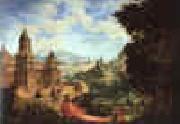
He most often painted religious scenes, but is mainly famous as the first frequent painter of pure landscape, and also compositions dominated by their landscape. Taking and developing the landscape style of Lucas Cranach the Elder, he shows the hilly landscape of the Danube valley with thick forests of drooping and crumbling firs and larches hung with moss, and often dramatic colouring from a rising or setting sun. His Landscape with footbridge (National Gallery, London) of 1518-20 is claimed to be the first pure landscape in oil. He also made many fine finished drawings, mostly landscapes, in pen and watercolour. His best religious scenes are intense, sometimes verging on the expressionistic, and often depict moments of intimacy between Christ and his mother, or others. His most famous religious artwork is the The Legend of St. Sebastian and the Passion of Christ that decorated the altar in the St. Florian monastery in Linz, Austria. He often distorts perspective to subtle effect. His donor figures are often painted completely out of scale with the main scene, as in paintings of the previous centuries. He also painted some portraits; overall his painted oeuvre was not large. |
|
 |
Albrecht Durer
|
|
b.May 21, 1471, Imperial Free City of Nernberg [Germany]
d.April 6, 1528, Nernberg
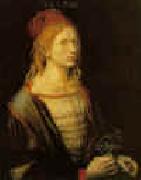
Albrecht Durer (May 21, 1471 ?C April 6, 1528) was a German painter, printmaker and theorist from Nuremberg. His still-famous works include the Apocalypse woodcuts, Knight, Death, and the Devil (1513), Saint Jerome in his Study (1514) and Melencolia I (1514), which has been the subject of extensive analysis and interpretation. His watercolours mark him as one of the first European landscape artists, while his ambitious woodcuts revolutionized the potential of that medium. D??rer introduction of classical motifs into Northern art, through his knowledge of Italian artists and German humanists, have secured his reputation as one of the most important figures of the Northern Renaissance. This is reinforced by his theoretical treatise which involve principles of mathematics, perspective and ideal proportions.
His prints established his reputation across Europe when he was still in his twenties, and he has been conventionally regarded as the greatest artist of the Renaissance in Northern Europe ever since. |
|
 |
Alden J Weir
|
|
1852-1919
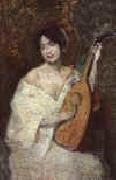
Painter, printmaker and teacher, son of (1) Robert Walter Weir. His art education began in the studio of his father. There he and his half-brother (2) John Ferguson Weir acquired an appreciation for the Old Masters, particularly of the Italian Renaissance and of the 17th-century Dutch schools. While Weir pursued in his art a course very different from that of his father and half-brother, his personality as well as his artistic attitudes were shaped by them. In the winters of 1870-71 and 1871-2, he continued his studies at the National Academy of Design in New York, where his instructor was Lemuel Wilmarth (1835-1918).
|
|
 |
aleijadinho
|
|
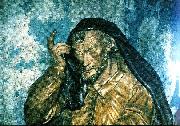
Aleijadinho (b. Antônio Francisco Lisboa; 1730 or 1738 ?C November 18, 1814) was a Colonial Brazil-born sculptor and architect, noted for his works on and in various churches of Brazil.
Born in Vila Rica (Rich Town), whose name was later changed to Ouro Preto (Black Gold), Brazil, in 1738 (sometimes said to be in 1730) he was the son of Manuel Francisco de Costa Lisboa, a Portuguese man and his African slave, Isabel. His father, a carpenter, had immigrated to Brazil where his skills were so in demand that he appears to have been elevated to the position of architect. When Antonio was young his father married and he was raised in his father's home along with his half siblings. It was there he is presumed to have learned the fundamentals of sculpture, architecture and the combination of the two. Antonio first appears as a day laborer working on the Church of Our Lady of Carmel in the town of Ouro Preto, a church designed by his father. |
|
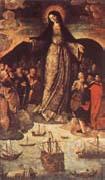 |
Alejo Fernandez
|
|
1475-1545 High Renaissance,Spanish,was a Spanish painter of the sixteenth century best known for his portrait of Christopher Columbus painted between 1505 and 1536. Fernandez arrived in Seville from Cordoba in 1508. He died in Seville around 1545. |
|
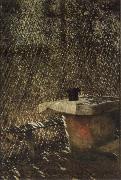 |
Aleksander Gierymski
|
|
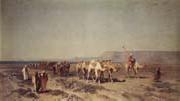
Warsaw 1850-1901 Rome, Brother of Maks Gierymski. He studied (1867) at the Warsaw Drawing Class, then (1868-73) at the Akademie der Bildenden Kenste in Munich under Georg Hiltensperger (1806-90) and Alexander Strehuber (1814-82), and later under Karl Theodor von Piloty. While in Munich he contributed illustrations to Polish, German and Austrian magazines. On a visit to Venice and Verona in 1871 he was especially impressed by the work of 15th-century Venetian artists; this new enthusiasm was reflected in his prize-winning painting of a subject set by the Munich Akademie, a scene from Shakespeare's Merchant of Venice (1872; destr., see Starzynski, pl. 4). After accompanying his dying brother Maks to various spa towns and other locations, he settled in Rome in mid-1874. Two genre scenes from this period, Roman Tavern and A Game of Mora (both 1874; Warsaw, N. Mus.), show the influence of Dutch painting. Gierymski remained in Italy until 1879, mostly resident in Rome. |
|
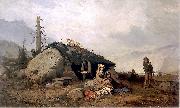 |
Aleksander Kotsis
|
|
- born 1836 in Ludwinew (now one of parts of Krakew), died 1877 in Podgerze (also a part of Krakew now)- was a Polish painter renowned for his landscapes, portraits and genre depictions of contemporary rustic scenes.
In 1850, he attended the Krakew College of Fine Arts, where he studied under Wojciech Stattler.
|
|
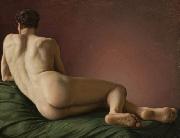 |
Aleksander Lesser
|
|
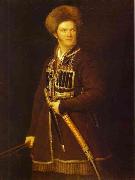
(May 13, 1814 - March 13, 1884) was a Polish painter and art critic of Jewish descent. Lesser specialized in Polish historic and contemporary themes. He was a member of Krakew Academy of Learning and co-founder of Warsaw's Zachęta, the Society for Encouragement of the Fine Arts.
Lesser studied painting at Warsaw University's department of fine arts, as well as at art schools in Dresden and Munich. He was a founder of the history-painting movement in Poland, which is considered a part of the "archeological trend" that existed before Jan Matejko. The trend's purpose was to portray the entire history of Poland in works of art.
|
|
 |
Aleksander Orlowski
|
|
(March 9, 1777 - March 13, 1832) was a Polish painter and sketch maker, pioneer of lithography in the Russian Empire.
Orłowski was born in 1777 in Warsaw to a tavern-keeper. In his early childhood he became known as a prodigy and soon Izabela Czartoryska financed his first classes of painting with the notable artist Jan Piotr Norblin. In 1793 Orłowski joined the Polish Army and fought in the Kościuszko Uprising against Imperial Russia and Prussia, but was wounded and returned to Warsaw for further studies, financed by Prince Jezef Poniatowski. He studied with many notable painters of the epoch, among them Norblin, Marcello Bacciarelli and Wincenty Lesserowicz. In 1802, after the Partitions of Poland, he moved to Russia, where he became one of the pioneers of lithography.
Among his works are countless sketches of everyday life in Poland and Russia, as well as scenes of the Kościuszko Uprising and other Polish wars.
|
|
|
|
Aleksander Orlowski
|
|
Aleksander Orłowski
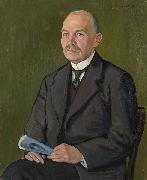
Aleksander Orłowski (March 9, 1777 - March 13, 1832) was a Polish painter and sketch maker, pioneer of lithography in the Russian Empire.
Orłowski was born in 1777 in Warsaw to a tavern-keeper. In his early childhood he became known as a prodigy and soon Izabela Czartoryska financed his first classes of painting with the notable artist Jan Piotr Norblin. In 1793 Orłowski joined the Polish Army and fought in the Kościuszko Uprising against Imperial Russia and Prussia, but was wounded and returned to Warsaw for further studies, financed by Prince Jezef Poniatowski. He studied with many notable painters of the epoch, among them Norblin, Marcello Bacciarelli and Wincenty Lesserowicz. In 1802, after the Partitions of Poland, he moved to Russia, where he became one of the pioneers of lithography.
Among his works are countless sketches of everyday life in Poland and Russia, as well as scenes of the Kościuszko Uprising and other Polish wars.
|
|
 |
Aleksander Uurits
|
|
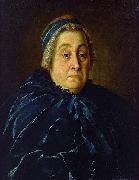
(May 12, 1888 - August 10, 1918) was an Estonian painter and graphic artist.
|
|
|
|
|
|
 |
Aleksey Antropov
|
|
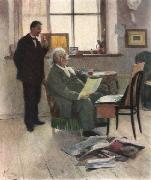
(Russian: 25 March [O.S. 14 March] 1716 - 23 June [O.S. 12 June] 1795) was a Russian barocco painter active primarily in St. Petersburg, where he was born and died. He also worked in Moscow and frescoed churches in Kiev. His preferred medium was oil, but he also painted miniatures and icons.
Alexei was born to a family of government official working in Armory and in the Department of Building (kantselyatiya stroeniy). Since 1732 Alexei also working at the same department under his relative A. Matveyev, since 1739 he is a member of the painting team (zhivopisnaja komanda) of the Department under Ivan Vishnyakov. As the member of the team Alexei took part in fresoeing of Summer Palace, Winter Palace, Anichkov Palace and other buildings of Saint Petersburg. He also studied portrait art from the court painter Louis Caravaque of France. In 1749 Alexei received the rank of the Painter's apprentice (zhivopisniy podmasterye) and in the end of 1750ies the rank of the Master Painter (zhivopisniy master).
In 1752-1755 he worked on the interiors of the St Andrew's Church of Kiev. He supervised the installation of the iconostasis, frescoed cupolas and walls. The most prominent of his frescoes in the church is the Last Supper in the altar.
He started to paint portraits before his Kiev period. The earliest known portraits of his are portraits of Elizabeth of Russia. He did not met his model but based the paintings on the works of his teacher, Louis Caravaque.
Unknown lady, 1760iesIn 1755-1757 he worked in Moscow frescoeing the Golovkin palace. Here he met prince Ivan Shuvalov who supported Antropov's works for the rest of his life.
In 1757 - 1759 Antropov returned to Saint-Petersburg and learned art from court painter Pietro Rotari of Italy. Historians consider his portrait of A.M. Izmaylova to be a sort of a graduation work. The 1760ies were probably the most productive period of the artist. He painted many good portraits among the Portrait of Ataman Krasnoschekov, Portrait of Rumyantseva. Ivan Shuvalov planned to move him to Moscow, so Antropov could teach art the Moscow University. For some reason this plan was canceled and Antropov instead got the job at the Synod of the Russian Orthodox Church, there he supervised icon painting, decorating of the churches, drew the portraits of church hierarchs and supervised art students. Among his apprentices was Dmitry Levitzky, who actually lived in the house of his teacher.
In 1762 Peter III of Russia became the new Emperor. Antropov soon became his favorite painter. For the six month of Peter III rule Antropov painted at least four of his portraits. After the palace revolt the new Emperess, Catherine II was of much lower opinion of the talents of Antropov. At that time the artists appreciated the soft combinations of colors and some sort of a fine flattering on the ceremonial portraits. |
|
 |
Aleksey Korin
|
|
Korin Alexey (1865-1923) -
brief biography
Alexey Korin was born in 1865.
The main themes of his painting were Russian lanscapes, genre-scenes, portraits, interiors.
Studied at the Moscvow School of Painting, Sculpture and Architecture in 1884-1889. Gradueted from this school with big silver medal.
Was the member and took part at the exhebitions of the The Association of Traveling Art Exhibitions (the Itinerants group) since 1891.
Teached at the Moscow School of Painting, Sculpture and Architecture since 1894.
Took part at the World Art Exhibition in Paris in 1900.
Some of the paintings of Alexey Korin were bought by Pavel Tretyakov for his collection. |
|
 |
Alessandro Allori
|
|
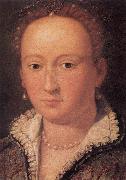
(May 3, 1535 - September 22, 1607) was an Italian portrait painter of the late Mannerist Florentine school.
Born in Florence, in 1540, after the death of his father, he was brought up and trained in art by a close friend, often referred to as his 'uncle', the mannerist painter Agnolo Bronzino, whose name he sometimes assumed in his pictures. In some ways, Allori is the last of the line of prominent Florentine painters, of generally undiluted Tuscan artistic heritage: Andrea del Sarto worked with Fra Bartolomeo (as well as Leonardo Da Vinci), Pontormo briefly worked under Andrea, and trained Bronzino, who trained Allori. Subsequent generations in the city would be strongly influenced by the tide of Baroque styles pre-eminent in other parts of Italy. |
|
 |
Alessandro Bonvicino
|
|
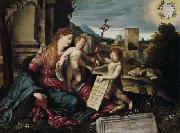
(c. 1498 - December 22, 1554), more commonly known as Il Moretto da Brescia, was an Italian Renaissance painter of Brescia and Venice.
He was born at Rovato, in Brescian territory, and studied first under Fioravante Ferramola. Others state he trained with Vincenzo Foppa. His brothers Pietro and Jacopo were also painters. The 1911 Britannica claims he apprenticed with Titian in Venice and that Moretto modelled his earlier portrait-painting style on the Venetian style. On the other hand, the style also resembles that of Giorgione or late Bellini. The 1911 Britannica also states that he conceived a great enthusiasm for Raphael, though he never traveled to Rome; on the other hand, his classical serenity resembles that shown by Leonardo and his followers in Lombardy such as, for example, Bramantino. He may have consulted with his contemporary Girolamo Savoldo.
Moretto excelled more in sedate altarpieces than in narrative action, and more in oil-painting than in fresco, although he painted fine frescoes depicting the lollygagging daughters of Count Martinengo in one of the palaces near Brescia. In 1521, he worked with Girolamo Romanino in the Cappella del Sacramento in the old cathedral of Brescia, where Moretto completed a Last Supper, Elijah in the Desert, and a Fall of Manna.He was active during 1522-24 in Padua.
He painted alongside with Lorenzo Lotto at Santa Maria Maggiore in Brescia. Also in Brescia, he completed a Five Virgin Martyrs and his masterpiece, the Assumption of the Madonna for the church of San Clemente; a Coronation of the Madonna with four saints (c. 1525) for the church of Santi Nazaro e Celso; a St. Joseph for Santa Maria della Grazie; and a St Nicholas of Ban for Santa Maria de Miracoli. He collaborated with Floriano Ferramola in the decoration of the dome of the cathedral in Brescia.
|
|
 |
Alessandro Botticelli
|
|
Florence ca.1445-1510
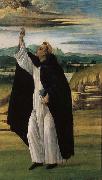
Italian painter and draughtsman. In his lifetime he was one of the most esteemed painters in Italy, enjoying the patronage of the leading families of Florence, in particular the Medici and their banking clients. He was summoned to take part in the decoration of the Sistine Chapel in Rome, was highly commended by diplomatic agents to Ludovico Sforza in Milan and Isabella d'Este in Mantua and also received enthusiastic praise from the famous mathematician Luca Pacioli and the humanist poet Ugolino Verino. By the time of his death, however, Botticelli's reputation was already waning. He was overshadowed first by the advent of what Vasari called the maniera devota, a new style by Perugino, Francesco Francia and the young Raphael, whose new and humanly affective sentiment, infused atmospheric effects and sweet colourism took Italy by storm; |
|
|
|
 |
Alessandro Longhi
|
|
1733-1813
Italian
Alessandro Longhi Gallery
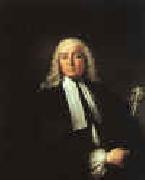
Alessandro Longhi (1733-1813) was a Venetian portrait painter and printmaker in etching (mostly reproductions of paintings). He is known best for his oil portraits of Venetian nobles of state. His father was the famed genre painter Pietro Longhi. He trained under his father and Giuseppe Nogari (1609-1763). Like Sebastiano Bombelli in the prior century, Alessandro Longhi is noted for his zealous full-length depicitions of robes and emblems of office. His "tumultuous and unusual (etching) technique shows first-hand knowledge of Rembrandt's etchings", according to Olimpia Theodoli. |
|
 |
Alessandro Magnasco
|
|
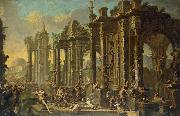
(February 4, 1667 - March 12, 1749), also known as il Lissandrino, was an Italian Rococo painter from Northern Italy. He is best known for stylized, fantastic, often phantasmagoric genre or landscape scenes.
|
|
 |
Alessandro Turchi
|
|
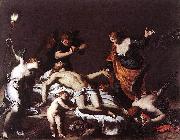
(1578 - 22 January 1649) was an Italian painter of the early Baroque, born and active mainly in Verona, and moving late in life to Rome. He also went by the name Alessandro Veronese or the nickname L'Obetto.
Turchi initially trained with Felice Riccio (il Brusasorci) in Verona. By 1603, he is already working as independent painter, and in 1606-1609, Turchi paints the organ shutters for the Filarmonica Academy of Verona. When Brusasorci dies in 1605, Turchi and his fellow Paschal Ottino (or Pasquale) complete a series of their deceased master's canvases. In 1610, he completes an Assumption altarpiece for the church of San Luca of Verona In 1612, the Veronese Guild of the Goldsmiths commissions an altarpiece, today lost, of the Madonna and Saints. On leaving the school of Riccio, he went to Venice, where he worked for a time under Curio Cagliari.
|
|
|
|
 |
Alesso Baldovinetti
|
|
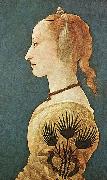
(October 14, 1427??August 29, 1499) was an Italian early Renaissance painter.
Baldovinetti was born in Florence to a family of a rich merchant. In 1448 he was registered as a member of the Guild of St. Luke: "Alesso di Baldovinetti, dipintore."
He was a follower of the group of scientific realists and naturalists in art which included Andrea del Castagno, Paolo Uccello and Domenico Veneziano. Tradition says that he assisted in the decorations of the church of S. Egidio, however no records confirm this. These decoration were carried out during the years 1441 - 1451 by Domenico Veneziano and in conjunction with Andrea del Castagno. That he was commissioned to complete the series at a later date (1460) is certain.
In 1462 Alesso was employed to paint the great fresco of the Annunciation in the cloister of the Annunziata basilica. The remains as we see them give evidence of the artist's power both of imitating natural detail with minute fidelity and of spacing his figures in a landscape with a large sense of air and distance; and they amply verify two separate statements of Vasari concerning him: that "he delighted in drawing landscapes from nature exactly as they are, whence we see in his paintings rivers; bridges, rocks, plants, fruits, roads, fields, cities, exercise grounds, and an infinity of other such things," and that he was an inveterate experimentalist in technical matters.
His favourite method in wall-painting was to lay in his compositions in fresco and finish them a secco with a mixture of yolk of egg and liquid varnish. This, says Vasari, was with the view of protecting the painting from damp; but in course of time the parts executed with this vehicle scaled away, so that the great secret he hoped to have discovered turned out a failure. In 1463 he furnished a cartoon of the Nativity, which was executed in tarsia by Giuliano de Maiano in the sacristy of the cathedral and still exists. From 1466 date the groups of four Evangelists and four Fathers of the Church in fresco, together with the Annunciation on an oblong panel, which still decorate the Portuguese chapel in the basilica of San Miniato, and are given in error by Vasari to Piero Pollaiuolo. A fresco of the risen Christ between angels inside a Holy Sepulchre in the chapel of the Rucellai family, also still existing, belongs to 1467.
In 1471 Alesso undertook important works for tile church of Santa Tr??nita on the commission of Bongianni Gianfigliazzi. First, to paint an altar-piece of the Virgin and Child with six saints; this was finished in 1472: next, a series of frescoes from the Old Testament which was to be completed according to contract within five years, but actually remained on hand for fully sixteen. In 1497 the finished series, which contained many portraits of leading Florentine citizens, was valued at a thousand gold forms by a committee consisting of Cosimo Rosselli, Benozzo Gozzoli, Perugino and Filippino Lippi; only some defaced fragments of it now remain. |
|
|
|
|