|
|
 |
Cosme Tura
|
|
Italian Early Renaissance Painter, ca.1430-1495
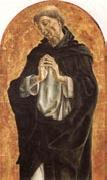
Italian Renaissance artist. He was a leading master of the school of Ferrara and court painter to the city's ruling Este family. Often vividly emotional, Tura's figures range from the graceful to the grotesque, as in the gentle Mary and contorted Jesus of his c.1472 Pieta (Correr Museum, Venice). Combining material splendor with asceticism, his stylistically idiosyncratic paintings are frequently filled with sharply portrayed natural details??diversified landscapes, squirrels, monkeys, fruits, etc.??that serve as both plastic and iconographic elements. His works are executed in a harsh, nervously linear, and rather angular style, with bold and sometimes strident coloring. Examples of his art include two organ panels, Annunciation and St. George Slaying the Dragon (cathedral, Ferrara); Christ on the Cross (Milan); St. Jerome (National Gall., London); Portrait of a Man and Saints (National Gall. of Art, Washington, D.C.). Attributed to him is a portrait of a member of the Este family, The Flight into Egypt, and St. Louis of Toulouse |
|
|
|
 |
David Teniers
|
|
Belgian
1610-1690
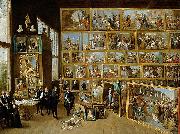
David Teniers Gallery
Flemish painter. His father, also named David Teniers (1582 ?C 1649), was a painter of primarily religious subjects. The younger Teniers was highly prolific and is best known for his genre scenes of peasant life, many of which were used for tapestry designs in the 18th century. He was brilliant at handling crowd scenes in an open landscape and adept at characterizing his figures with a warm, human, and often humorous touch. As court painter to the archduke Leopold William, he also made many small-scale copies of paintings in the archduke collection; engraved and published as Theatrum Pictorium (1660), they constitute a valuable source as a pictorial inventory of a great 17th-century collection. |
|
 |
David Teniers the Younger
|
|
(December 15, 1610 C April 25, 1690), a Flemish artist born in Antwerp, was the more celebrated son of David Teniers the Elder, almost ranking in celebrity with Rubens and Van Dyck. His son David Teniers III and his grandson David Teniers IV were also painters. His wife Anna nee, Anna Breughel was the daughter of Jan Brueghel the Elder and the granddaughter of Pieter Bruegel the Elder.
Through his father, he was indirectly influenced by Elsheimer and by Rubens. The influence of Adriaen Brouwer can be traced to the outset of his career. There is no evidence, however, that either Rubens or Brouwer interfered in any way with Teniers's education, and Smith (Catalogue Raisonne) may be correct in supposing that the admiration which Brouwer's pictures at one time excited alone suggested to the younger artist his imitation of them. The only trace of personal relations having existed between Teniers and Rubens is the fact that the ward of the latter, Anne Breughel, the daughter of Jan (Velvet) Breughel, married Teniers in 1637.
|
|
 |
Diego Quispe Tito
|
|
(1611-1681) was a Peruvian painter. He is considered the leader of the Cuzco School of painting.
The son of a noble Inca family, Quispe Tito was born in Cuzco, and worked throughout his life in the district of San Sebastien; his house is still extant, and shows his coat of arms on its door. His earliest signed painting is an Immaculate Conception from 1627, gilded in a fashion typical of the Cuzco school. The work's elongated forms reveal a knowledge of Mannerism; where Quispe Tito learned the style is unknown, but it is hypothesized that he encountered it in the work of Italian Jesuit Bernardo Bitti, who was active at the time in Cuzco. In addition, he is believed to have known Luis de Riaño in his youth, and may have derived some elements of his style from the older artist; de Riaño, a painter from Lima, had trained in the workshop of Angelino Medoro, and so would have provided another source of Italian influence.
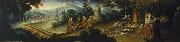
Quispe Tito also was influenced in his work by engravings from Flanders; indeed, his best-known work, the 1681 Signs of the Zodiac in Cuzco Cathedral, is a series of copies of Flemish engravings in which each zodiac sign is tied to a parable from the life of Christ. These engravings were designed for distribution in Peru, where worship of the sun, moon, and stars was still practiced in some quarters; they were designed to encourage worship of Christ and His miracles in place of the zodiac. A further series, depicting scenes from the life of John the Baptist and dating to 1663, was also produced on Flemish models. |
|
|
|
dioscoro teofilo de la puebla tolin
|
|
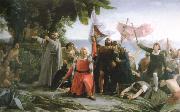
dioscoro teofilo de la puebla tolin(1831 to1901),who studied in madrid and rome,worked in the tradition fo historicism,asubgenre of history painting,which focused on the interplay of religious pride,patriotism ,and sntions of glory.tolin s technical style is referred to as eclecticism for its wide ranging,and often superficial ,borrowing from euopean techniques and visual trends. paintings in this genre were often funded by official organizations and art academies,which treated them as opportuities for propagandistic interpretations of history.the first landing of christopher columbus in america provides on shortage of drama |
|
 |
dioscoro teofilo puebla tolin
|
|
dioscoro teofilo puebla tolin(1831 to1901),who studied in madrid and rome,worked in the tradition fo historicism,asubgenre of history painting,which focused on the interplay of religious pride,patriotism ,and sntions of glory.tolin s technical style is referred to as eclecticism for its wide ranging,and often superficial ,borrowing from euopean techniques and visual trends. paintings in this genre were often funded by official organizations and art academies,which treated them as opportuities for propagandistic interpretations of history.the first landing of christopher columbus in america provides on shortage of drama |
|
 |
Domenico Tintoretto
|
|
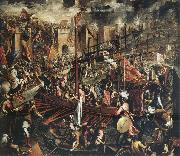
Italian, 1560-1635,Son of Jacopo Tintoretto. He was taught by his father and assisted him in his workshop. At the age of 17 he was admitted to the Venetian painters' guild, and he is recorded in the confraternity of painters from 1594. He began his career by helping his father to execute the paintings in the Sala del Collegio and Sala del Senato in the Doge's Palace, Venice. Following this he worked independently at the palace, on the Sala dello Scrutinio and the Sala del Maggiore Consiglio. His training with his father helped him in his own compositions, several of which, such as the Battle of Salvore, or the Second Conquest of Constantinople, are heroic battle themes with complex groupings and dramatic poses. In the last two decades of the 16th century Domenico concentrated on religious commissions in Venice, including a Last Supper and Crucifixion (both c. 1583) for S Andrea della Zirada (both in situ), a Marriage of the Virgin for S Giorgio Maggiore (in situ) and a Crucifixion for the Scuola dei Mercanti. |
|
 |
Dwight William Tryon
|
|
(August 13, 1849 ?C July 1, 1925) was an American landscape painter in the late 19th and early 20th centuries. His work was influenced by James McNeill Whistler, and he is best-known for his landscapes and seascapes painted in a tonalist style.
Tryon was born in Hartford, Connecticut. His father was killed in a gun accident before Tryon reached four years of age, and Tryon was raised by his mother on his grandparent's farm in East Hartford. His interest in art evolved naturally. As a young man Tryon took a job at a prominent Hartford bookstore and studied art instruction manuals from the store shelves. He also took to sketching the surrounding countryside during his off hours
Tryon sold his first painting in 1870. After exhibiting and selling work locally, he successfully exhibited at the National Academy of Design in 1873. His artistic convictions affirmed, Tryon married, quit his job at the bookstore and became a full-time artist. Some of his first works from this period are seascapes and harbor views executed in a luminist manner. Soon after, however, Tryon's style shifted towards the Barbizon school, which was then becoming popular among American artists. He may have been influenced by the works of George Inness and Alexander Helwig Wyant.
In 1876 Tryon decided to advance his skills through a formal study of art. He sold all of his paintings at auction and, with the help of a benefactor, traveled to France with his wife. He enrolled in the atelier of Jacquesson de la Chevreuse, and took classes at the École des Beaux-Arts. He also received instruction from Charles-François Daubigny, Henri Harpignies, and Jean Baptiste-Antoine Guillemet. Impressionism was blossoming in France all around Tryon, but he was not swayed by the new style and remained comfortably within the realm of the Barbizon school.
Tryon traveled and sketched Europe with his wife, and met Abbott Handerson Thayer and his wife with whom he became friends. He returned to the United States in 1881 and settled in New York City where he taught and painted landscapes. In New York, Tryon became friends with artists Robert Swain Gifford and Thomas Dewing. He became an early member of the Society of American Artists and continued to exhibit paintings to the National Academy of Design. He also became a member of the American Water Color Society and the National Institute of Arts and Letters (now The American Academy of Arts and Letters).
On the advice of Gifford, Tryon and his wife built a summer house in South Dartmouth, Massachusetts in 1887. Though he would continue to spend each winter in New York City, South Dartmouth became Tryon's home for the rest of his life. The coastal area appealed to Tryon's aesthetic sensibilities and allowed him to indulge in fishing, his favorite pastime.
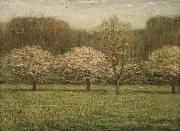
By the late 1880s Tryon began painting landscapes in what would become his mature and iconic style. Working most often in oil, Tryon's paintings typically feature a group or broken row of trees in the middle distance, often colored in an autumnal hue, separating a glowing sky above and a foreground marsh or pasture below. He also continued to paint the sea in his mature career, often employing pastel to show a bare expanse of water, sky and beach in various weather and light. He exhibited his works nationally but tended to favor The Pennsylvania Academy of Fine Arts in Philadelphia and the Montross Gallery in New York.
A Detroit industrialist, Charles Lang Freer, first bought a painting by Tryon in 1889 and became Tryon's most important patron. Freer eventually bought dozens of Tryon's paintings, including many of his best works, and worked closely with Tryon in the interior design of his Detroit home. Freer, a major collector of Asian art and works by James McNeill Whistler, went on to establish the Freer Gallery of Art, part of the Smithsonian Institution in Washington, DC, where many works by Tryon can be seen today.
Took the coveted First Prize for his painting Salt-Marsh, December at the Tennessee Centennial Exposition that was held in Nashville, Tennessee in 1897. He is described in the "Fine Art Catalogue" which is copyrighted by Theodore Cooley as follows: William Tryon is an American landscape painter whose pictures are greatly sought for their delicacy of coloring and refinement of feeling. A pupil of Daubdigny, he is, like that artist, a painter of country life - the idyllic rusticity of apple trees in bloom, of waving cornfields, of shining valleys and streams rippling gently to the sea. He is especially fine in the silvery-gray atmosphere.
In addition to his painting, Tryon taught at Smith College from 1886 to 1923, visiting part time to critique students' work and, late in his career, establishing the Tryon Gallery of Art. He died of cancer in South Dartmouth on July 1, 1925.
|
|
|
|
 |
Edmund Charles Tarbell
|
|
American Impressionist Painter, 1862-1938
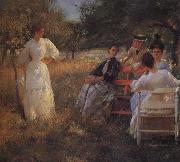
American painter, illustrator and teacher. He attended drawing lessons at the Normal Art School, Boston, MA, and art classes with W. A. G. Claus. From 1877 to 1880 he was apprenticed to a lithographic company in Boston. In 1879 Tarbell entered the School of the Boston Museum of Fine Arts, where he was a pupil of Otto Grundmann (1844-90), a former student of Baron Hendrik Leys in Antwerp. In 1883 Tarbell left for Paris with his fellow student Frank W. Benson. Both Tarbell and Benson attended the Acad?mie Julian, where they studied with Gustave Boulanger and Jules Lefebvre. They travelled to Italy in 1884 and to Italy, Belgium, Germany and Brittany the following year. Tarbell returned to Boston in 1886. Initially after his return, Tarbell made a living from magazine illustration, teaching privately and painting portraits. In 1889 Tarbell and Benson took Grundmann's place at the Museum School. |
|
 |
Edmund Tull
|
|
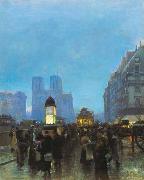
(1870 - 1911) was a Hungarian artist born at Szekesfeherver. He was educated at Budapest, Milan, and Paris, being in the last-named city a pupil of J. P. Laurens and of B. Constant. His first work, "The Cathedral of Notre Dame," attracted attention at the exposition in Budapest in 1896, while his etchings are especially valued in London and Vienna. His best-known works are: "Peasant Mowing," "A Lane in Dort," and "The Island of Capri," in the historical art museum of Budapest; and "The Smithy," owned by Archduchess Isabella.
|
|
 |
Edward La Trobe Bateman
|
|
book illuminator, draughtsman, architectural decorator and garden designer.
English
c.1815-1897
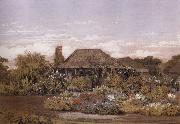
was a pre-raphaelite landscape artist, book illuminator and draughtsman. He was probably born in Derbyshire. Edward had lived in London where he had been engaged to the daughter of William and Mary Howitt. Edward visited Australia and stayed initially with Godfrey Howitt. In 1856, the Carlton Gardens in Melbourne were redesigned and Edward la Trobe Bateman was engaged to do the designs. |
|
 |
edward r taylor
|
|
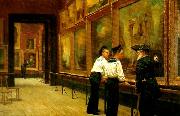
Edward Richard Taylor RBSA (June 14, 1838 - January 11, 1911) was an English artist and educator. He painted in both oils and watercolours.
Taylor taught at the Lincoln School of Art and became influential in the Arts and Crafts movement as the first headmaster at the Birmingham Municipal School of Arts and Crafts from 1877-1903.
In December 1898, he founded Ruskin Pottery at Smethwick, Staffordshire. His son William Howson Taylor (1876 -1935) took over Ruskin Pottery after the death of his father. |
|
 |
Edward Theodore Compton
|
|
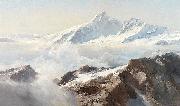
(July 29 1849 - March 22 1921) was an English-born, German artist, illustrator and mountain climber. He is well-known for his paintings and drawings of alpine scenery, and as a mountaineer made 300 major ascents including no fewer than 27 first ascents.
Compton was born in Stoke Newington in London, the son of Theodore Compton, an art-loving insurance agent, and grew up in a deeply religious Quaker household. He attended various art schools, including, for a time, the Royal Academy in London, but otherwise he was mainly self-taught in art.
|
|
 |
Edward Troye
|
|
American Artist .
b.1808 d.1874
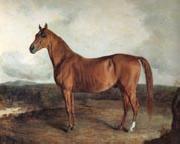
American painter of Swiss birth. Before 1822, his father, Jean-Baptiste de Troy, a sculptor of minor fame, moved his family to England, where Edward was instructed in drawing and perhaps painting. The animal painter Jacques-Laurent Agasse knew the family well. Troye wrote in 1857 that he was trained in London by the best masters and stated that he followed the style of George Stubbs and John N. Sartorius. In 1831 Troye arrived in Philadelphia, where he was employed as a magazine illustrator. The following year he exhibited animal subjects at the annual Pennsylvania Academy of Fine Arts exhibition and rapidly found patrons among racehorse owners. His typical works show motionless, unsaddled and riderless animals against a low horizon |
|
|
|
 |
Ettore Tito
|
|
(17 December 1859-26 June 1941) was an Italian artist particularly known for his paintings of contemporary life and landscapes in Venice and the surrounding region. He trained at the Accademia di Belle Arti in Venice and from 1894 to 1927 was the Professor of Painting there. Tito exhibited widely and was awarded the Grand Prize in painting at the 1915 Panama CPacific International Exposition in San Francisco. In 1926 he was made a member of the Royal Academy of Italy. Tito was born in Castellammare di Stabia in the province of Naples and died in Venice, the city which was his home for most of his life. |
|
|
|
|
|
|
|
|
|
 |
Francesco Trevisani
|
|
Italian Rococo Era Painter , Capodistria 1656-1746 Rome
was an Italian painter, active in the period called either early Rococo or late Baroque (barochetto) Born in Capodistria (modern Koper, then part of the Republic of Venice), he was the son of Antonio Trevisani, an architect, by whom he was instructed in the first rudiments of design. He then studied in Venice under Antonio Zanchi. He moved to Rome, where he remained until his death, in 1678. His brother, Angelo Trevisani remained a prominent painter in Venice. In Rome, he was supported by Cardinal Pietro Ottoboni. He was strongly influenced by Carlo Maratta, as it is manifest in his masterpiece, the frescoes in San Silvestro in Capite (1695-1696). In this commission, he worked alongside Giuseppe Chiari and Ludovico Gimignani. In Rome, he was favored with the patronage of Cardinal Chigi. Chigi employed him in several considerable works, and recommended him to the protection of Pope Clement XI, who not only commissioned him to paint one of the Prophets in San Giovanni Laterano, but engaged him to decorate the cupola of the cathedral in Urbino. There he represented, in fresco, allegories of the four Quarters of the World, in which he displayed much invention and ingenuity. He was employed by the Duke of Modena, in copying the works of Correggio, Parmigianino, and also painted in Brunswick, Madrid, Munich, Stockholm, and Vienna. He also shows Maratta's influence in the cartoons for baptismal chapel in St. Peter's Basilica, in the oval with Prophet Baruch in San Giovanni in Laterano, and in the Death of St. Joseph in Sant'Ignazio. Trevisani painted scenes from the Life of the Blessed Lucy of Narni in the church of Narni (1714-15). |
|
 |
Francis Towne
|
|
English Painter, 1739-1816
was an English water-colour painter. He was born in Isleworth, Middlesex, the son of a corn chandler. Apprenticed to a coach painter in London, he won a design prize from the Society of Arts, and studied for a while at St Martin??s Lane Academy. In 1763 he was employed by a coach painter called Thomas Watson, and went to Exeter on business. He had already begun painting in oils and also taught drawing, and now he began to accept commissions from wealthy families in Devon. After a tour of north Wales in 1777, undertaken with his friend, the lawyer John White, he began to specialize in water-colours. In 1780 he travelled to Rome and from there to Naples. On his return to Devon, he was asked by Sir Thomas and Lady Acland of Killerton to paint some views in Devon and North Wales, and in 1786 he went on a painting tour of the Lake District |
|
 |
Francisco de herrera the elder
|
|
Spanish Baroque Era Painter, ca.1590-1656
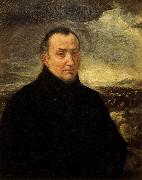
Spanish painter. His early works are in the Mannerist style. Under the influence of Francisco Zurbaren, he developed the naturalistic style seen in his four scenes from the life of St. Bonaventure (1627). About 1650 he moved to Madrid. His last documented work, a painting of St. Joseph (1648) influenced by Anthony Van Dyck, features elongated forms and elaborate draperies. He achieved considerable fame in Sevilla, where Diego Velezquez was briefly his pupil. His work marked the transition from Mannerism to the Baroque. His son, Francisco Herrera the Younger |
|
 |
Francois de Troy
|
|
French Baroque Era Painter, 1645-1730
was a French painter and engraver who became principal painter to King James II in exile at Saint-Germain-en-Laye and Director of the Academie Royale de peinture et de sculpture. One of a family of artists, Troy was born in Toulouse, the son of Nicolas de Troy (1608 - 15 September 1684), a painter in that city,and was the brother of Jean de Troy (4 April 1638 - 25 June 1691).Troy was taught the basic skills of painting by his father, and perhaps also by the more worldly Antoine Durand. François de Troy is not to be confused with his son, the portrait painter Jean-François de Troy (1679-1752), who studied under him At some time after 1662, Troy went to Paris to study portrait painting under Claude Lefebvre (1633-1675) and Nicolas-Pierre Loir (1624 - C1679]. A. P. F. Robert-Dumesnil states that this occurred when Troy was aged twenty-four. In 1669, Troy married his master Nicolas-Pierre Loir's sister-in-law, Jeanne Cotelle. In 1671, he was approved by the Academie Royale de peinture et de sculpture. In 1674, he was received into the Academy as a history painter, with a reception piece (morceau de reception) entitled Mercure coupant la tete d'Argus ('Mercury cutting off the head of Argus'). Troy's early known works include tapestry designs for Madame de Montespan, one of the many mistresses of Louis XIV of France, and paintings with religious and mythological subjects. In the 1670s, he became friendly with Roger de Piles, who introduced him to Dutch and Flemish painting, |
|
 |
Francois Louis Thomas Francia
|
|
French, 1772-1839
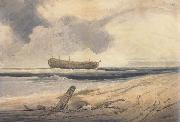
was a French painter born in Calais and famous for his shore landscapes. He was the master of the young British painter Richard Parkes Bonington. This article about a French painter is a stub. |
|
|
|
 |
Frans Pourbus the younger
|
|
Flemish Baroque Era Painter, 1569-1622
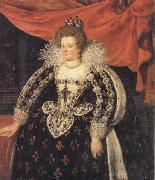
was a Flemish painter, son of Frans Pourbus the Elder and grandson of Pieter Pourbus. He was born in Antwerp and died in Paris. He is also referred to as "Frans II". Pourbus worked for many of the highly influential people of his day, including the Brussels-based Spanish Regents of the Netherlands, the Duke of Mantua and Marie de' Medici, Queen of France. Works of his can be found in the Louvre, the Prado, the Rijksmuseum, the Royal College of Art, the Metropolitan Museum of Art and many other museums. |
|
 |
Frans van mieris the elder
|
|
Dutch Baroque Era Painter, 1635-1681
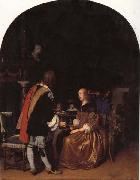
was a Dutch genre and portrait painter. The leading member of a Leiden family of painters, his sons Jan (1660-1690) and Willem (1662 C1747) and his grandson Frans van Mieris the Younger (1689 C1763) were also accomplished genre painters. Frans was the son of Jan Bastiaans van Mieris, a goldsmith, carver of rubies and diamond setter at Leiden. His father wished to train him to his own business, but Frans preferred drawing, and took service with Abraham Torenvliet, a glazier who kept a school of design. In his father's shop he became familiar with the ways and dress of people of distinction. His eye was fascinated in turn by the sheen of jewelry and stained glass; and, though he soon gave up the teaching of Torenvliet for that of Gerard Dou and Abraham van den Tempel, he acquired a manner which had more of the finish of the exquisites of the Dutch school than of the breadth of the disciples of Rembrandt. It should be borne in mind that he seldom chose panels of which the size exceeded 12 to 15 inches, and whenever his name is attached to a picture above that size we may surely assign it to his son Willem or to some other imitator. Unlike Dou when he first left Rembrandt, or Jan Steen when he started on an independent career, Mieris never ventured to design figures as large as life. Characteristic of his art in its minute proportions is a shiny brightness and metallic polish. The Music Lesson,National Museum of Serbia , BelgradeThe subjects which he treated best are those in which he illustrated the habits or actions of the wealthier classes; but he sometimes succeeded in homely incidents and in portrait, and not unfrequently he ventured on allegory. He repeatedly painted the satin skirt which Ter Borch brought into fashion, and he often rivalled Ter Borch in the faithful rendering of rich and highly-coloured woven tissues. But he remained below Ter Borch and Metsu, because he had not their delicate perception of harmony or their charming mellowness of touch and tint, and he fell behind Gerard Dou, because he was hard and had not his feeling for effect by concentrated light and shade. In the form of his composition, which sometimes represents the framework of a window enlivened with greenery, and adorned with bas-reliefs within which figures are seen to the waist, his model is certainly Dou. |
|
|
|
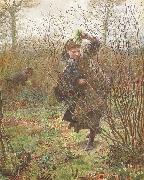 |
Frederick Walker,ARA,RWS
|
|
1840-1875
English painter and illustrator. He acquired his training in drawing and painting through study in the British Museum (where he copied heavily from the Antique), a short period spent in an architect's office, life classes at Leigh's school, a studentship at the Royal Academy and three years' employment as a draughtsman on wood with the commercial engraver Josiah Wood Whymper (1813-1903). |
|
|
|
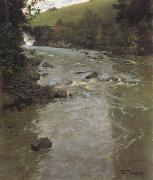 |
Frits Thaulow
|
|
Norwegian Impressionist Painter, 1847-1906
.Norwegian painter and engraver. Originally wanting to become a marine painter he studied at the art academy in Copenhagen (1870-73) as well as with the Danish marine specialist C. F. S?rensen (1818-79). He spent two winters at Karlsruhe (1873-4, 1874-5) as the pupil of Hans Gude and then went to Paris, where he spent much of the period 1875-9. His marines and coastal pictures, some of which were accepted at the Paris Salon, were only moderately successful, but he acquired a fair knowledge of contemporary French Realist art and felt that Norwegian artists should learn from it. |
|
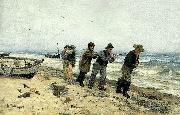 |
fritz thaulow
|
|
född 1847 i Christiania, död 5 november 1906, var en norsk målare. Han är en av de internationellt mest kända norska konstnärerna från 1800-talet.
Thaulow fick sin utbildning vid Konstakademin i Köpenhamn 1870 -72, och 1873-75 var han elev till Hans Gude i Karlsruhe. Åren efter detta uppehöll han sig för det mesta i Paris där han fick avgörande intryck från de franska impressionisterna.
1880 vände Thaulow hem som överbevisad naturalist. Tillsammans med Christian Krohg och Erik Werenskiold blev han snabbt en av ledarna i de unge konstnärernas kamp för en rikare och mer vidsynt norsk konstmiljö. Thaulow var bl.a. med på att etablera den första Höstutställningen 1882.
1892 slog han sig ner i Frankrike, och han besökte USA 1898. Från och med samma år bosatte han sig i Paris, där han blev en kändis och blev också känd internationellt, bl.a. genom att bli antagen till den prestigefulla Salongen. |
|
|
|
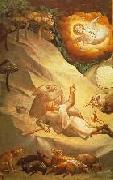 |
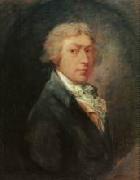
GADDI, Taddeo
|
|
Italian Early Renaissance Painter, ca.1300-1366
Italian painter active in Florence. He was the son of a painter and mosaicist and a student of Giotto. His best-known works are frescoes in the church of Santa Croce in Florence. He directed a flourishing workshop for three decades, producing pictures in the style of Giotto but featuring more vivid picturesque effects with narrative detail. His son and pupil Agnolo (c. 1350 C 96) was an influential and prolific artist who likewise produced a notable series of frescoes for Santa Croce, The Legend of the True Cross |
|
 |
GAINSBOROUGH, Thomas
|
|
English Rococo Era/Romantic Painter, 1727-1788
English painter, draughtsman and printmaker. He was the contemporary and rival of Joshua Reynolds, who honoured him on 10 December 1788 with a valedictory Discourse (pubd London, 1789), in which he stated: 'If ever this nation should produce genius sufficient to acquire to us the honourable distinction of an English School, the name of Gainsborough will be transmitted to posterity, in the history of Art, among the very first of that rising name.' He went on to consider Gainsborough's portraits, landscapes and fancy pictures within the Old Master tradition, against which, in his view, modern painting had always to match itself. Reynolds was acknowledging a general opinion that Gainsborough was one of the most significant painters of their generation. Less ambitious than Reynolds in his portraits, he nevertheless painted with elegance and virtuosity. He founded his landscape manner largely on the study of northern European artists and developed a very beautiful and often poignant imagery of the British countryside. By the mid-1760s he was making formal allusions to a wide range of previous art, from Rubens and Watteau to, eventually, Claude and Titian. He was as various in his drawings and was among the first to take up the new printmaking techniques of aquatint and soft-ground etching. Because his friend, the musician and painter William Jackson (1730-1803), claimed that Gainsborough detested reading, there has been a tendency to deny him any literacy. He was, nevertheless, as his surviving letters show, verbally adept, extremely witty and highly cultured. He loved music and performed well. He was a person of rapidly changing moods, humorous, brilliant and witty. At the time of his death he was expanding the range of his art, having lived through one of the more complex and creative phases in the history of British painting. He painted with unmatched skill and bravura; while giving the impression of a kind of holy innocence, he was among the most artistically learned and sophisticated painters of his generation. It has been usual to consider his career in terms of the rivalry with Reynolds that was acknowledged by their contemporaries; while Reynolds maintained an intellectual and academic ideal of art, Gainsborough grounded his imagery on contemporary life, maintaining an aesthetic outlook previously given its most powerful expression by William Hogarth. |
|
|
|
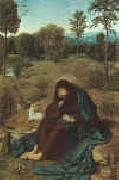 |
Geertgen Tot Sint Jans
|
|
Netherlandish Northern Renaissance Painter, ca.1460-1490
Geertgen tot Sint Jans is also known as Geertgen van Haarlem, Gerrit van Haarlem, or Gerrit Gerritsz.[citation needed] Alternative spellings of his first name are Gheertgen, Geerrit, and Gheerrit, where G(h)eertgen is the diminutive form of G(h)eerrit.
Presumably, he was born in Leiden, then in the Burgundian Netherlands in the Holy Roman Empire, around the year 1465. The assignment of Leiden as his birth place is traceable to a 17th century print by Jacob van Matham. There is no known archival evidence for this claim by Jacob van Matham. The modern acceptance of Leiden as Geertgen's birth place is roughly traceable to Johann Kessler's dissertation of 1930.
Probably, Geertgen was a pupil of Albert van Ouwater, who was one of the first oil painters in the northern Low Countries. Both painters lived in the city of Haarlem. Geertgen was attached to the monastery of the Knights of Saint John, for whom he painted an altarpiece. Although Geertgen was not a member of the Order of Saint John, his last name "tot Sint Jans" was derived from the order's name and means "unto Saint John".
Geertgen died in Haarlem, then the Habsburg Netherlands in the Holy Roman Empire, around the year 1495, when he was approximately 28 years old. He was buried in the monastery of the Knights of Saint John. Modern scholars have attempted to calculate the artist's death date with the information from The Painting-Book (Middle Dutch: Het Schilder-Boeck) by Karel van Mander, published in 1604. There are some archival traces that suggest he may in fact have lived into the 16th century. |
|
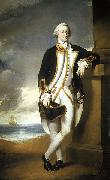 |
George Dance the Younger
|
|
George Dance the Younger (1 April 1741 - 14 January 1825) was an English architect and surveyor. The fifth and youngest son of George Dance the Elder, he came from a distinguished family of architects, artists and dramatists. He was hailed by Sir John Summerson as "among the few really outstanding architects of the century", but few of his buildings remain.
He was educated at the St. Paul's School, London. Aged 17, he was sent to Italy to prepare himself for an architectural career and joined his brother Nathaniel, who was studying painting in Rome. George was a member of academies in Italy, showing much promise as a draughtsman, and much of his later work was inspired by Piranesi, with whom he was acquainted.
He succeeded his father as City of London surveyor and architect on his father's death in 1768, when he was only 27. He had already distinguished himself by designs for Blackfriars Bridge, sent to the 1761 exhibition of the Incorporated Society of Artists.
His earliest London project was the rebuilding of All Hallows-on-the-Wall church in 1767. His first major public works were the rebuilding of Newgate Prison in 1770 and the front of the Guildhall, London. His other London works include the church of St Bartholomew-the-Less (1797). In Bath he largely designed the Theatre Royal, built by John Palmer in 1804-5. Sir John Soane was a pupil.
Many of his buildings have been demolished, including the Royal College of Surgeons, Newgate Prison, St Luke's Hospital for Lunatics, the Shakespeare Gallery in Pall Mall, the library at Lansdowne House, the Common Council Chamber and Chamberlain's Court at the Guildhall, Ashburnham Place, and Stratton Park (demolished save for its Tuscan portico)
With his brother Nathaniel, he was a founder member of the Royal Academy in 1768, and its second professor of architecture, from 1798 to 1805. For a number of years, he was the last survivor of the 40 original Academicians.
|
|
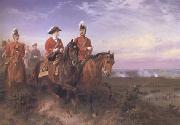 |
George Thomas
|
|
1816-1870
Union general in the American Civil War, b. Southampton co., Va. He served in the Seminole War and in the Mexican War. Later he taught at West Point and served in Texas. As a brigadier general of volunteers, he was sent to Kentucky, where he defeated the Confederates at Mill Springs (Jan., 1862). Thomas served under General Buell at Shiloh, Corinth, and Perryville. In the Chattanooga campaign, his stand on Sept. 20, 1863, which saved the Union army from complete rout, won for him the sobriquet Rock of Chickamauga. Appointed brigadier general in the regular army, he succeeded General Rosecrans in command of the Army of the Cumberland (Oct., 1863) and served under Ulysses S. Grant around Chattanooga and under General Sherman in the Atlanta campaign. With the fall of Atlanta (Sept., 1864), Grant ordered Thomas to pursue the army of General Hood into Tennessee. Although accused by Grant of moving too slowly, and threatened with the loss of his command, Thomas waited and finally defeated Hood at Nashville (Dec., 1864). |
|
|
|
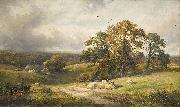 |
George Turner
|
|
1750-1843.
Turner was born in Cromford, Derbyshire in England, but then moved to Derby with his family. He showed an early talent for music and art - encouraged by his father Thomas Turner, who although a tailor by profession was also an art enthusiast. Turner was largely self-taught and went on to become a professional painter and art teacher.
A quiet scene in Derbyshire (1885)Turner lived in Derbyshire all his life. In 1865 he married Eliza Lakin (1837 - 1900), becoming a part-time farmer and raising four children at Walnut farm in Barrow upon Trent.[1] After Eliza's death in 1900, he moved to Kirk Ireton and later married fellow artist Kate Stevens Smith (1871-1964) - they set up home in Idridgehay where he died in 1910. His son William Lakin Turner (1867-1929) also became a landscape oil painter of repute.
Turner worked in oils and painted bucolic scenes mainly of his native Derbyshire, leaving an important legacy of hundreds of pictures depicting the English countryside before the coming of mechanisation, the motor car and urban expansion. His work was exhibited in Nottingham and Birmingham. Turner served on the Art Committee of Derby Art Gallery and both his and his son's paintings are included in the city's collection. |
|
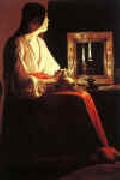 |
Georges de La Tour
|
|
1593-1652
French
Georges de La Tour Galleries
His early work shows influences from Caravaggio, probably via his Dutch followers, and the genre scenes of cheats??as in The Fortune Teller ??and fighting beggars clearly derive from the Dutch Caravaggisti, and probably also his fellow-Lorrainer, Jacques Bellange. These are believed to date from relatively early in his career.
La Tour is best known for the nocturnal light effects which he developed much further than his artistic predecessors had done, and transferred their use in the genre subjects in the paintings of the Dutch Caravaggisti to religious painting in his. Unlike Caravaggio his religious paintings lack dramatic effects. He painted these in a second phase of his style, perhaps beginning in the 1640s, using chiaroscuro, careful geometrical compositions, and very simplified painting of forms. His work moves during his career towards greater simplicity and stillness ?? taking from Caravaggio very different qualities than Jusepe de Ribera and his Tenebrist followers did.
He often painted several variations on the same subjects, and his surviving output is relatively small. His son Etienne was his pupil, and distinguishing between their work in versions of La Tour's compositions is difficult. The version of the Education of the Virgin, in the Frick Collection in New York is an example, as the Museum itself admits. Another group of paintings (example left), of great skill but claimed to be different in style to those of de La Tour, have been attributed to an unknown "Hurdy-gurdy Master". All show older male figures (one group in Malibu includes a female), mostly solitary, either beggars or saints.
After his death in 1652, La Tour's work was largely forgotten until rediscovered by Hermann Voss, a German scholar, in 1915. In 1935 an exhibition in Paris began the revival in interest among a wider public. In the twentieth century a number of his works were identified once more, and forgers tried to help meet the new demand; many aspects of his œuvre remain controversial among art historians. |
|
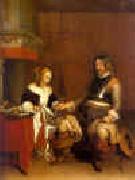 |
Gerard Ter Borch
|
|
1617-1681
Dutch
Gerard Ter Borch Locations
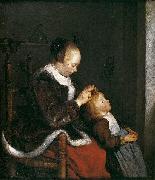
Gerard Ter Borch was born in Zwolle. His first teacher was his father, Gerard Ter Borch the Elder, who in his youth had spent some years in Rome and returned with drawings he had made as well as some he had collected in Italy. The son precociously revealed his gifts as a draftsman, as shown in his drawing of a man on horseback (1625).
Ter Borch traveled widely. In 1634 he was in Haarlem, in 1635 in London, in 1640 probably in Rome. A visit to Spain is reflected in reminiscences of Diego Velazquez in the style and psychological penetration of Ter Borch s portraits. His famous portrait Helena van der Schalke as a Child (ca. 1644) calls to mind Velazquez s Infantas; the placement of the figure in palpable yet undefined space, without the indication of a floor line, is a masterful adoption of the Spanish masters invention.
Between 1645 and 1648 Ter Borch was in Munster, Germany, where he went to seek portrait commissions during the meetings that ended the 80 years of war between the United Provinces and Spain. His small group portrait Swearing of the Oath of Ratification of the Treaty of Munster is a rare example in Dutch 17th-century painting of the recording of an actual historical event. It includes more than 50 recognizable portraits. The painter asked for this work the enormous price of 6, 000 guilders. Apparently no buyer was found, for the picture was in the hands of his widow after his death. From 1654 on Ter Borch lived mainly in Deventer, where he married, became a citizen, held honorary office, and died on Dec. 8, 1681.
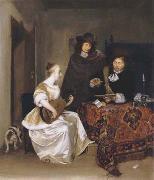
Ter Borch s early paintings were mainly scenes of military life, painted with great subtlety of color and values. Later he showed a predilection for small, dainty interior scenes, in which he revealed his delight in the sheen of satin and the grace of charming women. The elegance of his figures has tended to obscure the fact that in many cases they are shown as participants in situations of amatory commerce. The figures and costumes are painted with care and high finish that is not matched in the settings and backgrounds, which are often not well realized. The Music Lesson (ca. 1675) is a characteristic late example of Ter Borchs favorite subject matter. His most able pupil, Caspar Netscher, became a successful portraitist in the small-scale and fashionable tradition of his master. |
|
|
|
|
|
|
|
|
|
|