|
|
|
|
|
|
 |
Antonio Viladomat y Manalt
|
|
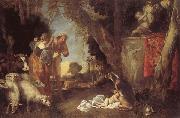
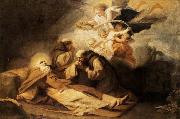
Spanish, 1678-1755,Spanish Catalan painter. He was the most significant figure in Catalan painting from the end of the 17th century to the first half of the 18th. He trained with P. B. Savall and J. B. Perram?n in Barcelona. The arrival of the Archduke Charles (later Charles VI) of Austria in Barcelona in 1703 as a pretender to the throne during the War of the Spanish Succession (1702-13), accompanied by such Italian artists as Ferdinando Galli-Bibiena, acquainted Viladomat y Manalt with artistic trends in Italy. He experienced problems with the artists' guild in Barcelona because of his refusal to participate in the traditional work system. Despite this, his workshop-academy became a centre for the training of numerous painters, sculptors and engravers. Viladomat y Manalt was principally a religious painter, and his oil paintings include Christ Appearing to St Ignatius of Loyola (c. 1711-20; Barcelona, Jesuit Convent) and St Augustine and the Holy Family (Madrid, Prado). He also painted such murals as the tempera Angels with the Sudarium (c. 1727; Matare, S Mar?a, Capilla de los Dolores), but most of the others have disappeared. He painted an extensive series of monastic and evangelical works, in which his revival of compositions characteristic of the Spanish Golden Age is apparent. Examples include the Stigmatization of St Francis (c. 1724; Barcelona, Mus. A. Catalunya), part of a cycle of paintings on the life of St Francis commissioned for the cloister of the convent of S Francisco de As?s in Barcelona. His late Baroque style is related to the severe and realistic trend in Spanish painting in the early 17th century. Some interesting profane allegories by the artist are extant, notably the series Four Seasons (c. 1720-30; Barcelona, Mus. A. Catalunya), which consists of landscapes with genre scenes. Several of the still-lifes by Viladomat y Manalt such as the realistic Still-life with Dead Turkey (Barcelona, Mus. A. Catalunya), which has strong contrasts of light, bear an affinity with Neapolitan painting of the last decades of the 17th century. |
|
|
|
|
|
 |
Aristide Maillol
|
|
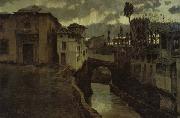
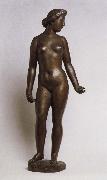
1861-1944 Banyuls-sur-Mer,was a French Catalan sculptor and painter. Maillol was born in Banyuls-sur-Mer, Roussillon. He decided at an early age to become a painter, and moved to Paris in 1881 to study art. After several applications, his enrollment in the Ecole des Beaux-Arts was accepted in 1885, and he studied there under Jean-Leon Gerome and Alexandre Cabanel. His early paintings show the influence of his contemporaries Pierre Puvis de Chavannes and Paul Gauguin. Gauguin encouraged his growing interest in decorative art, an interest that led Maillol to take up tapestry design. In 1893 Maillol opened a tapestry workshop in Banyuls, producing works whose high technical and esthetic quality gained him recognition for renewing this art form in France. He began making small terra cotta sculptures in 1895, and within a few years his concentration on sculpture led to the abandonment of his work in tapestry. The subject of nearly all of Maillol's mature work is the naked female body, treated with a classical emphasis on stable forms. The figurative style of his large bronzes is perceived as an important precursor to the greater simplifications of Henry Moore and Alberto Giacometti, and his serene classicism set a standard for European (and American) figure sculpture until the end of World War II. His important public commissions include a 1912 commission for a monument to Cezanne, as well as numerous war memorials commissioned after World War I. He died in Banyuls at the age of eighty-three, in an automobile accident. |
|
 |
Arman Manookian
|
|
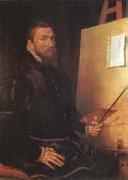
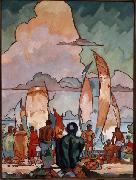
(1904 - 1931) was an Armenian-American painter. He was the oldest of three children born to a Christian Armenian family in Constantinople. As a teenager, he survived the Armenian Genocide. Manookian immigrated to the United States in 1920, at the age of 16, and studied illustration at the Rhode Island School of Design. He also took classes at the Art Students League of New York before enlisting in the United States Marine Corps in 1923. While serving in the U. S. Marine Corps he was assigned as a clerk to the author and historian, Major Edwin North McClellan. In 1925, McClellan and Manookian were transferred to Pearl Harbor. The latter supplied illustrations for Leatherneck Magazine and produced about 75 ink drawings for McClellanes history of the United States Marine Corps, which was never published. These drawings are now in the collection of the Honolulu Academy of Arts.
In 1927, Manookian was honorably discharged from the Marine Corps, but remained in Hawaii. He worked for the Honolulu Star-Bulletin and for Paradise of the Pacific.
His paintings are rare and highly valued due to his early death, by suicide, in 1931, and fewer than 30 are in existence. The Honolulu Academy of Arts held a memorial exhibition shortly after Manookianes death and a retrospective exhibition titled Meaning in Color/Expression in Line: Arman Manookianes Modernism Nov. 4, 2010 through April 24, 2011. The Bishop Museum and the Honolulu Academy of Arts are among the public collections holding works by Arman T. Manookian. According to the State of Hawaii's House of Representatives, he is "known as Hawaii's Van Gogh".
In early 2010 a group of seven Manookian paintings owned by the Hotel Hana-Maui were removed from public display. They were the only Manookian oil paintings known to be on public display anywhere in the world. Two of the murals, Red Sails and Hawaiian Boy and Girl, are now on long-term loan to the Honolulu Academy of Arts.
|
|
|
|
 |
Arthur Mathews
|
|
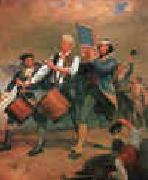
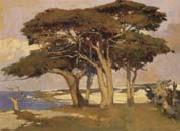
an American Tonalist painter who was one of the founders of the American Arts and Crafts movement
1860-1945
|
|
 |
Arthur Melville
|
|
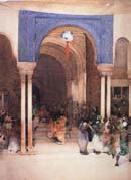
British Painter, 1858-1904, Scottish painter. He was trained in Edinburgh under James Campbell Noble (1846-1913) and at the Royal Scottish Academy Schools. His early works are peasant subjects in a subdued tonal style. While at the Acad?mie Julian in Paris and at Grez-sur-Loing (1878-81) he developed a colouristic watercolour style with strong chiaroscuro. This was consolidated during his journey in 1881 to Egypt and Constantinople, and on trips between 1890 and 1893 to Spain (with Frank Brangwyn) and North Africa. Contrasts of strong sunlight and coloured shadows were created in his 'blottesque' technique of colour droplets on paper saturated with Chinese white: sponge and brushwork were used to clarify form, as in Little Bullfight: 'Bravo Toro' (c. 1888-9; London, V&A). He was associated with the Glasgow Boys and influenced their development of colour and design. His closest contact with them came during outdoor sketching trips in Scotland between 1882 and 1889, and in Paris in 1886 and 1889. In 1886 he became an Associate of the Royal Scottish Academy and developed a strongly decorative oil style, seen in Audrey and her Goats (1884-9; London, Tate). |
|
|
|
 |
Artist Adolphe Joseph Thomas Monticelli
|
|
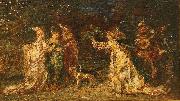
(October 14, 1824 - June 29, 1886) was a French painter of the generation preceding the Impressionists.
Monticelli was born in Marseille in humble circumstances. He attended the École Municipale de Dessin in Marseille from 1842 to 1846, and continued his artistic training in Paris, where he studied under Paul Delaroche at the École des Beaux-Arts. In Paris he made copies after the Old Masters in the Louvre, and admired the oil sketches of Eugene Delacroix. In 1855 he met Narcisse Diaz, a member of the Barbizon school, and the two often painted together in the Fontainebleau Forest. Monticelli frequently adopted Diaz's practice of introducing nudes or elegantly costumed figures into his landscapes.
He developed a highly individual Romantic style of painting, in which richly colored, dappled, textured and glazed surfaces produce a scintillating effect. He painted courtly subjects inspired by Antoine Watteau; he also painted still lives, portraits, and Orientalist subjects that owe much to the example of Delacroix.
After 1870, Monticelli returned to Marseille, where he would live in poverty despite a prolific output, selling his paintings for small sums. An unworldly man, he dedicated himself singlemindedly to his art.
The young Paul Cezanne had befriended Monticelli in the 1860s, and the influence of the older painter's work can be seen in Cezanne's work of that decade. Between 1878 and 1884 the two artists often painted landscapes together, once spending a month roaming the Aix countryside. Although Monticelli experimented briefly around 1870 with a treatment of light reflecting the discoveries of the Impressionists, he found the objectivity of this approach uncongenial.
Confronted with criticism of his style of painting Monticelli himself remarked, "I paint for thirty years from now". The work of this instinctive painter reached its greatest spontaneity in the decade before his death in 1886.
|
|
 |
Arturo Michelena
|
|
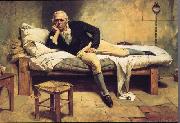
16 June 1863 - 29 July 1898) was a Venezuelan painter born in Valencia, Carabobo State. He began to paint at a young age under his father's tutelage. Traveled to Paris where he studied in the famous Academie Julian. He was the first Venezuelan artist to succeed overseas and, with Cristebal Rojas (1857-1890) and Marten Tovar y Tovar (1827-1902), one of the most important Venezuelan painters of the 19th century.
His first great success occurred in Paris at Le Salon des Artistes Français in 1887. Encouraged by his teacher Jean-Paul Laurens (1838-1921), Michelena presented a canvas titled L'Enfant Malade (The sick boy) which was awarded the Gold Medal, second class, the highest honor a foreign artist could receive at the salon. The painting was quickly considered a masterpiece and was acquired by the Astors in New York in the late 19th century. Later the painting traveled to South Florida when it was acquired by Owens Burns, a business partner of John Ringling, the circus magnate. After Burns' death the painting was stored in the Ringling Museum's vaults where it remained away from public view for more than 60 years. In 2004 Sotheby's rescued the canvas and arranged for it to be included in an auction of Latin American art.
|
|
 |
August Macke
|
|
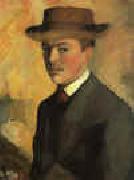
1887-1914
August Macke Locations
August Macke was born in Meschede, Germany. His father, August Friedrich Hermann Macke (1845-1904), was a building contractor and his mother, Maria Florentine, n??e Adolph, (1848-1922), came from a farming family in Germany's Sauerland region. The family lived at Br??sseler Straße until August was 13. He then lived most of his creative life in Bonn, with the exception of a few periods spent at Lake Thun in Switzerland and various trips to Paris, Italy, Holland and Tunisia. In Paris, where he traveled for the first time in 1907, Macke saw the work of the Impressionists, and shortly after he went to Berlin and spent a few months in Lovis Corinth's studio. His style was formed within the mode of French Impressionism and Post-impressionism and later went through a Fauve period. In 1909 he married Elizabeth Gerhardt. In 1910, through his friendship with Franz Marc, Macke met Kandinsky and for a while shared the non-objective aesthetic and the mystical and symbolic interests of Der Blaue Reiter.
Macke's meeting with Robert Delaunay in Paris in 1912 was to be a sort of revelation for him. Delaunay's chromatic Cubism, which Apollinaire had called Orphism, influenced Macke's art from that point onwards. His Shops Windows can be considered a personal interpretation of Delaunay's Windows, combined with the simultaneity of images found in Italian Futurism. The exotic atmosphere of Tunisia, where Macke traveled in 1914 with Paul Klee and Louis Moilliet was fundamental for the creation of the luminist approach of his final period, during which he produced a series of works now considered masterpieces. August Macke's oeuvre can be considered as Expressionism, (the movement that flourished in Germany between 1905 and 1925) and also his work was part of Fauvism. The paintings concentrate primarily on expressing emotion, his style of work represents feelings and moods rather than reproducing objective reality, usually distorting colour and form.
Macke's career was cut short by his early death at the front in Champagne in September 1914, the second month of World War I. His final painting, Farewell, depicts the mood of gloom that settled after the outbreak of war.
|
|
|
|
 |
auguste macke
|
|
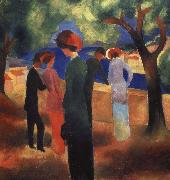
August Macke (1887-1914) was a German painter whose harmonious and simple scenes of everyday life made a unique contribution to Expressionism. |
|
|
|
 |
Aureliano De Beruete Y Moret
|
|
Spanish , Madrid, 1845 - Madrid, 1912
Spanish writer, painter and collector. After pursuing a political career and taking a doctorate in civil and canon law, he dedicated himself to writing on art and produced important studies on Diego Velezquez (1898), Joaqu'n Sorolla y Bastida (1901) and other artists. He travelled extensively and enthusiastically in Europe (France, Belgium, Switzerland, the Netherlands, Italy, Germany, England and elsewhere), studying especially the different national schools of painting. On his travels he also painted landscapes. After working for some time as a copyist in the Museo del Prado, Beruete decided in 1873 to concentrate his efforts on painting and on learning to perfect his craft. He enrolled at the Escuela Superior de Bellas Artes de S Fernando in Madrid and also studied at the studio of Carlos de Haes. Beruete was among the founders of the Instituci'n Libre de Enseeanza, and with its members, and with Carlos de Haes, he made several study trips abroad. In Paris he came to know the painting of the Barbizon school, and in Belgium he assimilated the teaching of the generation of landscape artists who had adopted a form of Realism. |
|
 |
Barabas Miklos
|
|
(February 10, 1810 in Mărcuşa, now Romania - February 12, 1898 in Budapest) was a Hungarian painter. He his mostly known for his portrait paintings.
He was born in Kezdimerkosfalva. He spent most of his life in Pest, where he was director of the art society from 1862 until his death. He became a member of the Parliament of Hungary in 1867. He died in Budapest.
|
|
 |
Barnaba Da Modena
|
|
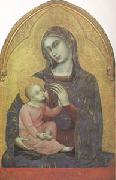
active in Genoa and Pisa 1361-1383
was an Italian painter of the mid-14th century Lombardy. There is a painting by him in the church of San Francesco in Alba. A Virgin and Child once in Frankfort, was painted in a Byzantine style and is currently located at the Museum of Fine Arts in Boston, |
|
 |
Barthelemy Menn
|
|
(20 May 1815 - 10 October 1893) was a Swiss painter and draughtsman who introduced the principles of plein-air painting and the paysage intime into Swiss art.
Menn was born in Geneva as the youngest son of four to Not (Rhaeto-Romance language form for Louis) Menn, a confectioner from Scuol in the canton of Grisons, and Charlotte-Madeleine-Marguerite Bodmer, the daughter of a wealthy farmer from Coinsins in the Canton de Vaud. Already at the age of twelve, Menn took drawing lessons from the little known Jean Duboi (1789-1849), and later, he entered the drawing school of the Geneva Arts Society. The repeated claim that he was also a pupil of the famous enameller Abraham Constantin (1785-1855) appears to be erroneous. In 1831, Menn was second in the annual drawing competition of the Geneva Art Society. The following year, he entered the studio of the Swiss history painter Jean-Leonard Lugardon (1801-1884), who was a pupil of Baron Gros(1771-1835) and acquainted with Jean-Auguste-Dominique Ingres (1780-1867). There, Menn was educated in figure drawing and composition before heading for Paris, where, in fall 1833, he entered the studio of Ingres. He was, therefore, no beginner when meeting the master, but needed some polishing and refinement in his art. In a letter to his friend Jules Hebert, Menn reported on the new situation: eEverybody, even the eldest in the studio tremble before Mr. Ingres. One fears him a lot in such a way that his corrections have a great impact. He is of an extreme sensibility,e while the education in Ingrese studio has been described by Theophile Silvestre, as follows: 'The students spend half of their time studying nature and half studying the masters among which they are especially attached to Phidias, the bas-reliefs of the Parthenon, classical sculpture in general.e This explains why among Menn's early works there are many copies after the Parthenon frieze that was accessible in Paris in a set of plaster casts at the Ecole des Beaux-Arts since 1816. (Fig. 2). Menn also copied several works by Raffael, Titian (Fig. 3), Veronese and Rubens in the Louvre, and works by Ingres.
When the latter decided to give up his studio to take the post as director of the French Academy in the Villa Medici in Rome, Menn returned to his grandparents in Coinsins before following his master in fall 1834. His journey led him first via Milan to Venice, where he met briefly his compatriot Louis-Leopold Robert (1798-1835), and where he would copy works by Titian and Tintoretto. He then travelled via Padua and Bologna to Florence, where he met old classmates from Ingrese studio, and arrived finally in Rome in spring 1835. There, Menn copied works by Raphael and Michelangelo, but he also started to produce extraordinary fresh small landscape paintings in the open air. In summer 1836, he visited the Campagna, Capri and Naples, where too he drew and painted landscapes directly from nature, and copied classical antiquities from Pompeii as well as Giovanni Bellini's Transfiguration in the Museo Borbonico. When back in Rome, he produced history - and genre paintings, of which in 1837, he sent 'Solomon presented to Wisdom by his Parents' (Salomon presente e la sagesse par son pere et sa mere; Fig.N) to the annual Salon in Geneva. Menn returned via Florence, Siena and Viterbo to Paris in late 1838, where he exhibited at the Salon from 1839 to 1843, and where he became the drawing master of Maurice Dudevant, the son of George Sand. In her circle, he became acquainted with Eugene Delacroix (1798-1863) who wanted to employ him as an assistant while working on the decoration of the cupola of the library in the Palais du Luxembourg. At the same time, Menn got to know the painters of the Barbizon School, and especially Charles Daubigny (1817-1878). Most importantly, however, Menn became friends with Camille Corot (1796-1875), who, from 1842 onwards, visited Switzerland frequently. It was also in Paris that he became acquainted with members of the Genevan Bovy family who followed the utopian socialist ideas of Charles Fourier.
|
|
 |
Bartolome Esteban Murillo
|
|
Spanish
1618-1682
Bartolome Esteban Murillo Galleries
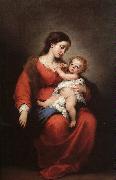
Murillo began his art studies under Juan del Castillo in Seville. Murillo became familiar with Flemish painting; the great commercial importance of Seville at the time ensured that he was also subject to influences from other regions. His first works were influenced by Zurbaran, Jusepe de Ribera and Alonso Cano, and he shared their strongly realist approach. As his painting developed, his more important works evolved towards the polished style that suited the bourgeois and aristocratic tastes of the time, demonstrated especially in his Roman Catholic religious works.
In 1642, at the age of 26 he moved to Madrid, where he most likely became familiar with the work of Velazquez, and would have seen the work of Venetian and Flemish masters in the royal collections; the rich colors and softly modeled forms of his subsequent work suggest these influences. He returned to Seville in 1645. In that year, he painted thirteen canvases for the monastery of St. Francisco el Grande in Seville which gave his reputation a well-deserved boost. Following the completion of a pair of pictures for the Seville Cathedral, he began to specialise in the themes that brought him his greatest successes, the Virgin and Child, and the Immaculate Conception.
After another period in Madrid, from 1658 to 1660, he returned to Seville. Here he was one of the founders of the Academia de Bellas Artes (Academy of Art), sharing its direction, in 1660, with the architect, Francisco Herrera the Younger. This was his period of greatest activity, and he received numerous important commissions, among them the altarpieces for the Augustinian monastery, the paintings for Santa Mar??a la Blanca (completed in 1665), and others. |
|
 |
Bartolomeo Manfredi
|
|
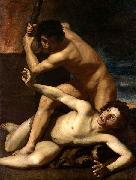
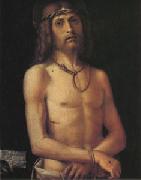
(baptised 25 August 1582 - 12 December 1622) was an Italian painter, a leading member of the Caravaggisti (followers of Michelangelo Merisi da Caravaggio) of the early 17th century.
Manfredi was born in Ostiano, near Cremona. He may have been a pupil of Caravaggio in Romeat his famous libel trial in 1603 Caravaggio mentioned that a certain Bartolomeo, accused of distributing scurrilous poems attacking Caravaggio's detested rival Baglione, had been a servant of his. Certainly the Bartolomeo Manfredi known to art history was a close follower of Caravaggio's innovatory style, with its enhanced chiaroscuro and insistence on naturalism, with a gift for story-telling through expression and body-language.
Caravaggio in his brief careerehe rocketed to fame in 1600, was exiled from Rome in 1606, and was dead by 1610 had a profound effect on the younger generation of artists, particularly in Rome and Naples. And of these Caravaggisti (followers of Caravaggio), Manfredi seems in turn to have been the most influential in transmitting the master's legacy to the next generation, particularly with painters from France and the Netherlands who came to Italy. Unfortunately no documented, signed works by Manfredi survive, and several of the forty or so works now attributed to him were formerly believed to be by Caravaggio. The steady disentangling of Caravaggio from Manfredi has made clear that it was Manfredi, rather than his master, who was primarily responsible for popularising low-life genre painting among the second generation of Caravaggisti.
Manfredi was a successful artist, able to keep his own servant before he was thirty years old, "a man of distinguished appearance and fine behaviour" according to the biographer Giulio Mancini, although seldom sociable. He built his career around easel paintings for private clients, and never pursued the public commissions upon which wider reputations were built, but his works were widely collected in the 17th century and he was considered Caravaggio's equal or even superior. His Mars Chastising Cupid offers a tantalising hint at a lost Caravaggio: the master promised a painting on this theme to Mancini, but another of Caravaggio's patrons, Cardinal Francesco Maria Del Monte, had taken it, and Mancini therefore commissioned Manfredi to paint another for him, which Mancini considered Manfredi's best work.
Manfredi died in Rome in 1622. Gerard Seghers (or Segers; 1589-1651) was one of his pupils
|
|
 |
Bartolomeo Montagna
|
|
Orzinuovi ca 1450-Vicenza 1523
.Painter and draughtsman. Montagna is first documented in 1459 in Vicenza as a minor and, still a minor, in 1467. In 1469 he is recorded as a resident of Venice. In 1474 he was living in Vicenza where, in 1476 and 1478, he was commissioned to paint altarpieces (now lost). He has variously been considered a pupil of Andrea Mantegna (Vasari), Giovanni Bellini, Antonello da Messina, Alvise Vivarini, Domenico Morone and Vittore Carpaccio. While none of these artists, except Carpaccio, was irrelevant to Montagna's stylistic formation, scholars agree that Giovanni Bellini was the primary influence on his art. He may have worked in Bellini's shop around 1470. Several of Montagna's paintings of the Virgin and Child in which the influence of Antonello da Messina is especially marked (e.g. two in Belluno, Mus. Civ.; London, N.G., see Davies, no. 802) are likely to be close in date to Antonello's sojourn in Venice (1475-6); they are therefore best considered Montagna's earliest extant works (Gilbert, 1967) rather than as an unexplained parenthesis around 1485 between two Bellinesque phases (Puppi, 1962). These early paintings appear to be followed by others in which the geometrically rounded forms derived from Antonello become more slender and sharper-edged. Their figures are imbued with a deeply felt, individual humanity, sometimes austere and minatory, sometimes tender. Among them are some larger-scale works, |
|
 |
BASAITI, Marco
|
|
Italian Painter, ca.1470-1530
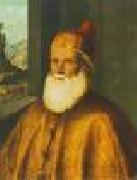
Marco Basaiti (c. 1470 ?C 1530) was a Venetian painter and a rival of Giovanni Bellini. His best known works are Christ Praying in the Garden (1516) and the Calling of St. Peter and St. Andrew.
Christ praying in the GardenThought to have originated in the Balkans, his date of birth and arrival in Venice are not known, but he began to paint actively around 1496. He is generally believed to have learned to paint in the workshops of Alvise Vivarini. Basaiti worked primarily with religious themes, but he also did portraits. Contrary to the trends of the time, he used very bright colours in rendering his religious subjects. |
|
 |
BASSETTI, Marcantonio
|
|
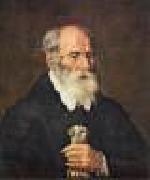
Italian painter, Veronese school (b. 1588, Verona, d. 1630, Verona)
Italian painter. He was a pupil of Felice Brusasorci (Ridolfi), but he soon moved to Venice, where he studied the art of Jacopo Tintoretto in particular, but also that of Jacopo Bassano and of Veronese, whose works he copied in chiaroscuro drawings (mainly Windsor Castle, Royal Lib.) similar to those of Domenico Tintoretto. Bassetti's early painted Portrait of a Man with a Glove (Verona, Castelvecchio) is essentially Venetian, close to the art of Bassano. |
|
 |
Benjamin Marshall
|
|
1767-1835
British
Benjamin Marshall Gallery
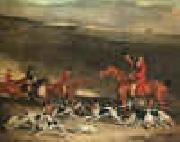
was an English sporting and animal painter. He was a follower of George Stubbs and studied under Lemuel Abbott for a short period of time. After 1792, he began painting animals, settling at Newmarket in 1812 near the racetrack. He returned to London in 1825 and died in 1835. |
|
|
|
|
|
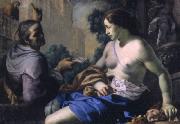 |
Bernardino Mei
|
|
(1612/15 - 1676) worked in a Baroque manner in his native Siena and in Rome, finding patronage above all in the Chigi family.
Briefly a pupil of the Sienese draughtsman and cartographer Giuliano Periccioli, where he learned the art of engraving, Bernardino passed to the studio of the painter Rutilio Manetti and probably also served in the workshop of Francesco Rustici.
He painted in and around Siena, where his work came to the attention of Cardinal Fabio Chigi, who, once elected pope as Alexander VII (1655), called Bernardino Mei to Rome in 1657. There Bernardino came under the influences of Mattia Preti, Andrea Sacchi and Pier Francesco Mola, and of Guercino, to the extent that until the 20th century Bernardino's fresco of Aurora in Palazzo Bianchi Bandinelli was attributed to Guercino himself. Through the fast friendship that bonded him to Gian Lorenzo Bernini, whose studio he frequented, he applied that sculptor's sense of theatrical action to his own mythological and allegorical subjects. He died in Rome in 1676.
|
|
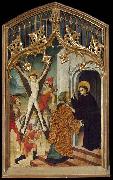 |
Bernat Martorell
|
|
was a Spanish painter, working in an Early Renaissance style. Little is known of his life prior to 1427, though by the mid 15th century he was one of the leading artists in Catalonia.
|
|
|
|
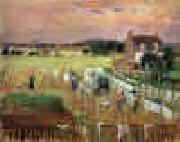 |
Berthe Morisot
|
|
French
1841-1895
Berthe Morisot Galleries
Berthe Morisot (January 14, 1841 ?C March 2, 1895) was a painter and a member of the circle of painters in Paris who became known as the Impressionists. Undervalued for over a century, possibly because she was a woman, she is now considered among the first league of Impressionist painters.
In 1864, she exhibited for the first time in the highly esteemed Salon de Paris. Sponsored by the government, and judged by academicians, the Salon was the official, annual exhibition of the Acad??mie des beaux-arts in Paris. Her work was selected for exhibition in six subsequent Salons until, in 1874, she joined the "rejected" Impressionists in the first of their own exhibitions, which included Paul C??zanne, Edgar Degas, Claude Monet, Morisot, Camille Pissarro, Pierre-Auguste Renoir, and Alfred Sisley. It was held at the studio of the photographer Nadar.
She became the sister-in-law of her friend and colleague, Édouard Manet, when she married his brother, Eugene.
|
|
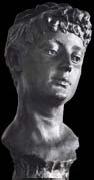 |
Bertram Mackennal
|
|
1863 - 1931,Mackennal was born in Fitzroy a suburb of Melbourne to parents who were both of Scottish descent. His father, John Simpson Mackennal, who was also a sculptor, provided his early training which was followed by studies at the school of design at the Melbourne National Gallery which he attended from 1878 to 1882. Marshall Wood, the English sculptor, who visited Australia in 1880, strongly advised him to go abroad. He left for London in 1882 to study at the National Gallery Schools, and for a time shared a studio with Charles Douglas Richardson and Tom Roberts. In 1884 he visited Paris for further study and married a fellow student, Agnes Spooner. On returning to England he obtained a position at the Coalport china factory as a designer and modeller. In 1886 he won a competition for the sculptured reliefs on the front of Parliament House, Melbourne, and returned to Australia in 1887 to carry these out. While in Australia he obtained other commissions, including the figure over the doorway of Mercantile Chambers, Collins Street, Melbourne. He also met Sarah Bernhardt, who was on a professional visit to Australia, and strongly advised the young man to return to Paris, which he did in 1891. In 1893 he had his first success, when his full length figure "Circe", now at the National Gallery of Victoria, obtained a "mention" at the Salon and created a good deal of interest. It was exhibited later at the Royal Academy where it also aroused great interest, partly because of the prudery of the hanging committee which insisted that the base should be covered. Commissions began to flow in, among them being the figures "Oceana" and "Grief' for the Union Club, Sydney. Two Melbourne commissions brought him to Australia again in 1901, the memorial to Sir William John Clarke at the Treasury Gardens, Melbourne, and the sculptures for the Springthorpe Memorial in Kew. He returned to London, and among his works of this period were the fine pediment for the local government board office at Westminster, a Boer War memorial for Islington, and statues of Queen Victoria for Ballarat, Lahore, and Blackburn. In 1907 his marble group "The Earth and the Elements" was purchased for the National Gallery of British Art under the Chantry Bequest, and in 1908 his "Diana Wounded" was also bought for the nation. This dual success brought Mackennal into great prominence, and he was elected an associate of the Royal Academy in 1909. In the following year he designed the Coronation Medal for King George V and also won the important commission for the obverse design (the monarch's head) of the new coinage needed for the new reign from 1911. This is certainly his most enduring design. His initials, B.M., can be seen on the truncation of the King's neck on the obverse of all British coins of George V. His next important piece of work was the memorial to Gainsborough at Sudbury, which was followed by the memorial tomb of King Edward VII at St. George's Chapel, Windsor. He also did statues of King Edward VII for London, Melbourne, Calcutta and Adelaide. He was the first Australian artist to be knighted.He was created a Knight Commander of the Victorian Order in 1921, and was elected R.A. in 1922. Among his later works were the nude male figure for the Eton War Memorial, the war memorial to the members of both houses of parliament in London, the figures of the soldier and the sailor for the cenotaph in Martin Place, Sydney, the bronze statue of King George V at Old Parliament House, Canberra, and the head of "Victory", presented to the Commonwealth by the artist, also at Canberra. He completed the Desert Mounted Corps memorial at the Suez Canal from the designs of Charles Web Gilbert a little while before his death. He died suddenly at his house, Watcombe Hall, near Torquay, |
|
|
|
|
|
 |
BROEDERLAM, Melchior
|
|
Netherlandish Gothic Era Painter, ca.1355-1411
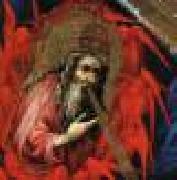
South Netherlandish painter. Broederlam's family, long-established in Ypres, provided three aldermen for the city and sided with the French Counts of Flanders against the Flemish populace. After a training that may have included contact with Jan Boudolf in Bruges before 1368 or Paris after 1370 and an extended visit to Italy, the artist became, by 1381, an official painter of the reigning count, Louis de M?le (reg. 1346-84), painting leather chairs, pennons and banners. On 13 May 1384, directly after Louis's death, he was appointed a valet de chambre to the count's heir, Philip the Bold, Duke of Burgundy. |
|
|
|
 |
Carel de Moor
|
|
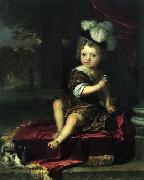
(February 25, 1655 - February 16, 1738) was a Dutch Golden Age etcher and painter. He was a pupil of Gerard Dou.
Carel de Moor was born in Leiden. According to Houbraken, his father was an art dealer who wanted him to study languages and only allowed him to study art when his talent for drawing surfaced at a young age. Houbraken met him in person at the atelier of Godfried Schalcken when he was completing his education there. According to the RKD he was the son of a Leiden painter of the same name and a pupil of Dou, Frans van Mieris, Godfried Schalcken, and Abraham van den Tempel. He became a member of the Leiden Guild of St. Luke in 1683, and became deacon many times over in the years 1688-1711. His own pupils later were Pieter Lyonet, Andrei Matveev, Arent Pijl, Arnout Rentinck, and Mattheus Verheyden.
|
|
 |
Carlo Maratta
|
|
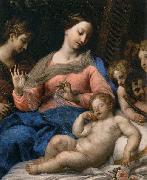
(13 May 1625 - 15 December 1713) was an Italian painter, active mostly in Rome, and known principally for his classicizing paintings executed in a Late Baroque Classical manner. Although he is part of the classical tradition stemming from Raphael, he was not exempt from the influence of Baroque painting and particularly in his use of colour. His contemporary and friend, Giovanni Bellori, wrote an early biography on Maratta.
|
|
 |
Carlo Maratti
|
|
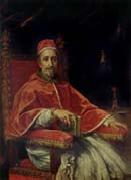
Italian Baroque Era Painter, 1625-1713,Italian painter, draughtsman and printmaker. He was the last major Italian artist of the classical tradition that had originated with Raphael, and his pre-eminence among the artists of his time marks the triumph of classicism. Nonetheless his art unites the virtues of disegno and colore, and he created a grandiose and decorative style that satisfied the demands of the Church. |
|
 |
Cassius Marcellus Coolidge
|
|
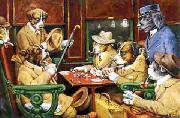
(September 18, 1844?CJanuary 13, 1934) was an American artist, best known for a series of nine paintings of anthropomorphized dogs.
Born in upstate New York to abolitionist Quaker farmers, Coolidge was known to friends and family as "Cash." While he had no formal training as an artist his natural aptitude for drawing led him to create cartoons for his local newspaper when in his twenties. He is credited with creating Comic Foregrounds, life-size cutouts into which one's head was placed so as to be photographed as an amusing character.
In 1903, Coolidge contracted with the advertising firm of Brown & Bigelow of St. Paul, Minnesota, to create sixteen oil paintings of dogs in various human poses. |
|
|
|
 |
Catesby Mark
|
|
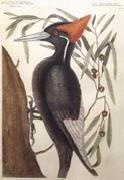
English-born artist-naturalist and Traveller, b.c.1679 d.1749
|
|
 |
CEREZO, Mateo
|
|
Spanish painter (b. ca. 1626, Burgos, d. 1666, Madrid) |
|
 |
CERQUOZZI, Michelangelo
|
|
Italian Baroque Era Painter, ca.1602-1660
Italian painter. He was a painter of bambocciate (low-life subjects), battles, small religious and mythological works and still-lifes. He was born of Roman parents, baptized in the parish of S Lorenzo in Lucina and spent his entire life in his native city. A member of the Accademia di S Luca since 1634, Cerquozzi attended meetings of the society as late as 1652. His friends included Domenico Viola, Pietro da Cortona and Giacinto Brandi. More significant were his associations with foreign residents in Rome. According to Baldinucci, Cerquozzi had special affection for the Spanish, owing to the patronage he received from the major-domo of the Spanish Embassy as a youth, and would often don Spanish attire as a sign of his sentiment. His Spanish connections may partly account for the many commissions he later received from patrons identified with Rome's pro-Spanish political faction (Haskell). Cerquozzi enjoyed equally good rapport with northern European residents of Rome. He is documented as having quartered with artists from beyond the Alps, including Paulus Bor and Cornelis Bloemaert, for the bulk of his career. |
|
|
|
 |
Charles M Russell
|
|
American Painter, 1864-1926
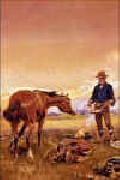
American painter and sculptor. In 1880 he left his upper-class home in St Louis for Montana Territory. He worked briefly on a sheep ranch, spent two years as a hunter's and trapper's assistant and then became a cowboy. During his considerable spare daytime hours he painted, sketched and modelled small animal figures in clay (e.g. Antelope, 1915; Fort Worth, TX, Amon Carter Mus.). Although he painted a few exceptional oils and watercolours prior to 1900, the vast majority of his best work was done in the last two decades of his life. Typically the subject-matter centres around cowboy life (e.g. Wagon Boss, 1909; Tulsa, OK, Gilcrease Inst. Amer. Hist. & A.) and the Plains Indians, for whom he had great respect. The luminous Piegans (1918; Denver, CO, Mus. W. A.), with its depiction of the Plains Indians, is a reminder of the vastness of the American West. Russell's sense of humour and empathy for his subject-matter radiates from his paintings as pleasingly as do the clear colours of the high country. His bronze sculptures (e.g. Buffalo Hunt, 1905; Denver, CO, Mus. W. A.) depict the same dramatic and tension-packed themes as his paintings. |
|
|
|
 |
Charles Martin
|
|
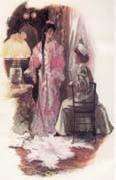
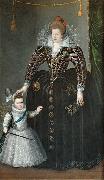
Charles Martin (1884-1934) was a French artist and illustrator. |
|
|