|
|
 |
Christian Friedrich Gille
|
|
1805-1899
German painter, engraver and lithographer. Between 1825 and 1833 he studied engraving under Johann Gottfried Abraham Frenzel, lithography under Louis Z?llner and painting under Johan Christian Dahl at the Hochschule f?r Bildende K?nste, Dresden. Dahl encouraged in Gille an appreciation for the natural formations and changing conditions of light that had inspired Dahl's friend and mentor, the Romantic painter Caspar David Friedrich. Gille, however, did not adopt Friedrich's tendency to find mystical significance in these phenomena. Gille's prints are highly descriptive in style and include Saxon landscapes, genre scenes, animal studies and portraits of celebrated men. His paintings and sketches, in oils, watercolour and pen and brown ink, were mostly of landscapes, many with animal staffage. |
|
 |
Christian Friedrich Tieck
|
|
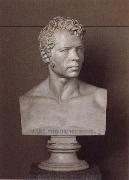
1776-1851 Berlin,was a German sculptor and a brother of Ludwig Tieck. Tieck was born in Berlin, where he also died. He was taught by Johann Gottfried Schadow. Based on a concept by Karl Friedrich Schinkel, Tieck created the tomb of General Gerhard von Scharnhorst at Berlin's Invalidenfriedhof in 1822. He also created a bust of Wilhelm Heinrich Wackenroder and a lion made of bronze after a model by Christian Daniel Rauch. |
|
|
|
|
|
 |
Ciro Ferri
|
|
Italian Baroque Era Painter and Sculptor , ca.1634-1689
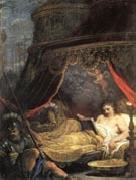
was an Italian Baroque sculptor and painter, the chief pupil and successor of Pietro da Cortona. He was born in Rome, where he began working under Cortona and with a team of artists in the extensive fresco decorations of the Quirinal Palace (1656-1659). He collaborated with Cortona and completed for him the extensive frescoed ceilings and other internal decorations begun in the Pitti Palace, Florence (1659-1665). His independent masterpiece is considered an extensive series of scriptural frescoes in the church of Basilica di Santa Maria Maggiore (Bergamo). In addition, also well known is his an altarpiece of St Ambrose Healing the Sick in the church of Sant'Ambrogio della Massima in Rome. In 1670, he began the painting of the cupola of Sant'Agnese in Agone in central Rome, in a style recalling of Lanfranco's work in the dome of Sant'Andrea della Valle; but died before it was completed in 1693 by his successor Sebastiano Corbellini. He executed also a large amount of miscellaneous designs, such as etchings and frontispieces for books; and served as an architect as well. Ferri was appointed to direct the Florentine students in Rome, and Gabbiani was one of his leading pupils. As regards style, Ferri ranks as chief of the grand manner of Cortona, as opposed to the more sober and spare style promulgated by Andrea Sacchi, and continued by Carlo Maratta and others. |
|
 |
COLLANTES, Francisco
|
|
Spanish Baroque Era Painter, 1599-1656
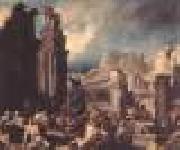
Spanish painter. He was probably a pupil of Vicente Carducho, but there is nothing to support this idea. His evident familiarity with contemporary Italian art indicates that he visited Rome and Naples, and this might explain the absence of documentation on him in Spain. Collantes enjoyed considerable prestige, and his paintings were acquired in 1634 for the decoration of the Buen Retiro Palace in Madrid; some of them may have been specially painted for this setting. His name appears frequently in the inventories of collectors in Madrid throughout the 17th century. It is impossible to date Collantes's undated paintings with any accuracy. However, his work shows two very clear and different lines of development. His canvases of large, intensely naturalistic figures, with tenebrist lighting effects , are close in style to those of Jusepe Ribera. In them the intense, energetic figures are sometimes set against landscape backgrounds, for example in St Humphrey (1645-50; Madrid, Prado) and St John the Baptist , but, still following Ribera, the naturalistic elements are emphasized. He also specialized in landscapes and in biblical or mythological subjects, compositions with minute figures set against wide landscapes or architecture with strong light effects. These are the works for which he is best known and which are the most important, since he was one of the few landscape painters in Spain in the 17th century. |
|
|
|
|
|
 |
COSSA, Francesco del
|
|
Italian Early Renaissance Painter, ca.1435-1477
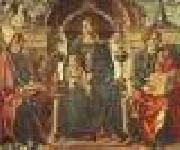
Italian painter. Together with Cosimo Tura and Ercole de' Roberti, Cossa was one of the most important painters working in Ferrara and Bologna in the second half of the 15th century. With them he shared an expressive use of line and solidity of form, but he also had a gift for decorative and anecdotal scenes, most evident in the frescoes in the Palazzo Schifanoia, Ferrara. |
|
|
|
|
|
 |
Daniel Chester French
|
|
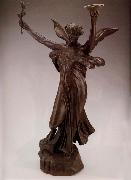
American Neoclassical Sculptor, 1850-1931.was an American sculptor. His best-known work is the sculpture of a seated Abraham Lincoln at the Lincoln Memorial in Washington, D.C. French was born in Exeter, New Hampshire, to Henry Flagg French, a lawyer, Assistant US Treasury Secretary and author of a book that described the French drain. Daniel Chester French was a neighbor and friend of Ralph Waldo Emerson, and the Alcott family. His decision to pursue sculpting was influenced by Louisa May Alcott's sister May Alcott. After a year at the Massachusetts Institute of Technology, French worked on his father's farm. While visiting relatives in Brooklyn, New York City, he spent a month in the studio of John Quincy Adams Ward, then began to work on commissions, and at the age of twenty-three received from the town of Concord, Massachusetts, an order for his well-known statue The Minute Man, which was unveiled April 19, 1875 on the centenary of the Battle of Lexington and Concord. Previously French had gone to Florence, Italy, where he spent a year working with sculptor Thomas Ball. In 1917, he designed the Pulitzer Prize gold medal presented to laureates. In collaboration with Edward Clark Potter he modelled the George Washington statue, presented to France by the Daughters of the American Revolution; the General Grant in Fairmount Park, Philadelphia, and the General Joseph Hooker statue in Boston. In 1893, French was a founding member of the National Sculpture Society, and he became a member of the American Academy of Arts and Sciences. French also became a member of the National Academy of Design (1901), the American Academy of Arts and Letters, the National Sculpture Society, the Architectural League, and the Accademia di San Luca, of Rome. French was one of many sculptors who frequently employed Audrey Munson as a model. |
|
|
|
 |
David Henry Friston
|
|
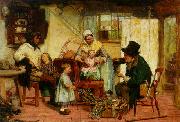
(1820 - 1906) was a British illustrator and figure painter in the Victorian Era. He is best remembered as the creator of the first illustrations of Sherlock Holmes in 1887, as well as his illustrations of the controversial female vampire story Carmilla (1872). He is also remembered for his illustrations accompanying reviews of Gilbert and Sullivan operas and plays of W. S. Gilbert in The Illustrated London News and the Illustrated Sporting and Dramatic News in the 1870s and 1880s.
|
|
|
|
 |
Defendente Ferrari
|
|
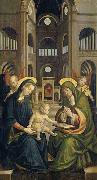
(c. 1480/1485 - c. 1540) was an Italian painter active in Piedmont.
Ferrari was born at Chivasso, near Turin, and worked in the workshop of Giovanni Martino Spanzotti.
He met considerable success as a painter of polyptychs and altarpieces, characterized by a highly decorative style inspired by Northern Europe masters.
|
|
|
|
 |
Domenico Feti
|
|
1589-1625
Italian
Domenico Feti Locations
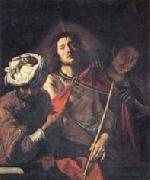
Italian painter. Court painter to the Gonzaga family in Mantua, Feti was influenced by the chiaroscuro technique of Caravaggio. His later works, such as Melancholia (Louvre), belong, in their use of color, to the Venetian tradition. |
|
 |
Domenico Fetti
|
|
Italian painter ,
Rome 1589 - Venice 1623
was an Italian Baroque painter active mainly in Rome, Mantua and Venice. Born in Rome to a little-known painter, Pietro Fetti, Domenico is said to have apprenticed initially under Ludovico Cigoli, or his pupil Andrea Commodi in Rome from circa 1604-1613. He then worked in Mantua from 1613 to 1622, patronized by the Cardinal, later Duke Ferdinando I Gonzaga. In the Ducal Palace, he painted the Miracle of the Loaves and Fishes. The series of representations of New Testament parables he carried out for his patron's studiolo gave rise to a popular specialty, and he and his studio often repeated his compositions. In August or September 1622, his feuds with some prominent Mantuans led him to move to Venice, which for the first few decades of the seventeenth century had persisted in sponsoring Mannerist styles (epitomized by Palma the Younger and the successors of Tintoretto and Veronese). Into this mix, in the 1620s?C30s, three "foreigners"??Fetti and his younger contemporaries Bernardo Strozzi and Jan Lys??breathed the first influences of Roman Baroque style. They adapted some of the rich coloration of Venice but adapted it to Caravaggio-influenced realism and monumentality. In Venice where he remained despite pleas from the Duke to return to Mantua, Fetti changed his style: his formalised painting style became more painterly and colourful. |
|
 |
e. j. f. bendemann
|
|
Eduard Julius Friedrich Bendemann (3 December 1811, Berlin - 27 December 1889, Dusseldorf) was a German painter.
Bendemann was born in Berlin. His father, Anton Heinrich Bendemann, a Jewish banker, monitored his education closely; it was one that would have naturally led him to some sort of technical occupation, but his talent and propensity towards art resulted in his being allowed to pursue other interests. His mother Fanny Eleonore Bendemann nee von Halle, also a daughter of the Jewish banker Joel Samuel von Halle.
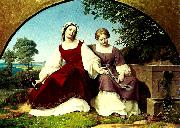
After he completed elementary school he enrolled in the Wilhelm von Schadow's School in Dusseldorf. In 1830 he went on a school trip to Italy. After a series of jobs, among them with Boas and Ruth, his talent as an artist began to show, especially with his very large 1832 painting titled, The Sad Jews of Babylon which was featured in the Berlin art exhibition. The picture garnered a great deal of attention, which was in part due to the deep and simple feeling and the noble composition of the piece (museum in Cologne). Bendemanns second picture: The Two Girls at the Well (1832), was acquired by the North Rhine-Westphalia art association.
Soon thereafter followed Jeremias on the Ruins of Jerusalem for which the artist received a medal in Paris in 1837. This painting was for the most part about the progress of the Jews in Babylon. (Royal Palace in Hanover). His best known work is The Harvest.
The artist's first fresco was a symbolic representation of the art at the Poetry Well at the house of his parents-in-law in Berlin. In the year 1838 he was appointed professor of the academy of arts in Dresden, where he had the opportunity to paint even larger frescos. Bendemann was given the task to decorate three halls of the Dresden royal palace, the throne room, the tower room, and the tower hall with wall paintings. In the throne room, on both sides of the throne, there are representations of important rulers and legislators in gold leaf with smaller representations in relief form below, from Moses up to Albrecht III, the King at the time. On the wall facing the throne there are four paintings depicting events from the life of King Heinrich I each with other pictures attached which explain each of the four events. Bendemann died in Dusseldorf. |
|
 |
E.Phillips Fox
|
|
Australian Naturalist Painter, 1865-1915
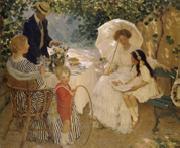
Australian painter and teacher. From 1878 to 1886 he trained at the National Gallery of Victoria Art Schools, Melbourne, and in 1887 left to study in Europe. In Paris he attended the Academie Julian and was taught by Jean-Leon Gereme at the Ecole des Beaux-Arts and by the American artist T. Alexander Harrison (1853-1930). He was involved with the plein-air artists at Etaples, Pas-de-Calais, and in Brittany and also visited Giverny, where from 1883 Monet was living. By 1890 he had moved to England, to the artists' colony at St Ives, Cornwall. In 1892 he returned to Melbourne where he chiefly painted portraits and landscapes. He was a member of the Victorian Artists' Society, exhibiting with them between 1892 and 1900. In 1893 he established the lively Melbourne Art School with Tudor St George Tucker (1862-1906). There an academic training coupled with a modified Impressionist technique was taught, as can be seen in Fox's painting the Art Students . In 1901 he left for London, having been commissioned by the Trustees of the National Gallery of Victoria to paint the Landing of Captain Cook at Botany Bay. After his marriage in 1905 to the artist Ethel Carrick, he and his wife settled in Paris and remained there until 1913. |
|
 |
ecole francaise
|
|
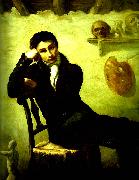
Founded in 1846, the EfA is the oldest foreign institute in Athens. Its early foundation, still a source of considerable prestige, is to be seen culturally connected with French philhellenism and politically with the French East Mediterranean strategy of the time.
|
|
|
|
|
|
|
|
 |
Eleanor Fortescue-Brickdale,RWS
|
|
1872-1945
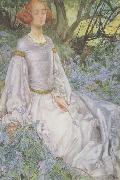
English illustrator, painter and designer. She entered the Royal Academy Schools, London, and won a prize for a mural design in 1897. She specialized in book illustration, in pen and ink and later in colour. Among her many commissions were illustrations to Tennyson's Poems (1905) and Idylls of the King (1911) and Browning's Pippa Passes (1908). She was particularly popular with the publishers of the lavishly illustrated gift-books fashionable in the Edwardian era. She exhibited regularly at the Royal Academy and the Royal Water-Colour Society. She took up stained-glass design (windows in Bristol Cathedral), which modified her style of illustration to flat areas of colour within black outlines. |
|
|
|
|
|
 |
Emile Friant
|
|
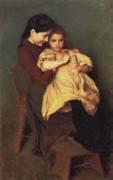
French Realist Painter, 1863-1932, Was a French painter. With a naturalist style Emile Friant painted quotidian scenes involving people. His creations are characterized by the photographic realism of the human skin portions, and a less defined portrayal of the rest of the scene. |
|
|
|
 |
Erastus Salisbury Field
|
|
1805-1900
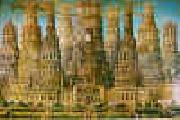
American painter. He studied with Samuel F. B. Morse in New York during the winter of 1824-5. On his return to the rural isolation of Leverett, MA, he painted his earliest known work, the portrait of his grandmother Elizabeth Billings Ashley (Springfield, MA, Mus. F.A.). His career as an itinerant portrait painter began in 1826, most of his commissions coming through a network of family associations in western Massachusetts and Connecticut. The portraits of 1836-40 are considered his best. From 1841 he lived mainly in New York, where he expanded his subject-matter to include landscapes and American history pictures. There he presumably studied photography, for on his return to Massachusetts he advertised himself as a daguerreotypist. His few portraits painted after 1841 are copied from his own photographs and lack the expressive characterization and decorative power of his earlier work. From 1865 to 1885 his paintings were based primarily on biblical and patriotic themes. The Historical Monument of the American Republic (1867-88; Springfield, MA, Mus. F.A.) stands alone in American folk art in size (2.82*3.89 m), scope and imaginative vision. Inspired by plans for a national celebration of the centennial of the USA in 1876, Field painted an architectural fantasy of eight towers linked by railway bridges and trains at the tops, with the history of the USA in low-relief sculpture on the exterior surfaces of the towers. Field added two more towers to the painting in 1888 and thereafter retired. |
|
 |
Eric Forbes-Robertson
|
|
(1865-1935).
a figure and landscape painter
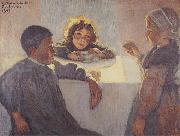
a figure and landscape painter.was a Scottish painter of landscapes, flowers, and foliage, with children. He was a cousin of James Hornell. He was born in Australia, of Scottish parents, and he was brought up and lived practically all his life in Scotland, at Kirkcudbright. He studied for three years at the art school at Edinburgh, and for two years at Antwerp under Professor Verlat. Returning from Antwerp in 1885, he met George Henry and associated himself with the Glasgow School. Hornel and Henry collaborated upon "The Druids Bringing In The Mistletoe" (1890), a procession of priests bringing in the sacred mistletoe, gorgeous with polychrome and gold. The two worked side by side to achieve decorative splendor of color, Hornel boldly and freely employing texture effects produced by loading and scraping, roughening, smoothing, and staining. In 1893-94 the two artists spent a year and a half in Japan, where Hornel learned much about decorative design and spacing. Towards the close of the nineties his colors, while preserving their glow and richness, became more refined and more atmospheric, and his drawing more naturalistic, combining sensuous appeal with emotional and poetic significance. In 1901 he declined election to the Royal Scottish Academy. In 1901 he acquired Broughton House, a townhouse and garden in Kirkcudbright, which was his main residence for the rest of his life. |
|
|
|
 |
Ernest Fuhr
|
|
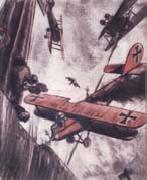
A popular illustrator of the period and this is classic patriotic art . 1874-1933
|
|
 |
Ernst Fries
|
|
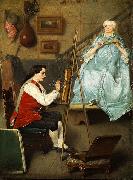
(22 June 1801 Heidelberg - 11 October 1833 Karlsruhe) was a German painter.
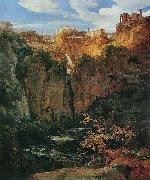
Fries was a pupil of Karl Kuntz at Karlsruhe, and afterwards studied in Munich and in Italy. Examples of his work are: eA View of Tivoli, Sorrento and the House of Tasso, The Waterfall of Liris at Isola di Sora, The Castle of Massa, and A View of Heidelberg.
|
|
 |
Eugene Fichel
|
|
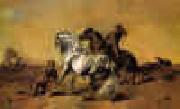
(30 August 1826 Paris - 2 February 1895 Paris) was a French painter.
He entered the École des Beaux-Arts in 1844 and became a pupil of Hippolyte Delaroche, but painted very much more under the inspiration of Jean-Louis-Ernest Meissonier, whose exquisite handling is suggested in numerous small canvases of his which by their refined technique and vivid action recall the characteristic intensity and directness of composition which belong to the painter of eFriedland.e Along with great care in finish, Fichel's canvases also exhibit an archæological exactness, and a kind of delicate humor. His first work of importance was exhibited in 1850, eHarvey Demonstrating the Circulation of the Blood to Charles I.e He was a chevalier of the Legion of Honor and, in 1857, received a medal for his painting in the Salon of that year. He exhibited a canvas every year at the Salon, up to a few years before his death.
|
|
 |
Eugene Fromentin
|
|
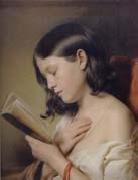
1820-1876
He was born in La Rochelle. After leaving school he studied for some years under Louis Cabat, the landscape painter. Fromentin was one of the earliest pictorial interpreters of Algeria, having been able, while quite young, to visit the land and people that suggested the subjects of most of his works, and to store his memory as well as his portfolio with the picturesque and characteristic details of North African life. In 1849 he obtained a medal of the second class.
In 1852 he paid a second visit to Algeria, accompanying an archaeological mission, and then completed that minute study of the scenery of the country and of the habits of its people which enabled him to give to his after-work the realistic accuracy that comes from intimate knowledge. In a certain sense his works are contributions to ethnological science as much as they are works of art. |
|
 |
EYBL, Franz
|
|
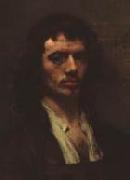
1805, Vienna - 1880, Vienna,Austrian painter and lithographer. He entered the Vienna Akademie at the age of ten, studying sculpture under Josef Klieber and landscape painting (1817-20) with Joseph Messmer (1780-1845), from whom he also learnt the new technique of lithography. He then spent three years with Johann Baptist Lampi (i) and Franz Caucig (1762-1828), drawing after antique statues and casts. He studied history painting (1823-8), during which period he came under the influence of Johann Peter Krafft, who introduced him to the principles of realism, suggesting that he work directly from nature and reflect contemporary, everyday subject-matter in his painting. Together with Josef Danhauser and Matthias Ranftl (1805-54), Eybl was among the most significant followers of Krafft's ideas, |
|
|
|
|
|
|
|
|
|
|
|
|
|
|
|
|
|
 |
FABRITIUS, Carel
|
|
Dutch Baroque Era Painter, 1622-1654
Painter. His oeuvre consists of a scant dozen paintings, since research has rigorously discounted many previously attributed works. These few paintings, however, document the painter's unique development within his brief 12-year career. He is often mentioned as being the link between Rembrandt and the Delft school, particularly Pieter de Hooch and Jan Vermeer, whose depiction of light owes much to Fabritius's late works in which his use of cool silvery colours to define forms in space marks a radical departure |
|
|
|
 |
FALCONE, Aniello
|
|
Italian painter, Naples school (b. 1607, Napoli, d. 1656, Napoli).
Italian painter and draughtsman. He trained briefly with Jusepe de Ribera, the Caravaggesque Spanish painter. He quickly won fame as a specialist in scenes of battle, and his contemporaries nicknamed him the 'oracle' of this genre. Falcone created the 'battle scene without a hero' (Saxl): he showed the battle as a brutal, confused struggle between anonymous troops, without heroes, without defeats and without particular historical incidents. The Battle between Turks and Christians (1621; Paris, Louvre; see fig.) is one of the earliest. The frieze-like composition is elaborately structured, yet the picture is rich in intensely naturalistic, vividly coloured details of armour and weapons and precisely observed expressions of anger and pain. The famous dealer and collector Gaspar Roomer and other Neapolitan collectors commissioned many battle pictures from him, and these were soon introduced throughout Europe. He was especially favoured by Ferrante Spinelli, Prince of Tarsia, who gave Falcone a residence in his palace after 1651. |
|
|
|
|